
Damascus steel is the name given to the sword blades of the medieval and early modern Islamic world that carry a pattern like running water in the metal itself: pale, wavering bands across a darker grey, as if the blade had been cut from a frozen stream. They were forged from cakes of crucible steel, called wootz, made in India, Sri Lanka and Central Asia. The technique for making those patterned blades did not survive into the modern age.
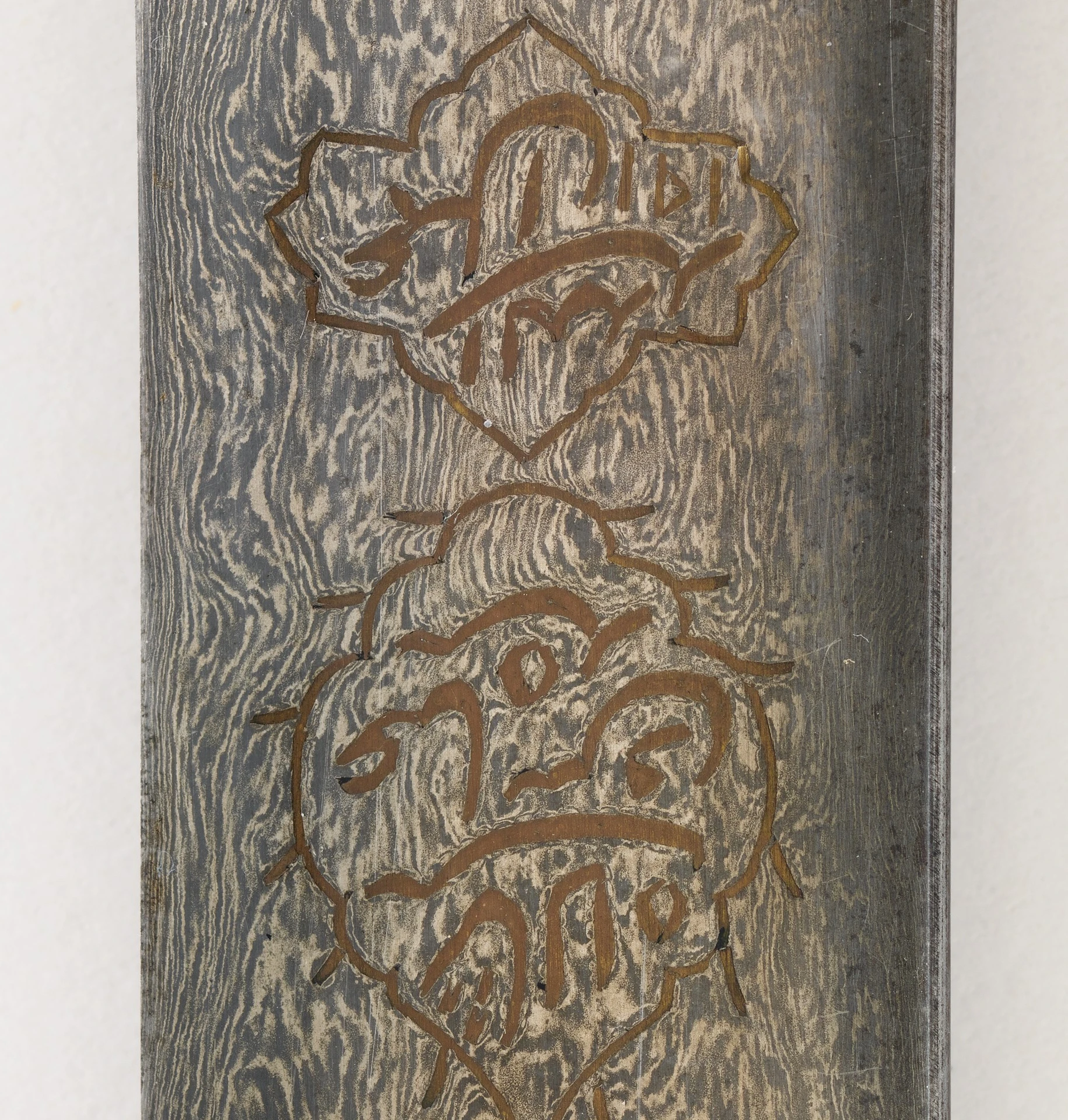
The pattern is not painted on or engraved. It is the steel itself: layers of hard carbide inside the metal, brought up to the surface by polishing and etching. Water, frozen in iron. On a Persian sabre in the Metropolitan Museum of Art in New York, its blade possibly dated 1777 or 1778, the bands run through the steel and part around two cartouches of gold lettering near the hilt. That sabre is a later blade than the one in this story, and it has never been under the Dresden microscope; it shows what the pattern looks like.
In November 2006 a team of materials scientists in Dresden reported, in the journal Nature, what they had found inside one such blade, a seventeenth-century sabre, when they looked at it under an electron microscope.
Carbon nanotubes.
A blade in an acid bath
The sabre came from the Bern Historical Museum in Switzerland, one of two genuine seventeenth-century Damascus sabres the museum provided for study. Press accounts attribute it to the Persian smith Assad Ullah. The team at the Technical University of Dresden, with Peter Paufler as its voice in the press, had been working on the same blades for years. In 2004 they had reported cementite nanowires in the steel: strands of iron carbide only billionths of a metre across, lying in the bands of the pattern.
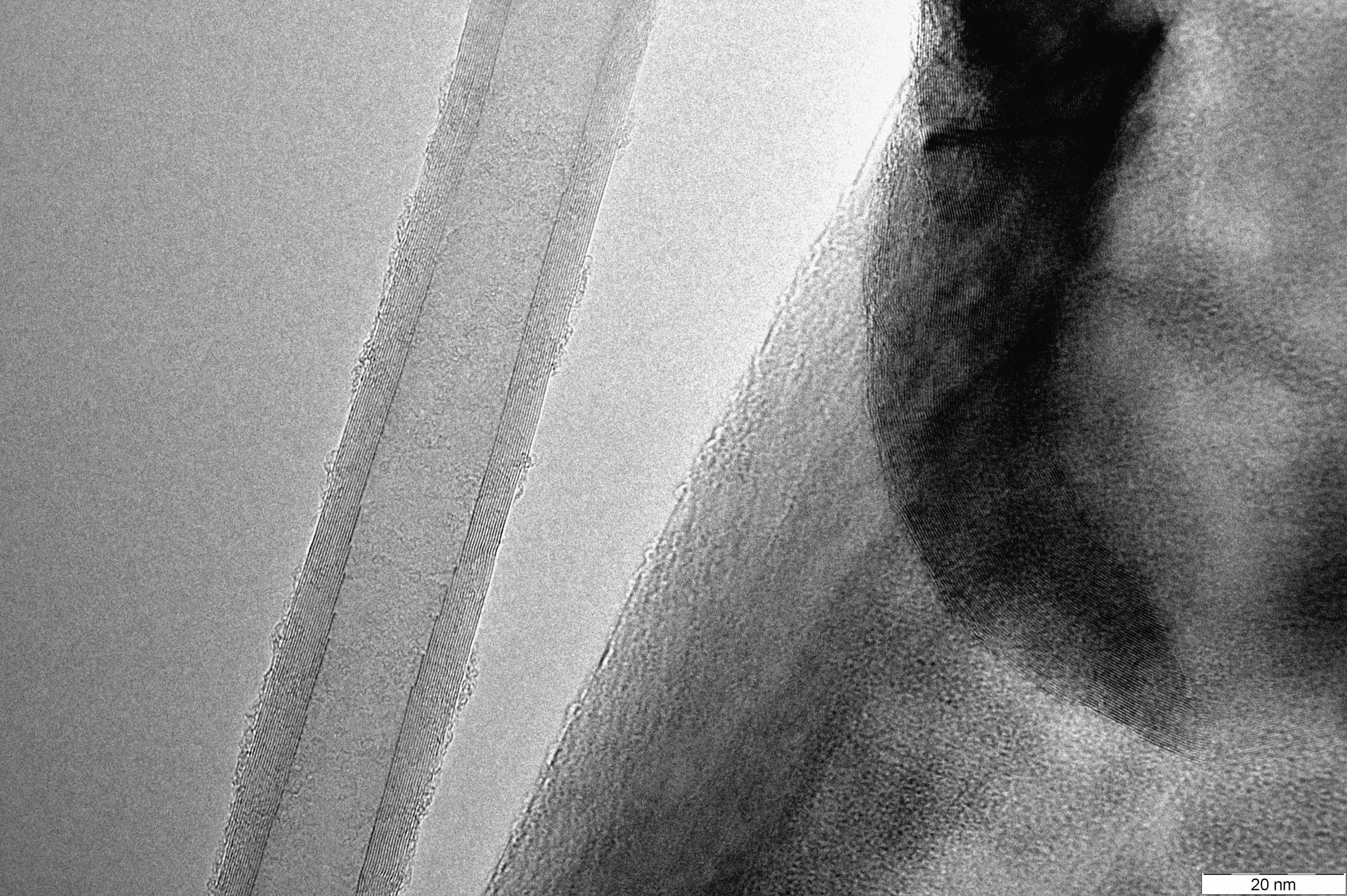
The 2006 work went one step further. A piece of the blade was dissolved in hydrochloric acid and what was left was examined by high-resolution transmission electron microscopy. In the remains were carbon nanotubes, and cementite wires that appeared to sit inside them. The paper ran as a one-page Brief Communication in Nature on 16 November 2006, under the title "Carbon nanotubes in an ancient Damascus sabre". Its authors were Reibold, Paufler, A. A. Levin, W. Kochmann, N. Paetzke and D. C. Meyer.
Their explanation was a chain of small causes. The Indian ores that made wootz carried traces of vanadium, chromium, manganese, cobalt and nickel. Through the repeated heating and cooling of forging, those traces gathered into planes inside the steel. There, the team suggested, they acted as catalysts for the growth of nanotubes from carbon in the crucible, carbon that, Paufler suggested, came in part from the wood and leaves added to the crucible. The nanotubes in turn shaped the growth of cementite, and the cementite made the bands.
In an earlier paper the same group had heated one of the sabres. The nanowires survived a day at 400 degrees Celsius. At 800 they were gone. And it was already known that heating such blades destroyed their famous qualities. Which led the team to suggest, in 2006, that the nanostructures had "a significant influence" on what made the blades special.
The nanotech sword
The idea that came out of Dresden, carried by the press within days, was simple and startling. The smiths of the Islamic world had been making nanotechnology three or four hundred years before anyone knew what a nanotube was.
Paufler did not claim the smiths understood it. In the team's account, the quality of the steel probably came from long trial and error: the craftsmen kept what worked, generation after generation, until their procedure produced structures they had no means of seeing. The Christian Science Monitor put the team's conclusion this way: by empirically optimising their treatment of the blades, craftsmen had ended up making nanotubes more than 400 years ago.
The blades already had a legend. The paper's own opening recalls blades known to the Crusaders, with their wavy banding, unusual strength and very sharp edge. The most famous scene, a Saracen sabre slicing a silk veil in the air, comes from Walter Scott's novel The Talisman of 1825, and it is fiction. But the bands in the metal are real, and so is the record of how highly the steel was valued. Al-Biruni, writing around the year 1000, is quoted in popular histories as saying that the best steel comes from India.
What the Dresden paper offered was a reason the legend might have rested on something physical. A recipe built from particular ores, particular fuel, and a particular rhythm of fire and hammer, which happened to produce a structure at the scale of molecules.
And then, it seemed, a recipe that was lost. The patterned blades stopped being made. Nature's own news story in 2006 placed the loss in the eighteenth century. Ben Bronson of the Field Museum in Chicago put it at about two hundred years before 2001.
If the smiths were building molecules
Set aside for a moment whether those tubes are what the team says they are. Ask what follows if they are.
It would mean the steel was not only good but structured, from the scale of a sword down to billionths of a metre, by people who had no microscope and no chemistry. The pattern on the blade would be the visible top of an architecture that runs all the way down.
It would mean the blades' fame was earned below the reach of the eye. The edge, the strength, the legends, the prices paid: all of it, on that reading, resting on structures no one alive could see.
It would mean a craft tradition can reach places a science cannot yet see. The smiths would have been running an experiment over centuries, keeping the results and discarding the failures, and arriving at a material that our own laboratories could not describe until the twenty-first century.
It would mean our species has been making the very small for far longer than we knew, by hand, by fire and by patience, without a theory of any of it. Knowledge we think of as a product of the modern laboratory would turn out to have lived, unwritten, in the forearms of a few families of smiths.
And it leaves a question still in front of us. If that kind of knowledge can exist without being written down, then what else was known that way, in which workshops, and how much of it went with the last person who knew it?
What the metallurgists say
The standard account of Damascus steel was built mostly in Iowa. From 1987 the metallurgist John Verhoeven of Iowa State University, working from the 1990s with the Florida bladesmith Alfred Pendray, set out to make the pattern again. Their key paper, in the journal JOM in 1998, carries the title "The key role of impurities in ancient Damascus steel blades". By their account the bands form when tiny amounts of carbide-forming elements, vanadium among them, at around three thousandths of a percent in some of their iron, make iron carbide gather into layers as the steel is cycled again and again through heat. Pendray's method took dozens of heating cycles. Their reproduced blades showed both the pattern and the microstructure of the old ones.
On that account the decisive ingredient was in the ore: traces too small for any smith to notice. Other writers tie the end of the blades to the Indian ores running out, or to the trade that carried them failing; if the traces went, the smiths could follow the old procedure exactly and still not get the bands.
When the Dresden paper came out, Verhoeven offered a caution. Cementite, he pointed out, can form rod-like structures on its own. Alex Zettl of the University of California, Berkeley, noted that electron microscopes can carry nanotubes from earlier samples. Paufler answered that he had used several instruments and was convinced the tubes came from the swords.
What the doubts do not reach
The doubts reach the tubes. They do not reach the wires.
The cementite nanowires were reported by the Dresden group in 2004, two years before the tubes. Verhoeven's own account of the pattern is a story of carbide forming in layers. The two explanations agree that something unusual happens to the carbon in this steel at a very small scale, and that the impurities in the ore drive it. They differ on what the structures are and how they formed.
Here is the strange part. In 2009 the same Dresden group compared the old blades with more recent crucible steel, and found colonies of wire- and tube-like particles, 40 to 50 billionths of a metre across, in all of them. Which suggests the nanostructure, if it is real, is not the fingerprint of one lost workshop, but something this kind of steel does when it is made a certain way.
Whatever the tubes turn out to be, the structure is not a single sighting.
That cuts both ways. It weakens the idea of a unique lost recipe. And if the structures are real, they come with the method: make the steel the old way and they appear, whether or not anyone knew they were there.
No replication of the nanotube finding by another laboratory turned up in the sources this article draws on, searched in October 2026. The team's own 2008 summary of its mechanism used the word "speculate". How nanotubes could grow at the heat of a forge, the team did not show.
The water in the metal
The question of what Damascus smiths knew has been asked for two hundred years. In 1820 Michael Faraday, working with James Stodart in London, made what they called an artificial wootz by adding aluminium to steel, and wrote that etching it brought up a damask pattern: "This we have never yet seen produced by pure steel." Their explanation was wrong. In Paris the metallurgist Jean-Robert Breant ran some three hundred experiments in the 1820s. At Zlatoust in the Urals, Pavel Anosov published "On damask steels" in 1841 after years of making patterned blades himself.
Crucible steel itself never quite died. Travellers watched it being made in Sri Lanka in 1854 and again in 1904. What vanished was the line from a particular ingot to a particular blade, and the hand that knew which was which. Other crafts of the old world have left the same kind of silence: the liquid fire of Byzantium, Greek fire, whose formula Byzantine writers kept secret and which has never been securely reconstructed, and the bronze gearing of the Antikythera mechanism, whose like is not known again for many centuries.

The Bern sabre is still a single sabre. The tubes have been reported by one group, after an acid bath. The pattern, though, can be seen by anyone who stands in front of a blade in a museum case and looks along it.
It looks like water. It was there when the smith put the blade down, and it is there now.
Questions This Leaves You With
Is there anything a person actually does with this?
Not much, in your own life, and that deserves saying first. No one needs a Damascus blade, and many knives sold today as "Damascus" are layers of different steels welded together for the look, not wootz. Anyone selling a lost secret in a box is selling something. The question that is genuinely yours is collective: how much skill lives only in practice, in workshops and kitchens and farms, and what is lost each time a craft that was never written down comes to an end.
Does this sit against a religious account of the world?
It can be read both ways. The smiths of Isfahan and the Deccan worked in deeply religious worlds, and many of the blades carry inscriptions inlaid in gold beside the watered steel. One reader sees in their patient craft a kind of devotion, matter shaped well because it was made well. Another sees ordinary human trial and error, nothing more. The steel makes no claim either way. This site will not tell you which reading to hold. That one is yours.
Does it change what a human life is?
Think of a smith in the seventeenth century, hammering a cake of Indian steel through its heats, who may never have known that anything inside it was smaller than a grain of sand. One reaction is that it makes a life smaller: his best work done blind, perhaps never knowing what he had made. The other is that it makes a life larger: knowledge that real, carried in hands and habit, good enough that a laboratory four centuries later is still trying to describe it. Which did you feel first?
What would change your mind, in either direction?
Name it now. Toward the nanotech reading: a second laboratory finding carbon nanotubes in old wootz blades without dissolving them, and finding none in ordinary steels prepared the same way. Toward the ordinary account: careful work showing that the tubes form during the acid treatment or come from the microscope, or a reproduced blade with the full pattern and no nanostructure at all. Notice that the pattern itself is not in dispute; the argument is about what lies beneath it, and about how much a single sabre can tell anyone about a whole tradition.
Where does the open problem actually sit?
It sits at the bottom of the blade, at the scale of molecules, where only a handful of samples have ever been looked at. One group has reported tubes; two scientists cautioned in the press that they could be something else; no published test has settled it either way. Meanwhile the question of exactly which step was lost, the ore, the fuel, the rhythm of heats or the eye that judged them, has several answers and no proof. The blades are in museum cases around the world, and only a handful have ever been looked at on that scale.
Sources
- Reibold, Paufler, Levin, Kochmann, Paetzke and Meyer, Carbon nanotubes in an ancient Damascus sabre (2006) Nature 444, 286 (record on RePEc/IDEAS) Primary record
- Katharine Sanderson, Sharpest cut from nanotube sword (2006) Nature news Study
- Ed Yong, Carbon nanotechnology in an 17th century Damascus sword (2008) National Geographic Study
- Paetzke et al., Nanostructured Ancient Damascus Blades (2008) Deutsche Mineralogische Gesellschaft, conference abstract Primary record
- Altes Damaszener Schwert mit hochmodernen Kohlenstoff-Nanoroehren (2006) bionity.com Study
- Robert C. Cowen, report on the Damascus nanotube paper (2006) Christian Science Monitor Study
- Kochmann et al., Nanowires in ancient Damascus steel (2004) Journal of Alloys and Compounds 372 (Crossref record) Primary record
- Reibold et al., Microstructure of a Damascene sabre after annealing (2006) International Journal of Materials Research 97 (Crossref record) Primary record
- Reibold et al., Structure of several historic blades at nanoscale (2009) Crystal Research and Technology 44 (Crossref record) Primary record
- Jeremy Manier, Damascus steel's lost secret found (Chicago Tribune, 2001) Chicago Tribune, reposted on Ganoksin Study
- Verhoeven and Pendray, papers on Damascus steel (1987-2018), including The key role of impurities in ancient Damascus steel blades, JOM 50(9) (1998) Crossref records Primary record
- Michael Faraday to Charles-Gaspard De La Rive, 26 June 1820 Epsilon: The Michael Faraday Collection Primary record
- S. Srinivasan and S. Ranganathan, Wootz steel: an advanced material of the ancient world hosted by Kiel University Study
- G. N. Shumkin, P. P. Anosov in Zlatoust (1817-1847) (2026) Chernye Metally Study
- M. L. Wayman and G. Juleff, Crucible steelmaking in Sri Lanka (1999) Historical Metallurgy 33(1) Primary record
- Feuerbach, Merkel and Griffiths, Production of Crucible Steel by Co-Fusion at Merv (1996) MRS Proceedings 462 Primary record
- Walter Scott, The Talisman (1825) Project Gutenberg Primary record
- Tom Metcalfe, Damascus steel origins and mystery (2026) History.com General reference
- Saber with Scabbard, Persian, blade possibly A.H. 1191 / 1777-78, The Metropolitan Museum of Art 26.35.1a, b The Metropolitan Museum of Art (open access, via Wikimedia Commons) Primary record