
The front of the Antikythera mechanism, the geared bronze machine raised from a Greek shipwreck in 1901, is almost entirely gone. In March 2021 a team at University College London published a model of what it showed: the Sun, the Moon and all five planets known to the ancient world, each turning on its own ring around a small dome of the Earth.
The model exists on a screen. Gold rings, nested one inside the next. A tiny sphere of lapis lazuli for Venus, one of turquoise for Mercury, a golden sphere with rays for the Sun. Near the centre, on its pointer, the Moon, half dark and half bright, turning to show its phase. Around the rim, the signs of the zodiac and the days of the year.
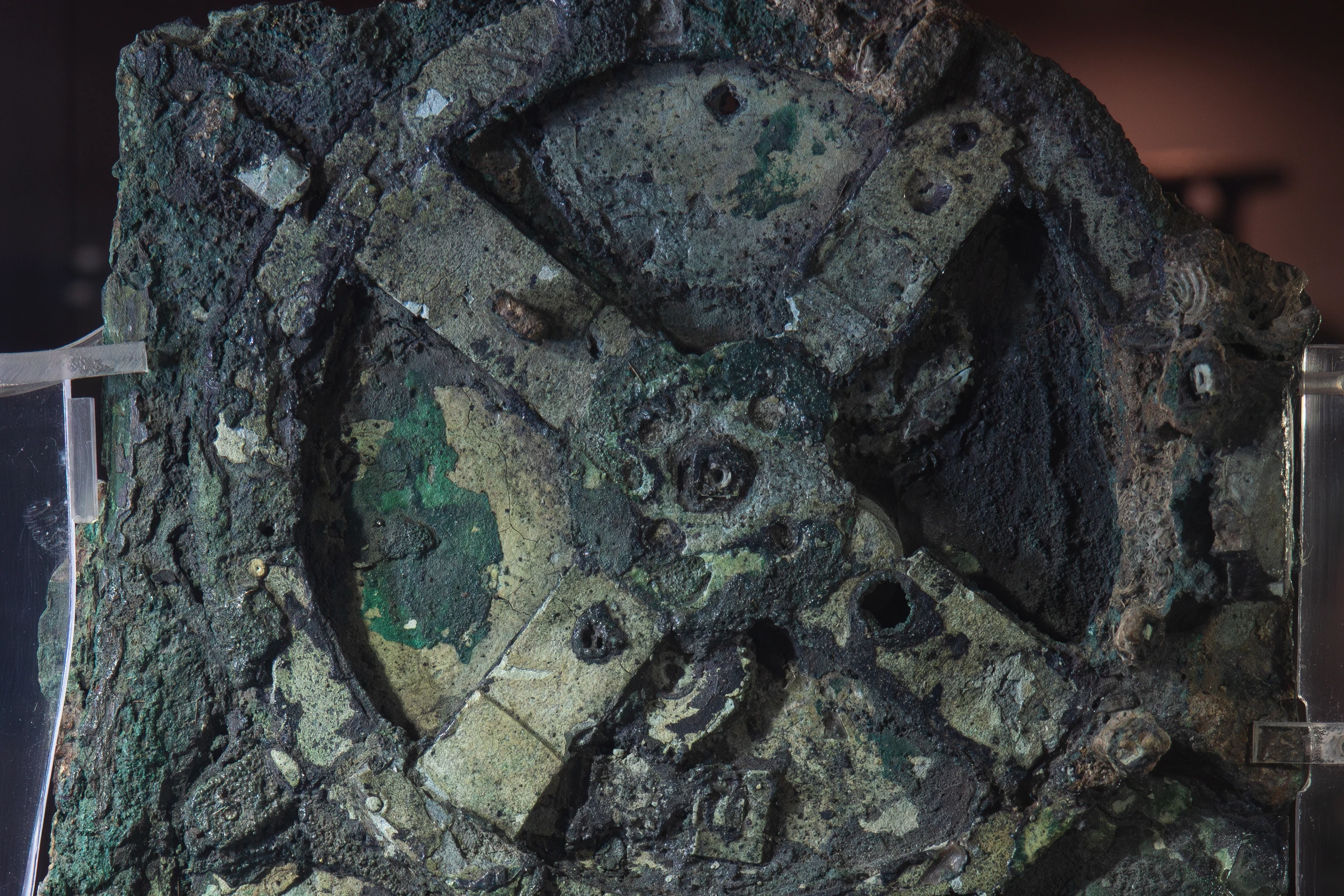
Almost none of that face survives: pieces of the zodiac and calendar scales, and nothing at all of the planets. Almost all of the gears that drove it are lost. What survives is the main drive wheel with marks on its spokes, one small gear, and scraps of a cover carrying tiny letters that the scans have read.
From those, the team built the sky.
Two numbers in the cover
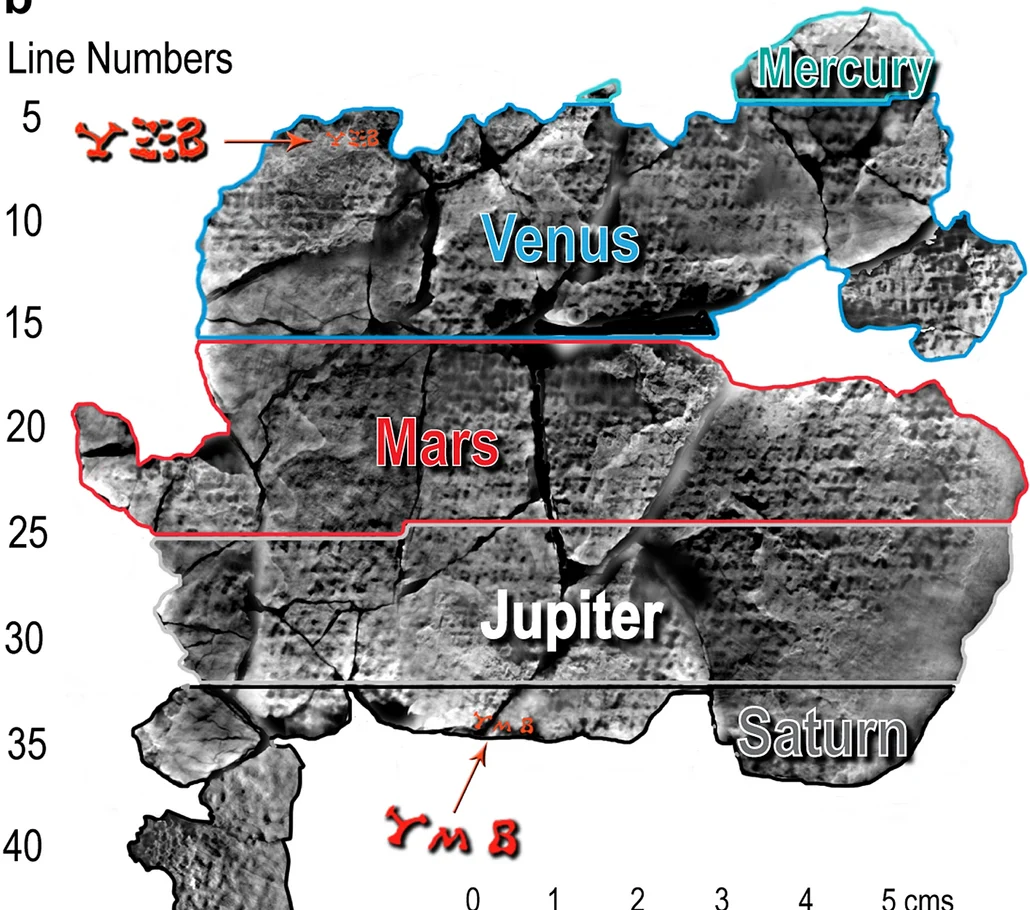
The mechanism's cover once carried a text about the planets, now broken into small pieces. Read with X-ray computed tomography, the pieces fit together into what researchers call the Front Cover Inscription. It lists, planet by planet, the cycles of each one relative to the Sun and the days between its appearances.
In 2016 the scans gave up two numbers in it. In the Venus section, the Greek numerals for 462. In the Saturn section, 442.
The UCL team, led by Adam Wojcik with Tony Freeth, David Higgon, Aris Dacanalis, Lindsay MacDonald and Myrto Georgakopoulou, read them as two halves of planetary cycles: 289 cycles of Venus relative to the Sun in 462 years, and 427 cycles of Saturn in 442. Both numbers break down into small factors, which means both can be built from gears of fewer than a hundred teeth.
"The classic astronomy of the first millennium BC originated in Babylon," Dacanalis said in the university's announcement, "but nothing in this astronomy suggested how the ancient Greeks found the highly accurate 462-year cycle for Venus and 442-year cycle for Saturn."
The team's answer came from Plato. In his dialogue Parmenides lies a way of narrowing in on a number by adding the tops and bottoms of two fractions that bracket it. Run without limits, the team found, that one step reaches the two numbers on the cover and fills in the three that are missing, for Mercury, Mars and Jupiter, almost without choice.
Then the gears. On the main drive wheel in Fragment A, the scans show four spokes with holes, flattened patches and broken pillars where something was once mounted. A single 63-tooth gear survives in the small Fragment D, with a disc riveted to it. Higgon put it plainly: "After considerable struggle, we managed to match the evidence in Fragments A and D to a mechanism for Venus, which exactly models its 462-year planetary period relation, with the 63-tooth gear playing a crucial role."
A cosmos on rings
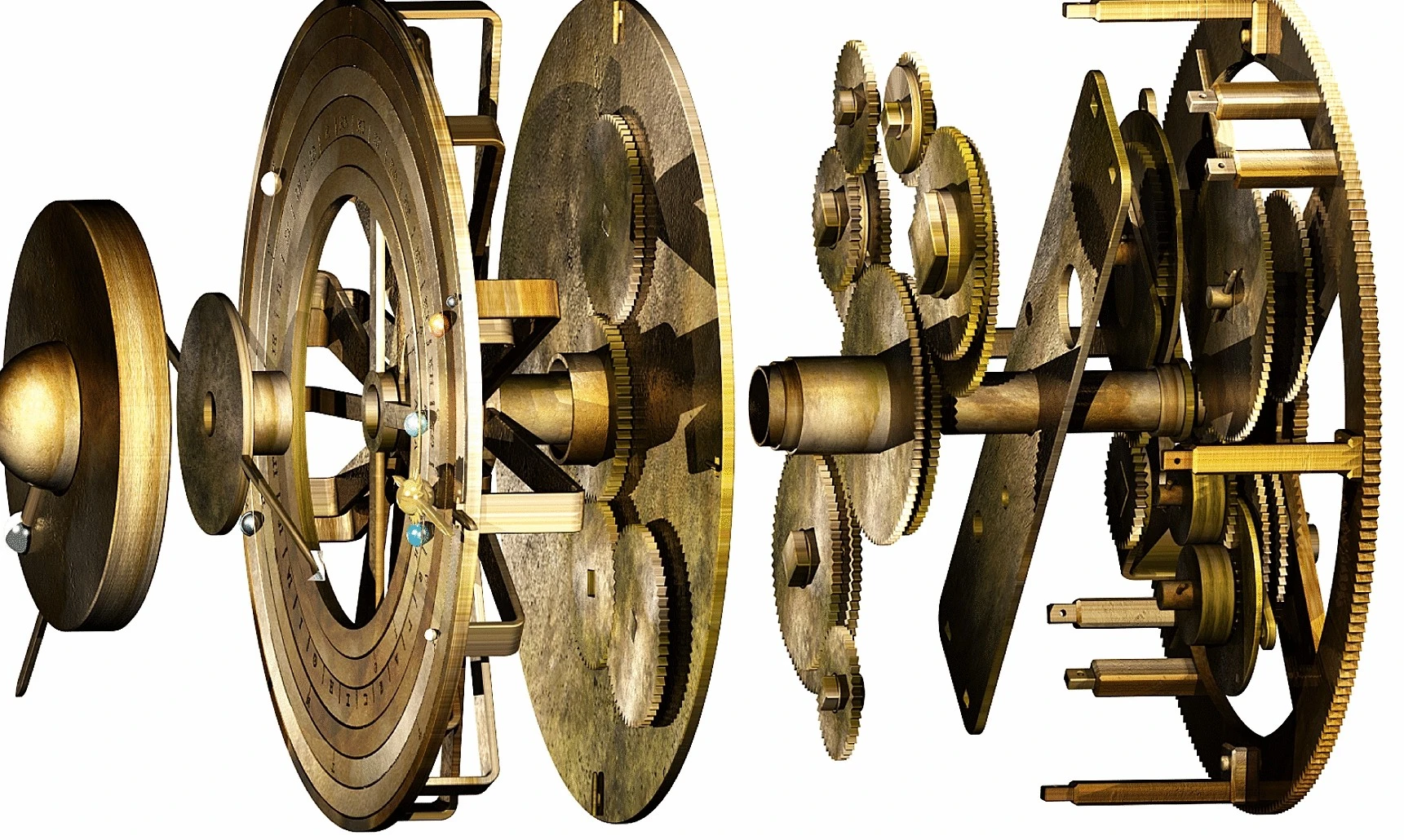
Scientific Reports published "A Model of the Cosmos in the ancient Greek Antikythera Mechanism" on 12 March 2021. Its design puts 34 gears in front of the main wheel, each train cut to carry the prime factors of its planet's cycle, sharing wheels wherever the numbers allow. Venus and Mercury share a fixed wheel of 51 teeth. Mars, Jupiter, Saturn and the true Sun share one of 56. Behind the main wheel run the 35 gears of the back dials, for 69 in all.
The display comes from the machine's own description of itself. The back cover inscription speaks of a cosmos in rings, with planets marked by "little spheres" and the Sun as a little golden sphere with a ray and a pointer. In the model nine outputs, carried on tubes nested one inside another, turn nine rings: the Moon, the line of the Moon's nodes, Mercury, Venus, the Sun, Mars, Jupiter, Saturn and the date.
The authors did not hold back. Solving the puzzle, they wrote, "reveals a creation of genius - combining cycles from Babylonian astronomy, mathematics from Plato's Academy and ancient Greek astronomical theories." Their conclusion goes further: "It challenges all our preconceptions about the technological capabilities of the ancient Greeks."
"Ours is the first model that conforms to all the physical evidence," Freeth said, "and matches the descriptions in the scientific inscriptions engraved on the Mechanism itself."
And here is the strange part. The team found that the evidence left almost no room to choose. "What has struck us forcefully in making the present model," they wrote, "is just how few these options are."
If the rings turned
Set aside whether this is the dial the bronze once carried. Ask what it means if it is.
It would mean a Greek workshop, about two thousand years ago, built the whole known sky into a box small enough to carry. Not a sketch of it. The planets in their order, each at its own speed, each slowing and reversing in the sky as it does, all driven by one handle.
It would mean the mathematics behind it was not only borrowed. On the team's reading, someone took Babylonian periods and a method out of Plato's Academy and found cycles that, on the team's account, Babylonian astronomy does not explain, then cut them into teeth. Theory, arithmetic and metalwork in one pair of hands, or one small room.
It would mean that our species held a working model of the planetary system, in metal, more than a thousand years before anything like it is known to have been built again. Which means the gap between what we knew and what we could build was once closed, and then reopened for most of recorded history.
And it leaves something in front of us. If a model this complete was built once and lost, the question is no longer whether the ancient world could do it. It is how much of what we think of as late, slow, hard-won progress was in fact recovery.
What the model is built from
The standard account of the 2021 model starts with the authors' own caution. "Because of the loss of evidence," they wrote, "we cannot claim that our model is a replica of the original."
Of the 30 gears that survive from the whole machine, 27 are in Fragment A; the one the model's planetary trains rest on is the 63-tooth wheel in Fragment D. The paper says directly that there is "no surviving direct evidence for the gearing systems that calculated the true Sun and the superior planets." Two of the five planetary cycles, Venus and Saturn, are read on the bronze. The other three come from the team's method. The pointer for the line of the Moon's nodes, the Dragon Hand, is described in the paper as a hypothetical element, and the scheme of index letters on the rings as "not provable".
Other specialists have read the same evidence differently. In 2010 James Evans, Christian Carman and Alan Thorndike proposed that the front showed each planet's key events on small dials rather than planets moving round the zodiac. In 2022 Voulgaris and colleagues argued that the Fragment D gear belongs to the Moon's node gearing, not to Venus; in a 2024 preprint they went further and read the machine as a calendar for the Sun and Moon with no planetarium at all. And the calendar ring on the front, drawn in the model as the 365 days of the Egyptian year, is now argued by Budiselic and colleagues in 2020, and by Woan and Bayley at the University of Glasgow in 2024, to have held about 354 holes, a lunar year.
What the doubts do not reach
The doubts reach the gearing. They do not reach the numbers.
462 and 442 are on the bronze, read on the scans, in the sections for Venus and Saturn. They are not reconstruction. Any account of the machine has to explain why a cover text lists planetary cycles at all, and why two of them are period relations that can be cut into gears.
The structure on the main wheel is on the bronze too: the four short pillars and four long ones, the pierced block on one spoke, the bearing on another. Of that bearing, the paper says, "No other use has previously been found." A model that finds a job for every mark on the wheel is doing something a model that ignores them is not.
The idea of a planetary front was not new in 2021 either. Derek de Solla Price left room for planetary gearing in 1974 without attempting it. Michael Wright of the Science Museum in London built a working model with all the planets on its front in 2002, and in the team's words proved "its mechanical feasibility". The rings themselves came, on Alexander Jones's account, from his own reading of the back cover inscription, set out to Freeth in 2011; Jones has written that the 2021 paper does not acknowledge that debt.
And the 2025 study of the machine's manufacturing errors, a preprint by Esteban Guillermo Szigety and Gustavo Francisco Arenas, found that with the errors earlier measured on the fragments its gears would tend to jam, so that either it never worked or its real errors were smaller; it modelled the surviving gear trains, not the planets, and calls its own variables speculative.
What nobody has done is build it. No completed physical model of the 2021 design has been reported.
The tubes at the centre
When the paper came out, Wojcik set out the next step. "Now we must prove its feasibility by making it with ancient techniques," he said. "A particular challenge will be the system of nested tubes that carried the astronomical outputs."
Nine outputs, one inside the next, each turning at its own rate around a shared axis, in bronze, at a scale that fits in two hands. Freeth and Jones had written in 2012 that making seven such tubes would have been "one of the hardest challenges in the whole design". The 2021 design needs more.
Wojcik was candid about it. As Newser reported his interview with the Guardian, the concentric tubes at the core of the planetarium "are where my faith in Greek tech falters, and where the model might also falter." "Lathes would be the way today," he added, "but we can't assume they had those for metal."
As of October 2026 the front dial of the Antikythera mechanism remains what it has been since 2021: a model on a screen, fitted to every mark the scans can find, waiting for someone to cut it in metal and turn the handle.
If the tubes can be made, the rings could turn.
Questions This Leaves You With
Is there anything a person actually does with this?
In your own life, probably not, and it is fair to say so. The model predicts where the planets stood two thousand years ago; no one needs it to plan a week, and anyone selling a date from it is selling something. The larger question belongs to everyone: how a culture records what it knows so that it can be rebuilt. The UCL team worked from a few square centimetres of letters. Most of what any civilisation knows is never written that densely, or that durably.
Does this sit against a religious account of the world?
It can be read in two directions. The Greeks who designed it believed the heavens moved in perfect, knowable cycles, and many people of faith since have taken that order as the signature of a maker. Others take a sky that can be run by gears as a sky that needs no one to run it. The rings themselves are neutral: they count, and they repeat. This site will not tell you which reading is right. That one is yours.
Does it change what a human life is?
Consider whoever worked out the Venus cycle written on that cover, 462 years long. One reaction is that it shrinks a life: a discovery that size, and the name is gone. The other is that it enlarges one: a single mind reaching across four and a half centuries of sky, and two thousand years later the number is still being read off the bronze. Which did you feel first?
What would change your mind, in either direction?
Name it now, before you settle. Toward the 2021 model: a physical build that runs, made with tools the Greeks are known to have had, or a new fragment carrying a planetary gear train. Away from it: a scan that places Fragment D firmly in the Moon's node gearing, or a fuller reading of the cover text that turns out to describe events, not motions. Notice that the strongest evidence for planets on the front is not a gear but a text, and ask how much weight a text can carry on its own. A second machine with a surviving front, or an ancient description of such a dial, would outweigh any number of models.
Where does the open problem actually sit?
It sits in the space between the inscription and the metal. The cover lists the planets and two of their cycles; the back cover describes rings and little spheres. The gears that would have turned them are almost entirely gone. Several models fit what remains, and the 2021 team says theirs is the first to conform to all of it. Whether completeness is the same as correctness, when most of the machine is missing, is the question still standing. It is also why a physical build matters, and why it cannot settle everything: a model that runs proves the design could work, not that it was the design.
Sources
- Freeth, Higgon, Dacanalis, MacDonald, Georgakopoulou and Wojcik, A Model of the Cosmos in the ancient Greek Antikythera Mechanism (2021) Scientific Reports 11, 5821 Primary record
- Experts recreate a mechanical Cosmos for the world's first computer (UCL announcement, 2021) Archaeology Wiki, reprinting UCL News Study
- Scientists: We May Have Figured Out Ancient Computer (2021) Newser, reporting the Guardian General reference
- Tony Freeth and Alexander Jones, The Cosmos in the Antikythera Mechanism (2012) ISAW Papers 4 Primary record
- Evans, Carman and Thorndike, Solar Anomaly and Planetary Displays in the Antikythera Mechanism (2010) Journal for the History of Astronomy 41 Primary record
- Voulgaris, Mouratidis and Vossinakis, Assembling the Fragment D on the Antikythera Mechanism (2022) Mediterranean Archaeology and Archaeometry 22(3), preprint on arXiv Primary record
- Voulgaris et al., Is there something missing from the Antikythera Mechanism? (2024 preprint) arXiv Primary record
- Woan and Bayley, An improved calendar ring hole-count for the Antikythera mechanism (2024) Horological Journal, July 2024 (arXiv preprint) Primary record
- Szigety and Arenas, The Impact of Triangular-Toothed Gears on the Functionality of the Antikythera Mechanism (2025 preprint) arXiv Primary record
- Alexander Jones, The 'Cosmos' of the Antikythera Mechanism (notes 2011, commentary after 2021) NYU Faculty Digital Archive Primary record