
The Cardiff Giant is a stone figure of a naked man, a little over ten feet long, dug up on a farm at Cardiff, in central New York, on 16 October 1869. Within days thousands of people were paying to look at it in a tent beside the pit. Some of them believed they were looking at a petrified giant, one of the giants of Genesis. It lies today in a farm museum in Cooperstown, New York.
Two men were digging a well behind the barn when a shovel struck stone. In the photographs taken that autumn the figure lies full length, one hand across its belly, the face calm.
Ten feet four and a half inches long. About 2,990 pounds.
Grey stone, with what looked like pores in the skin.
A giant behind the barn
The farm belonged to William C. Newell, known as Stub. The men digging the well were Gideon Emmons and Henry Nichols. Newell soon had a tent over the pit and was charging admission: 25 cents at first, 50 cents two days later.
The people who came were not all country people. Andrew Dickson White, the first president of Cornell University, went to see it and wrote, decades later, the best-known account of what followed. The men of learning divided.
James Hall, the state geologist of New York, wrote on 23 October that "Altogether it is the most remarkable object brought to light in this country, and, although not dating back to the stone age, is, nevertheless, deserving of the attention of archaeologists." Others read it as a statue: the physician John F. Boynton suggested a carving made by Jesuit missionaries in the seventeenth century.
And many read it as a body. White records a Syracuse doctor of divinity asking how anyone, "after seeing this wonderfully preserved figure, can deny the evidence of his senses, and refuse to believe, what is so evidently the fact, that we have here a fossilized human being, perhaps one of the giants mentioned in Scripture?" Another clergyman: "This is not a thing contrived of man, but is the face of one who lived on the earth, the very image and child of God."
A visitor put the case most plainly. "Why, you can see the veins in his legs."
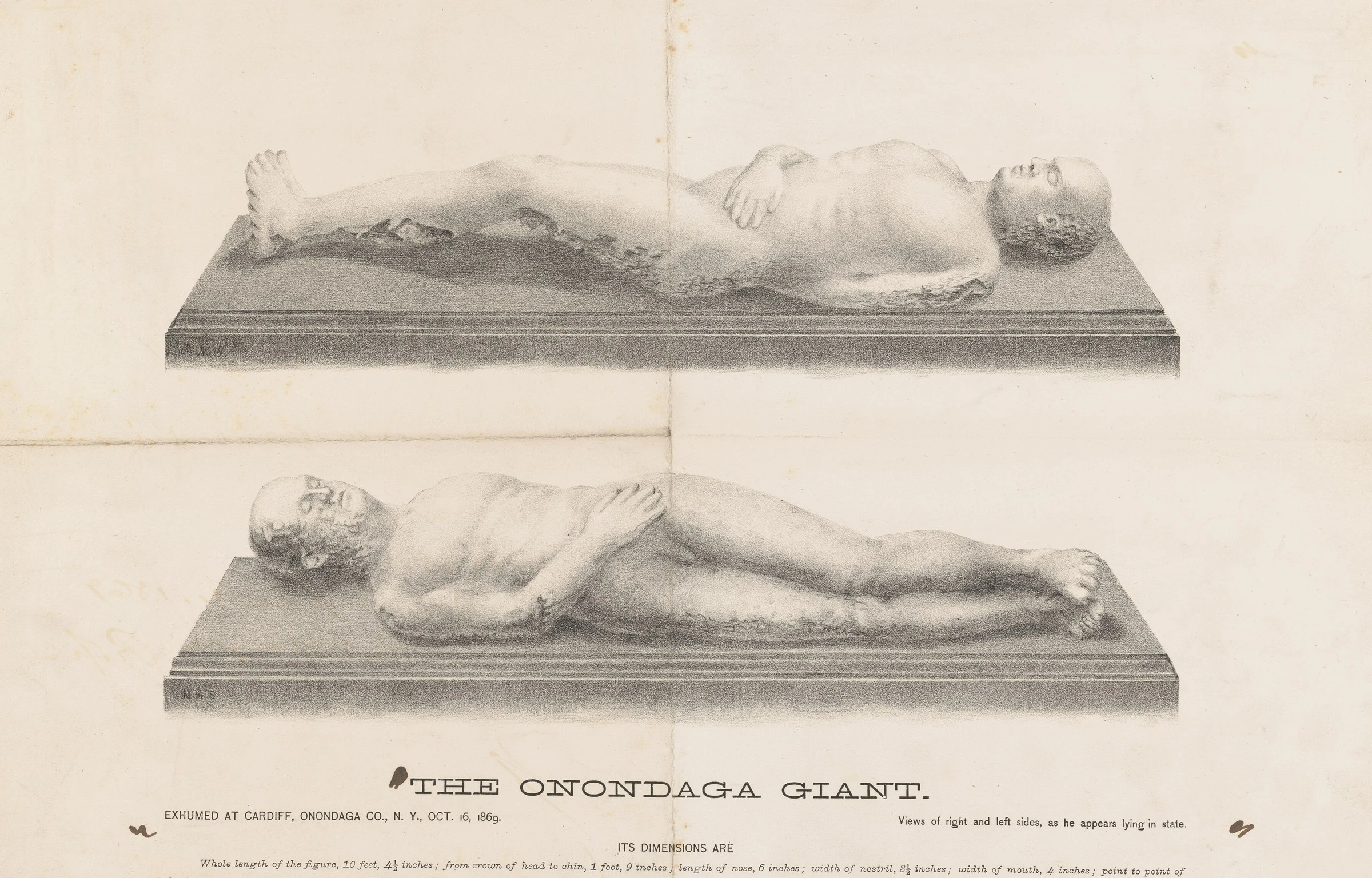
There were giants in the earth
The case for a giant had a text behind it. "There were giants in the earth in those days," says the sixth chapter of Genesis in the King James Bible. White recorded people hailing the find as "an edifying confirmation of the biblical text." In Genesis the giants come before the Flood; a giant buried in the earth of New York, turned to stone, was where a reader of Genesis might expect to find one.
The arguments for its being genuine, as White later set them out, were not foolish. A poor farmer could not have devised such a thing or paid for it. The family would swear they knew nothing. A mass of three thousand pounds could not have been buried without someone seeing. And the underside was cut with fine grooves, which looked like the work of water running over it for centuries.
A pamphlet printed in Syracuse that year, The American Goliath, quoted a regional newspaper: "I venture to affirm that no living sculptor can be produced who will say that the figure was conceived and executed by any human being." An Onondaga woman was reported to have said it was the body of a gigantic Indian prophet.
The money moved faster than the debate. A syndicate led by David Hannum of Homer, New York, bought a share in the giant; accounts of the price range from $23,000 to $37,500. It was moved to Syracuse and shown there to crowds. The showman P. T. Barnum offered, by his own later account, "fifty thousand dollars for your Cardiff Giant, as it is"; other accounts say $60,000 to lease it for three months. When the owners refused, he had a copy carved and showed it in New York City, two blocks from the original, which had also come to town.
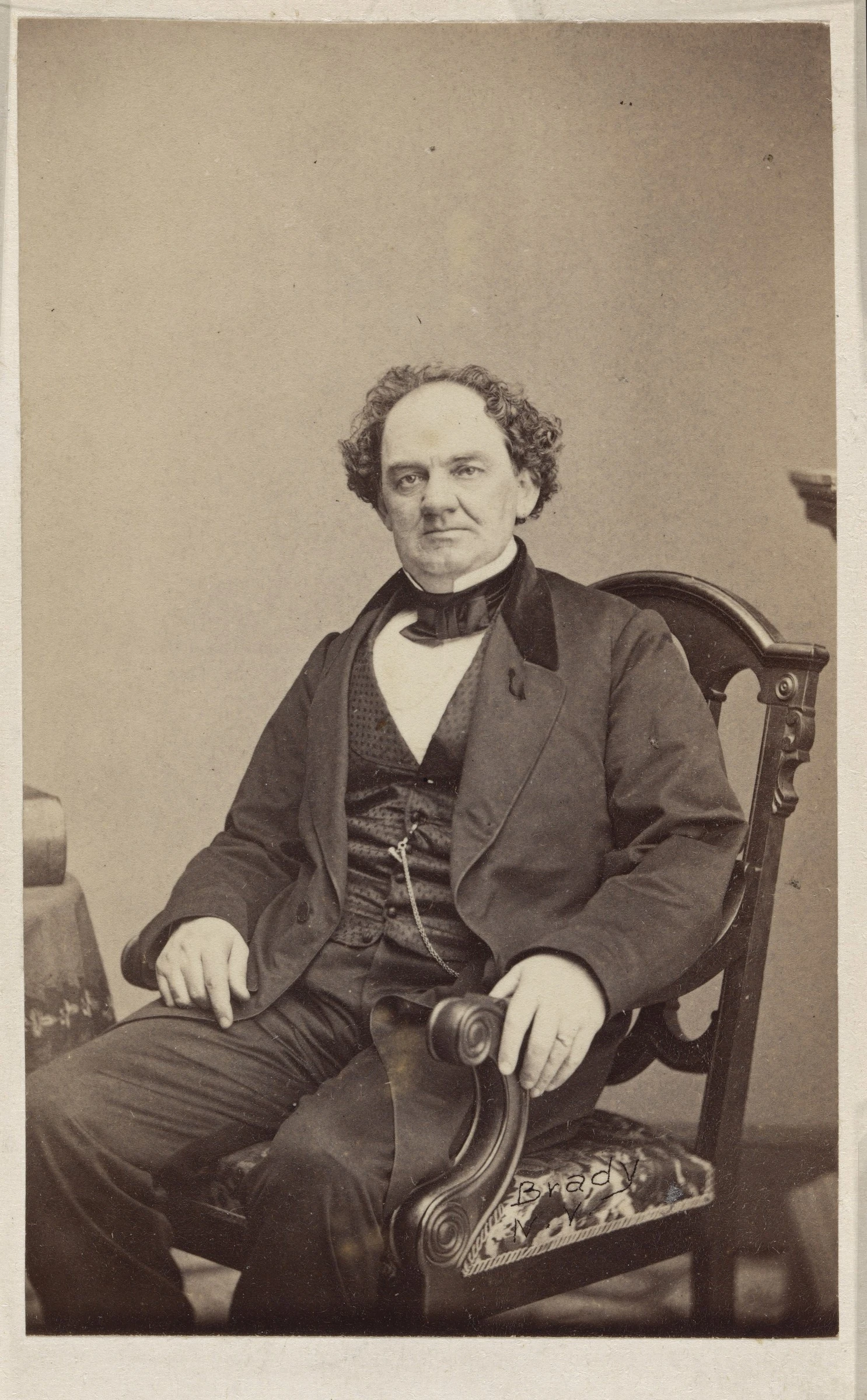
A stone man, two copies of him, and a city full of people paying to choose.
If the giant were real
Set aside for a moment what the record later showed. Ask the better question. What kind of world would the visitors of 1869 have been living in, if they were right?
It would mean, first, that the earth of upstate New York held a body ten feet long, preserved in stone, from a time before the history anyone had written.
It would mean that the giants of Genesis were not a figure of speech but a people, with bodies, who died and were buried, and that the oldest book in the visitors' homes was also a book of natural history.
It would mean something about us. If giants walked the earth, human beings were once more, or other, than we are now, and our own size is the end of a long shrinking, not the measure of what a person is.
And it would leave one question in front of us that the visitors could not answer either. Where were the others? A people needs more than one body.
A block of Iowa gypsum
The answer came within weeks, from science and from the man who made it.
Othniel C. Marsh, the Yale paleontologist, wrote in November, in a letter printed in the Syracuse Daily Journal: "It is of very recent origin, and a most decided humbug.... Very short exposure of the statue would suffice to obliterate all trace of tool-marks, and also to roughen the polished surfaces, but these are still quite perfect, and hence the giant must have been very recently buried."
White had already been shown a chip. It was not hard limestone, he wrote, "but a soft, friable sulphate of lime, a form of gypsum," which water dissolves, so the grooves on the underside could be cut in a short time, not over ages. And he asked a plain question: why would a farmer dig a well in that spot at all?
In December 1869 George Hull, a cigar maker from Binghamton and a relative of Newell's (accounts call him a cousin or a brother-in-law), told the newspapers he had made it. The story he told was confirmed by affidavits from Iowa and Illinois. In 1868 he had bought a block of gypsum at Fort Dodge, Iowa, some five tons, telling the locals it was for a monument to Lincoln. He hauled it by wagon to the railroad and shipped it to Chicago, where the stonecutter Edward Burghardt and his assistants carved it with Hull himself as the model. They made the pores by beating the surface with a mallet faced with steel needles. Then he boxed it, shipped it east, and buried it behind Newell's barn in November 1868. Almost a year later, Newell had two men dig a well there.
Hull said the idea came from an argument with a Methodist revivalist in Iowa about the giants of the Bible. The whole thing, by the usual account, cost him about $2,600.
What the confession did not end
The confession settled who made this giant. It did not settle the rest of the story.
The crowds did not stop. Hannum's syndicate went to court in New York to stop Barnum showing his copy, before Justice Barnard, in December 1869. The case was never reported; the Library of Congress's law library looked for it in 2011 and found no report. The courtroom lines that later books quote, the judge saying the giant must swear to its own genuineness, among them, rest on no court record.
The most famous line of all is attached to Hannum: "There's a sucker born every minute." No source from 1869 has been found that has it. The earliest known use found by the researcher Garson O'Toole of Quote Investigator is anonymous, in January 1879, and the line was tied to Barnum, not Hannum, in the 1890s.
Even the simple facts wobble. The syndicate's price is given as $23,000, $30,000 and $37,500. The preacher Hull argued with is placed in 1866 in one account and 1867 in another. Hull's kinship to Newell is given two ways.
And the oldest question was not answered by the confession at all. Why did so many people, including ministers, doctors and a state geologist, want so much for it to be a giant? White, who saw the crowds, called his chapter on it "A Chapter in the History of Human Folly," and saw in it the joy people take in believing. That is a view, not a measurement; historians have offered other explanations, and none settles it.
Where the giant lies now
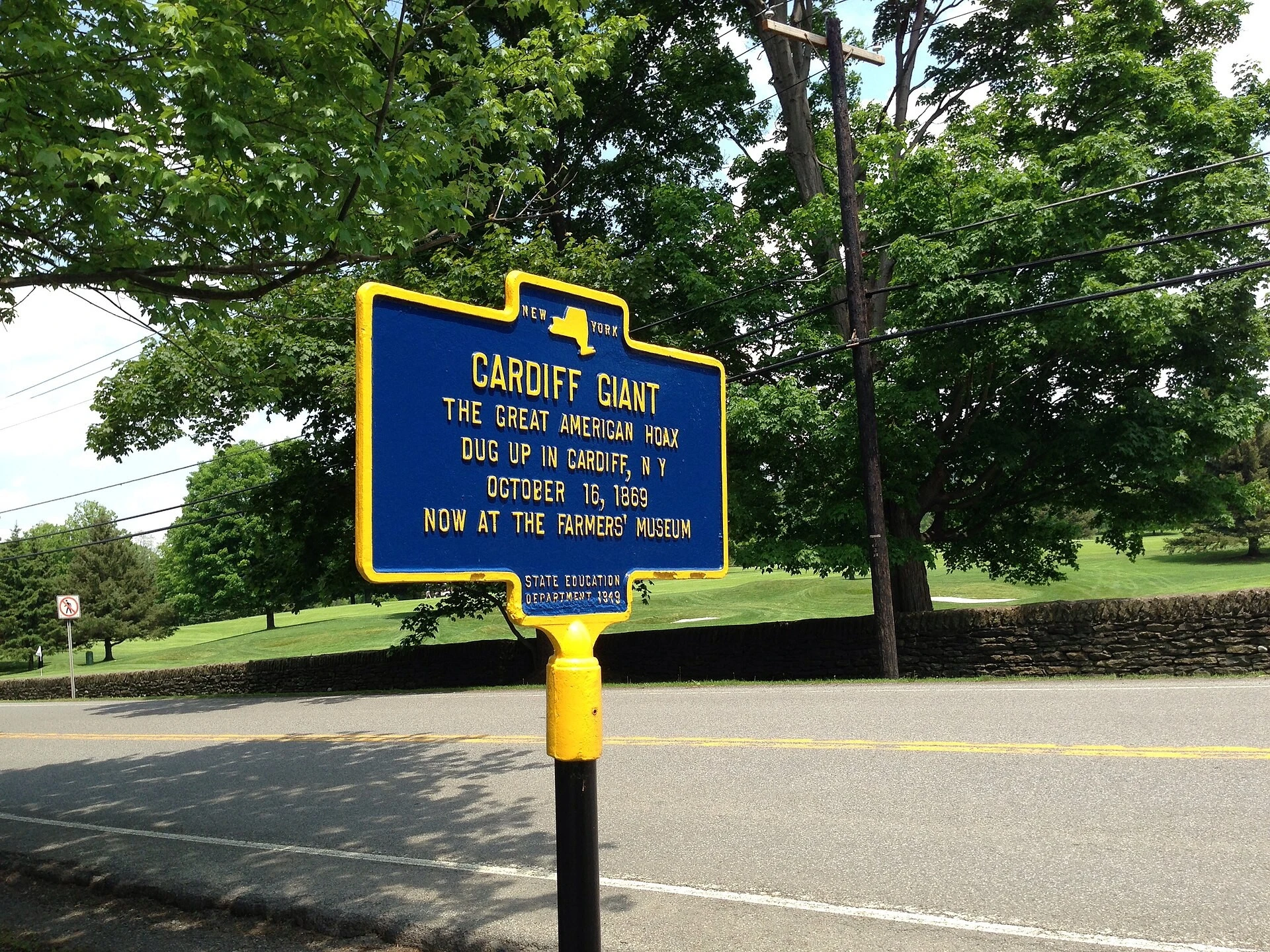
After Syracuse the giant travelled. It was shown at the Pan-American Exposition in Buffalo in 1901, stored for years in Massachusetts, and in 1921 was in Fort Dodge, Iowa, where its stone came from. In 1947 the Farmers' Museum in Cooperstown, New York, bought it. It lies there still, in a pit under a banner, at the museum now called Fenimore Farm. A New York State marker set up at Cardiff in 1949 calls it "THE GREAT AMERICAN HOAX." The museum's own page ties Hull's idea to the giants of Genesis. A copy said to be Barnum's has been shown in a mechanical-arcade museum in Michigan.
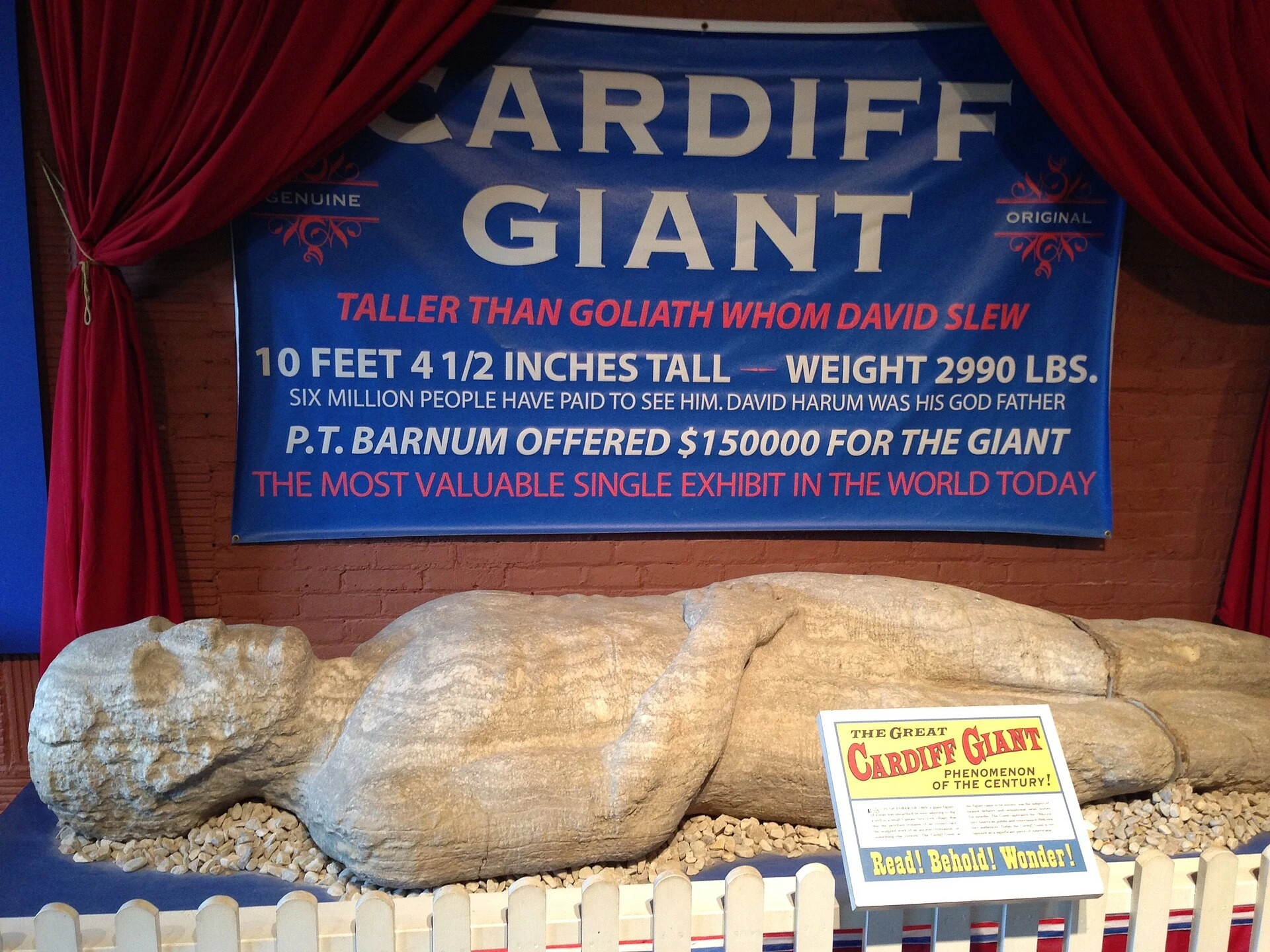
The question it raises has not moved. Another article on this site follows the giant skeletons in the Smithsonian's own 1894 mound report, records that are still argued over. The Cardiff Giant is the other kind of evidence: a figure whose maker came forward.
A carved block of Iowa stone. And a crowd that came to see a giant.
Questions This Leaves You With
Is there anything a person actually does with this?
Not much, in a practical sense, and that is worth admitting. The giant is a carving and its maker said so. What it gives you is a test you can use on any find that arrives with a crowd already around it: who found it, why they were digging there, who is selling tickets, and what the material is. White asked exactly those questions in 1869. Whoever brings you a wonder with a ticket booth attached has given you something to check.
Does this sit against a religious account of the world?
It can be read both ways. Ministers in 1869 hailed the giant as proof of Scripture, and others were among its first doubters. Hull himself said he made it to answer a preacher. Some readers take the story as a warning about faith wanting proof too much; others as a warning about how easily anything can be dressed as a sign. Genesis says what it says about giants either way. Where that leaves your own faith is for you to decide. This site will not tell you.
Does this change what a human life is?
The giant was the size of what people hoped for: bigger than any of them, older than their history, proof that their book was literal. You might find the story diminishing, a whole county fooled by a cigar maker. Or you might find it the opposite: thousands of people who were willing to believe the earth held wonders, and a few who stood in the crowd and asked the right question. Which one did you feel?
What would change your mind, in either direction?
Name it now, before you are committed. Toward the giants of Genesis as bodies in the earth: a skeleton of a giant human, excavated and recorded in place by professionals, measured and kept in a museum where anyone can see it, with a date. Toward the giant stories being made, all of them: every other famous giant find traced, as this one was, to a maker or a mistake. Notice that the Cardiff Giant answers only for itself: one carving, confessed, says nothing either way about a bone in another state, dug by another hand.
Why giants?
This is the open problem, and it is a real one. Giants appear in Genesis, in Greek legend, in the stories of many peoples, and in American reports of the nineteenth century, of which the Cardiff Giant is only the most famous. White's answer was the pleasure of believing. That is a guess by a witness, not a finding, and the other explanations offered since have not settled why the giant, of all wonders, is the one people keep expecting the ground to give back.
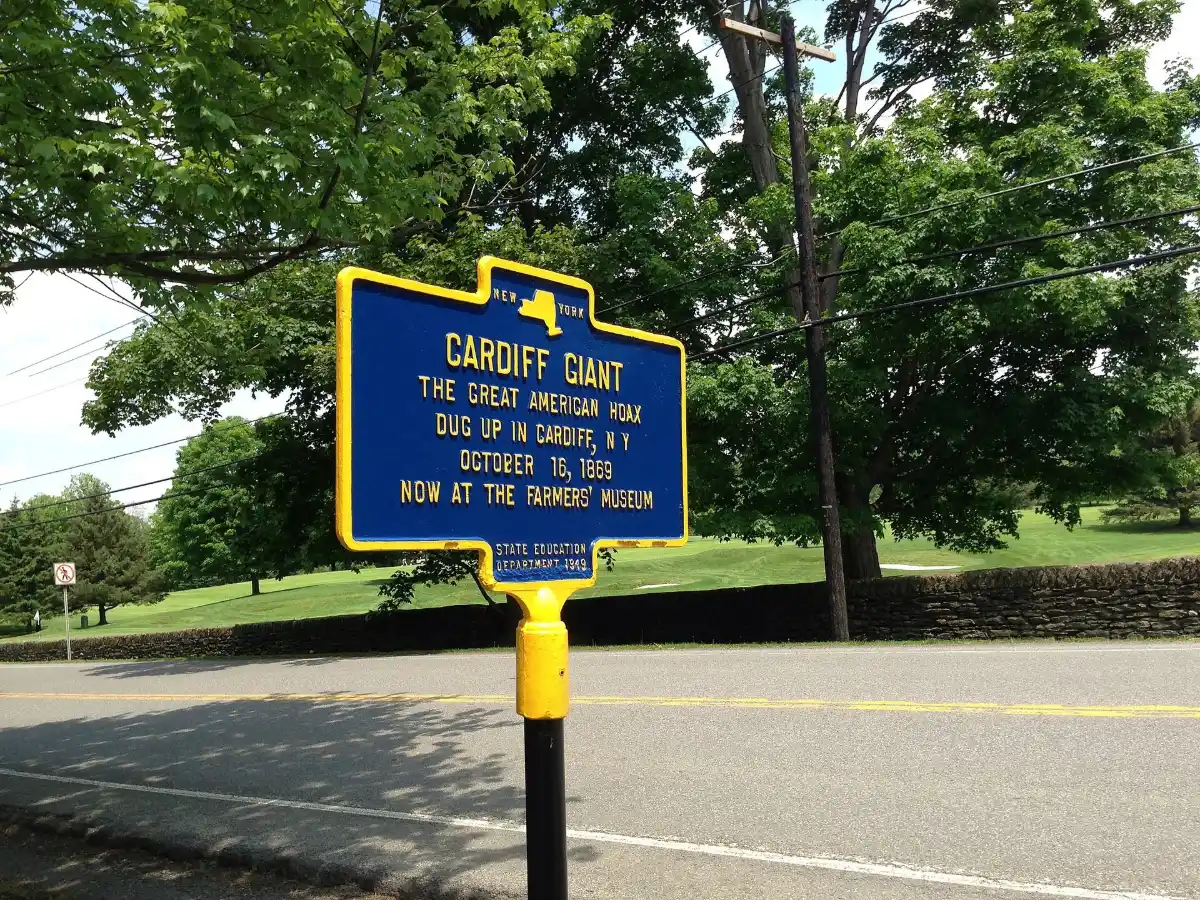
The New York State marker at Cardiff, set up in 1949. New York State historic marker at Cardiff, 2013. Photo: Martin Lewison, CC BY-SA 2.0 (creativecommons.org/licenses/by-sa/2.0), via Wikimedia Commons.
Sources
- Autobiography of Andrew Dickson White, vol. 2 (1905), ch. LVI, The Cardiff Giant: A Chapter in the History of Human Folly Andrew Dickson White, Project Gutenberg Primary record
- The Giant in the Earth (American Heritage 26(5), 1975) Stephen W. Sears Study
- When Giants Roamed the Earth (Archaeology 58(6), 2005) Mark Rose Study
- The Cardiff Giant (The Palimpsest II(9), 1921) Ruth A. Gallaher, State Historical Society of Iowa Study
- The Hoax Is on You: A Short Question about a Tall Tale (2011) Megan Lulofs, Library of Congress, In Custodia Legis Study
- There's a Sucker Born Every Minute (2014) Garson O'Toole, Quote Investigator Study
- Cardiff Giant Fenimore Farm and Country Village (the Farmers' Museum), Cooperstown Primary record
- Cardiff Giant (encyclopedia entry, read 2026) Wikipedia General reference
- Genesis 6:4 (King James Version) Bible Gateway Primary record
- A Remarkable Deception (2017) Massachusetts Historical Society Study