
The Sumerian King List is a roll call of reigns, king after king, city after city, back to the time when "the kingship had descended from heaven." Thirteen names after the flood, in the first dynasty of Kish, one line stops being a list. "Etana, the shepherd, who ascended to heaven and consolidated all the foreign countries, became king; he ruled for 1500 years."
Ascended to heaven. In a document that otherwise counts years.
Behind that line is a story told in clay for well over a thousand years: a king with no son, an eagle with broken wings, and a flight. The eagle carries the man up on its back. As they rise, the eagle tells him to look down, and the land becomes a hill, the sea a ditch. In another telling the land shrinks to a garden plot, until Etana cries out in fear.
"I looked but could not see the land!"
Zecharia Sitchin read it as the oldest description of the Earth seen from above. Specialists read it as a king's journey toward the heaven of Anu.
A king list and a story
The King List survives in copies of the early second millennium BC, the best known being the Weld-Blundell prism in Oxford. In the Electronic Text Corpus of Sumerian Literature translation, made at Oxford, Etana is the thirteenth king of Kish after the flood, following Arwium, son of Mashda. His son Balih follows him, with 400 years. Most copies give Etana 1,500 years; one manuscript gives 635. Thorkild Jacobsen's 1939 edition, the standard for decades, read 1,560, and that number still travels.
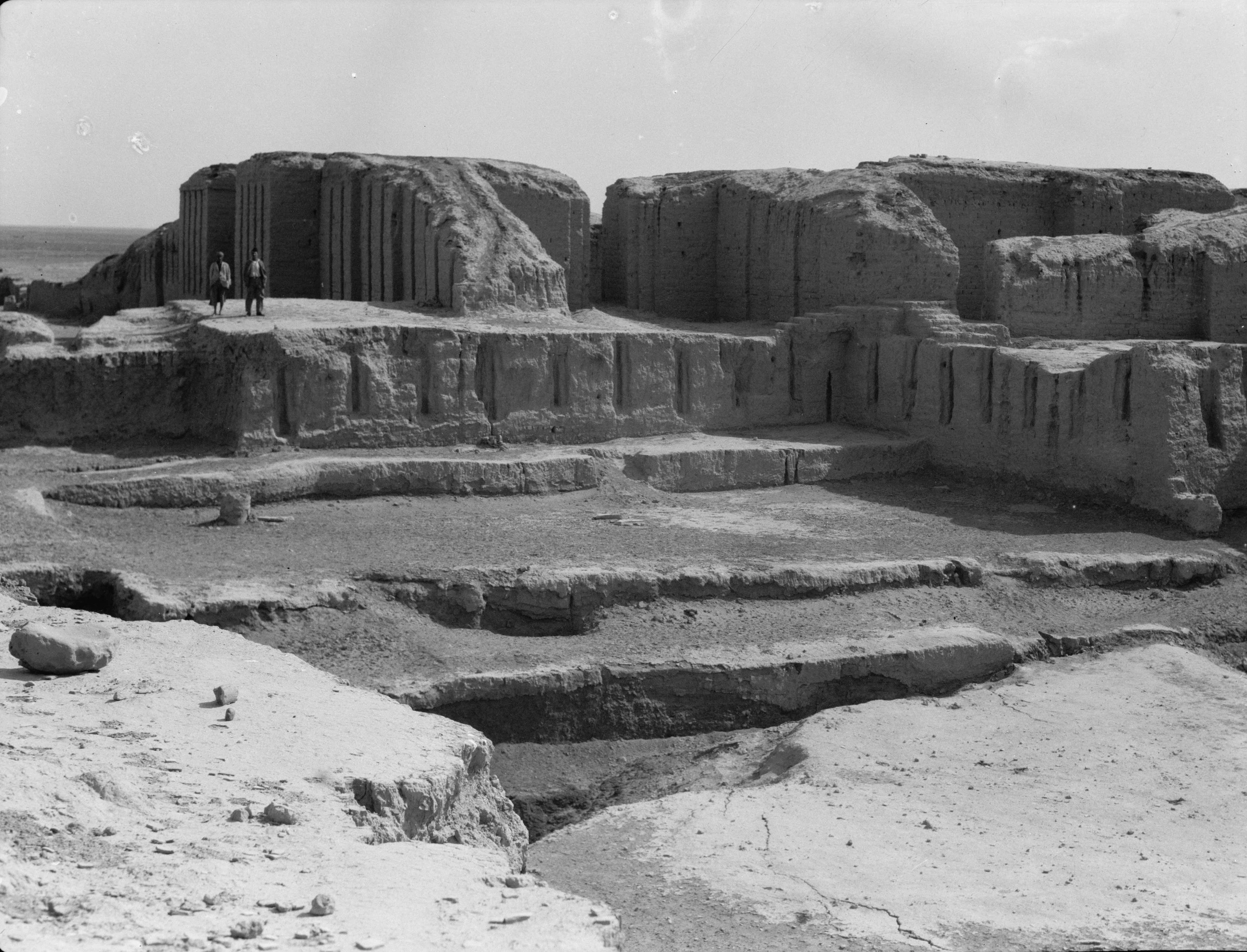
The story behind the line is in Akkadian, and it lasted. The Assyriologist Jamie Novotny lists three versions: an Old Babylonian one, from Susa and perhaps a second site; a Middle Assyrian one from Assur, now in Berlin; and a Standard Babylonian one from Nineveh, in the British Museum. A cuneiform catalogue of literary works names its author as Lu-Nanna, a sage of Ur.
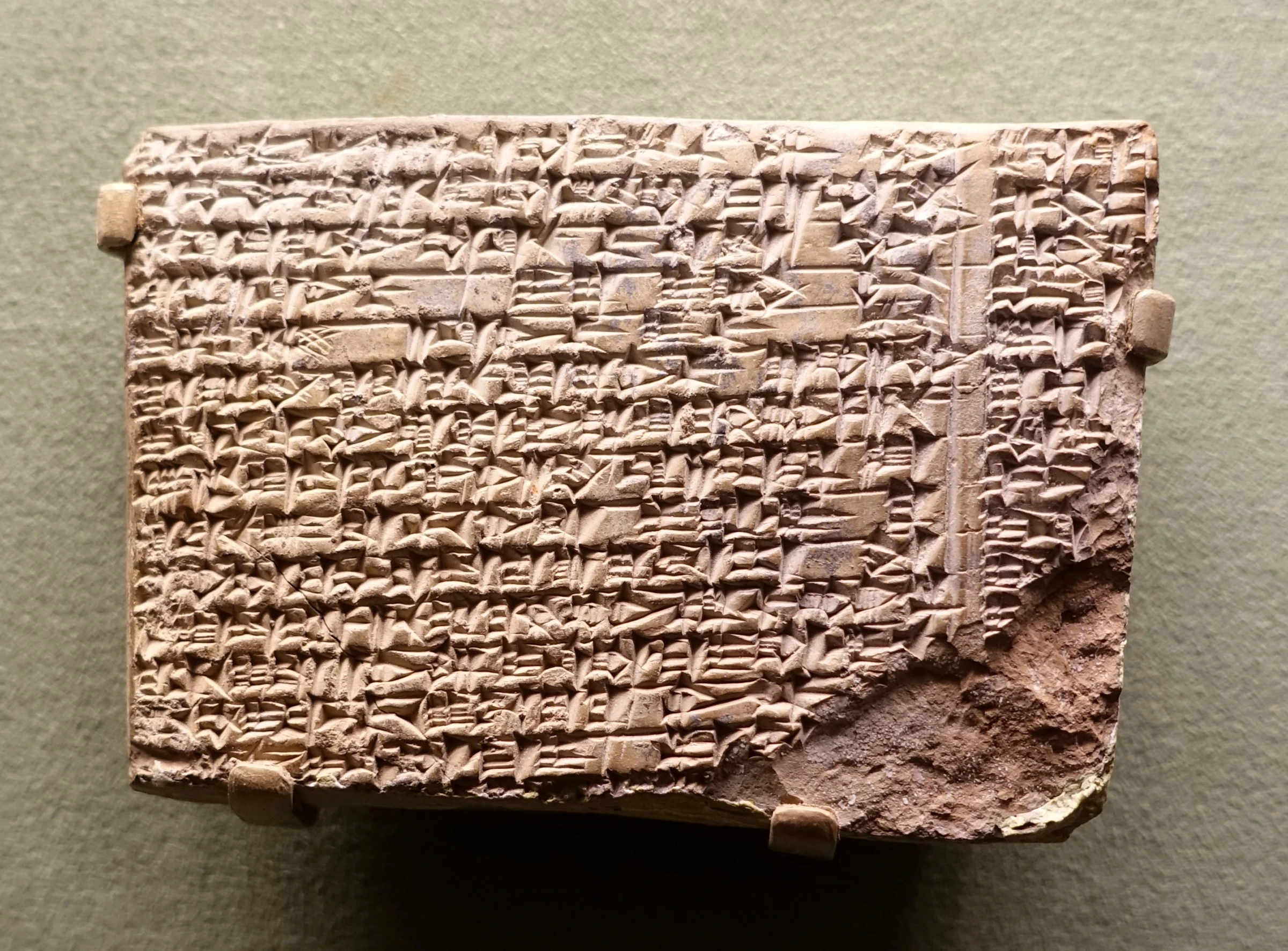
The plot, as the versions together give it, runs like a fable. An eagle and a serpent share a tree and swear friendship before Shamash, the sun god. The eagle eats the serpent's young. The serpent, on Shamash's advice, hides in the carcass of a bull, seizes the eagle, breaks its wings and throws it into a pit. Etana, the king, has no son and prays for the plant of birth. Shamash sends him to the pit. He frees the eagle, and the eagle, in return, carries him up toward the heaven of Anu, the sky god, to find the plant.
The flight is told in stages, and the versions differ. In Benjamin Foster's translation, on the first ascent the eagle tells the king to look down: "The land is a hill." "The sea has become a gardener's ditch." In another sequence, "The land has become a garden plot, and the vast sea has become a trough."
Then Etana, afraid, cannot see the land at all.
The eagle on the seals
The story is older than the King List copies. Seal-cutters of the Akkadian age, about 2300 to 2150 BC, carved it on cylinder seals: a man borne up on the back of a great bird, shepherds and dogs below with their faces turned up, flocks and a pen, sometimes a man churning milk. One such seal, now in the Ashmolean Museum in Oxford, number AN1931.114, was found at Kish itself, the city of Etana's dynasty.
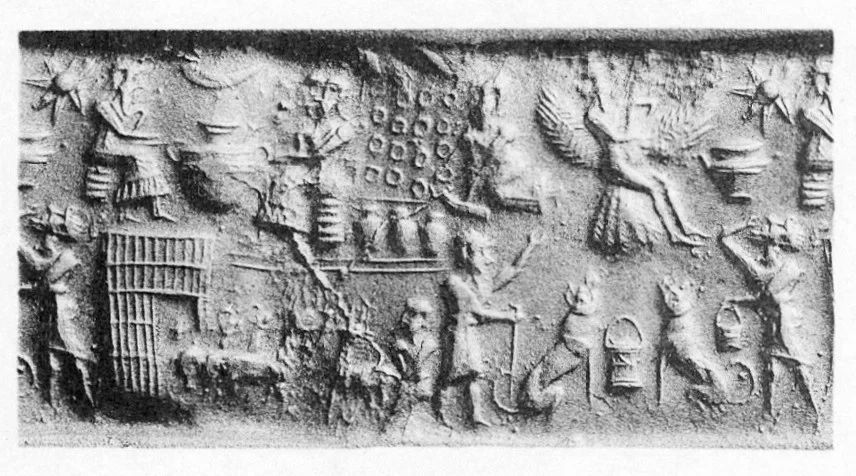
The scenes carry no names. They are called Etana seals by convention, because they match the story so closely, and in the specialist literature, Michael Haul's 2000 edition of the epic among it, they have a section of their own.
A view from space
The ancient-astronaut reading takes the flight literally. Zecharia Sitchin, in The 12th Planet in 1976 and in later books, read Etana's ascent as space flight. In the words of a 1997 summary of his argument in Skeptic magazine, "Sitchin argues that the eagle was actually a spacecraft that took Etana to the god's planet," and the proof he offered was "Etana's observation of how the land and sea seem to grow smaller with distance."
On that reading, the stages of the flight are a record. A hill, a garden plot, a ditch, then the land vanishing: on that reading, the view from a craft climbing away from the Earth, described in the only words the teller had. And the King List, a sober document of reigns, marks this one king as the one who went up.
Erich von Daniken had reached for a Mesopotamian flight eight years before Sitchin. In Chariots of the Gods? (1968) he wrote of a sun god who seized a hero with "mighty wings and claws"; the writer Jason Colavito has argued that the passage, which von Daniken placed in the Gilgamesh epic, conflates Gilgamesh with the story of Etana.
The pull of it is plain. A people who never left the ground described the ground falling away, in order, until it disappeared.
If Etana went up
Set aside for a moment whether it is true. Ask the better question. On the ancient-astronaut reading, what kind of history are we living inside?
It would mean, first, that the first dynasty after the flood remembered a real ascent, and wrote it into the official list of kings as plainly as a length of reign.
It would mean that someone in the third millennium BC saw the Earth shrink beneath them, and that the seal-cutters of Akkad, carving a man borne up by a great bird, were recording an event rather than a story.
It would mean something about the oldest kingship of all. On that reading, kingship that "descended from heaven" was not a figure of speech, and one of the first kings went back up the way it came.
And it would leave one question still in front of us. The King List says Etana went up; it says nothing of his coming down. If the reading were right, the first account of the Earth from above would have been set down more than four thousand years before any camera looked down on it. The question is whether we would know an eyewitness account if it came to us in the shape of a story about an eagle.
How the specialists read the flight
The standard account reads the flight against the picture of the world the Babylonians held. In that picture the land was a disc ringed by ocean, and heaven had levels, three of them, the heaven of Anu the highest. Novotny, reviewing Haul's edition in 2002, sets the flight beside two cuneiform texts that describe those three heavens. The eagle's stages fit that cosmos: the land a hill, the encircling sea a ditch, then out of sight. Colavito puts the same point plainly: what Etana sees is the old idea of the earth as an island girdled by the river Ocean, not the round Earth seen from space.
Perspective, on this account, needed no flight. "The peoples of the ancient Near East were surely aware that as something moved further away, it appeared to be smaller," Eric Wojciehowski wrote in Skeptic in 1997.
The story's own concerns, the specialists note, are kingship and an heir. Etana is made the first king in Kish by the gods, he has no son, and he goes to heaven for the plant of birth; the King List gives him a son. The University of Hamburg's manuscript centre, in a 2025 bulletin, reads its lesson as the limit of human life. The eagle remains an eagle throughout: Etana rides on its back, holding its feathers.
And the order of the evidence runs story first. The Hamburg bulletin notes that the story is older than the surviving King List copies and is already shown on Akkadian seals; on that order, the specialists read the list's epithet as pointing to a tale already told.
What the reading leaves open
The standard account explains why the story exists. Three things it leaves.
The first is the list itself. The King List gives most of its kings a name, a father and a number. A handful get a phrase of story: a shepherd who went up to heaven is one. Why the compilers kept the flight, in a document that otherwise counts years, the account does not say.
The second is the ending. The Standard Babylonian tablets break off. Haul's edition, as Novotny summarises it, argues that Etana flew twice, three leagues each time, that the first flight was abandoned when the king panicked, and that "the second and final flight was successful." Earlier editors read one flight of six leagues, or as many as four. Whether Etana reached the heaven of Anu depends on how the broken pieces are arranged.
The surviving Standard Babylonian text breaks off; some reconstructions have the plant won, and the son Balih in the King List born.
The third is the man. No inscription from Etana's own time is cited that names him, and the 1,500-year reign is not historical on anyone's account. Whether there was a king of Kish named Etana behind the story is open.
Where it stands
Work on the epic goes on. The University of Hamburg's manuscript centre published its reading of Etana and the creation of kingship in August 2025. The scholar Seth Sanders, in a 2017 book, traced Etana into the long line of ascent stories that runs through the Near East to the heavenly journey of Enoch.
The seal from Kish is in Oxford. The King List is in Oxford too. Between them is one of the shortest notes of an ascent in any Mesopotamian text, six words in English.
A shepherd. Who went up.
Questions This Leaves You With
Is there anything a person actually does with this?
Not in a practical sense, and it is worth being honest about it. Nothing in the Etana story tells anyone what to do, or predicts anything, and no date or warning can honestly be read from it. What it does offer is a reading exercise you can do yourself: the King List and several translations of the epic are free online, and the seals are on museum websites. Put the flight's stages beside a photograph of the Earth from orbit and ask what each one actually describes.
Does this sit against a religious account of the world?
It can be read both ways. In the story itself, the flight is an act of the gods: Shamash arranges it and the heaven Etana seeks is Anu's. On the ancient-astronaut reading, the gods become travellers, which some take as an explanation of religion and others as a rival to it. Ascent stories run through many traditions, from Enoch to Elijah, and serious people have argued over what they share. Which way it falls for you is yours to decide. This site will not tell you.
Does this change what a human life is?
Etana's whole quest is about one life passing into the next: a king who needs a son. On any reading, he goes as high as a human can go for something every family wants. You might find that diminishing, all that height for an heir. Or you might find it the opposite: the oldest story of flight is not about conquest or knowledge but about a child. Which one did you feel?
What would change your mind, in either direction?
Name it now, before you are committed. Toward the ancient-astronaut reading it would take a Mesopotamian text describing what a disc-and-ocean cosmos does not predict, the Earth's curve, its round edge, the night side, together with a reason to read it as a report rather than a story. Toward the standard reading: more texts setting Etana's flight inside the known picture of three heavens, as Novotny's review already does. On the evidence so far, the record favours the specialists' reading; what is still open is why the list kept the line.
Why does the King List remember a flight?
This is the real gap. The list's compilers kept a phrase of story for only a few of their kings, and one of them is a shepherd who went up to heaven. They did not say why. The answer may be that the story was the most famous thing anyone knew about Etana. It may be something else. Until a text explains how the list was built, that line sits there, one flight in a column of numbers.
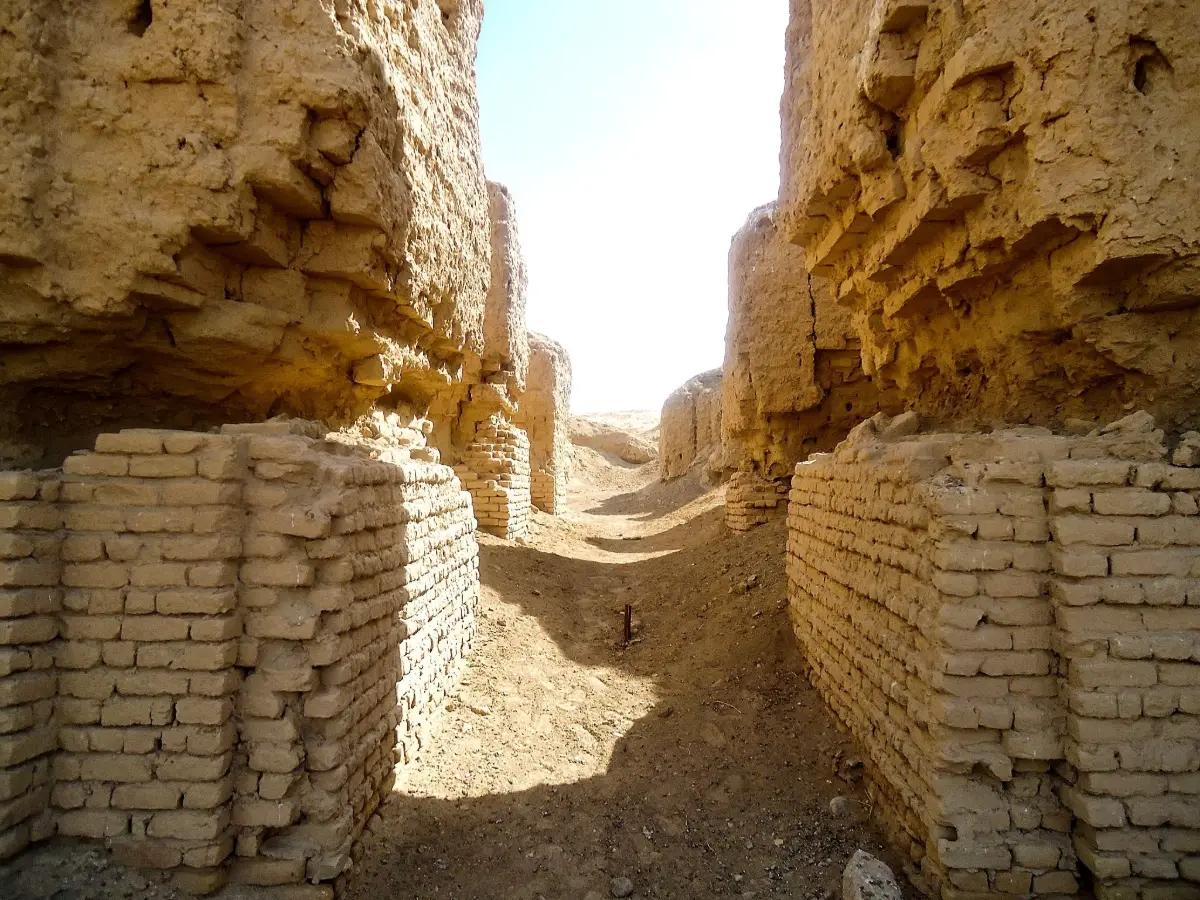
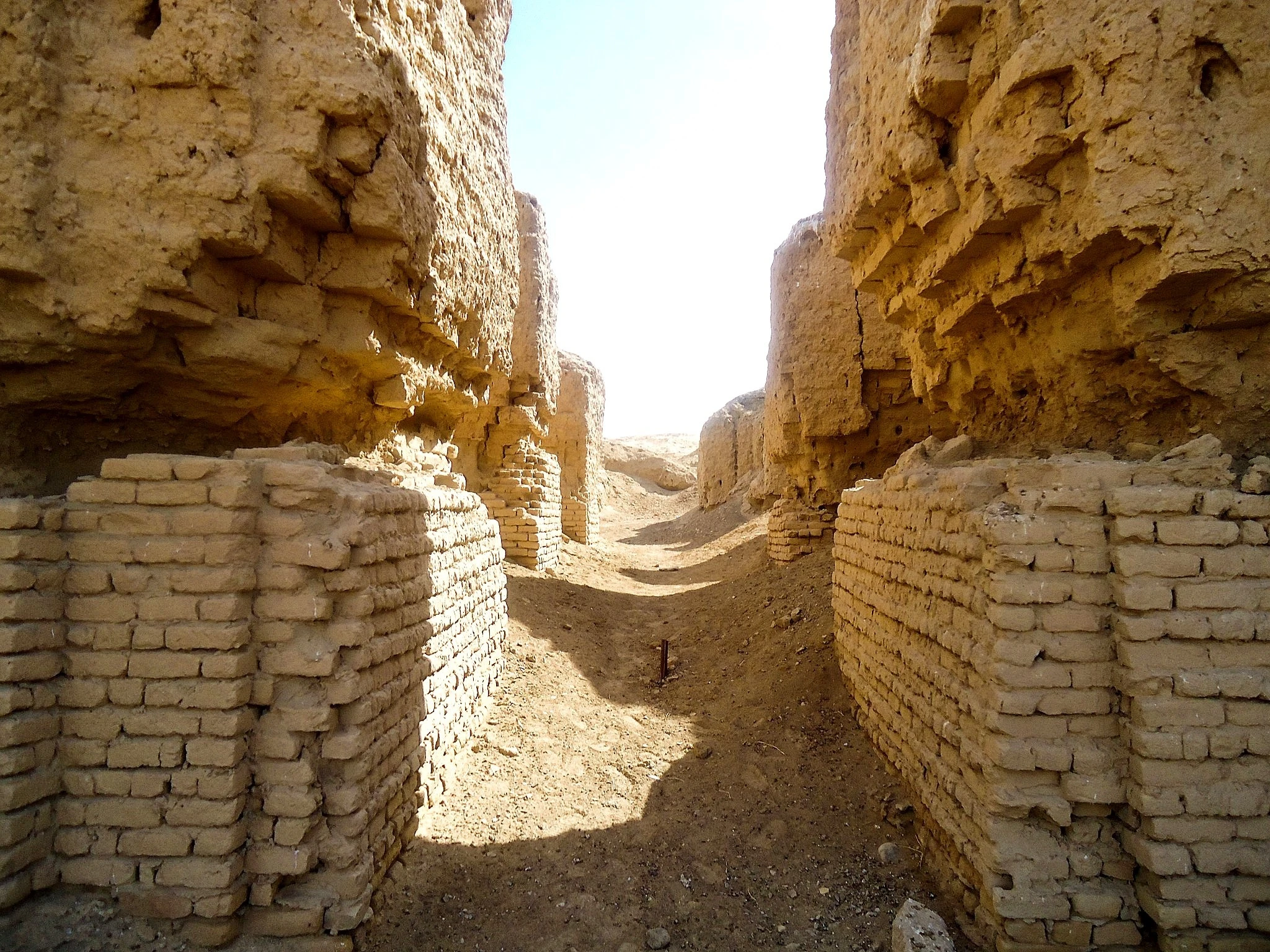
Ruins at Kish in 2011. These walls are from a much later temple, of the 6th century BC, not from Etana's time. Ruins at Kish (Tell al-Uhaymir), 2011. Photo: Osama Shukir Muhammed Amin FRCP(Glasg), CC BY-SA 4.0 (creativecommons.org/licenses/by-sa/4.0), via Wikimedia Commons.
Sources
- The Sumerian king list: translation (t.2.1.1) Electronic Text Corpus of Sumerian Literature, University of Oxford Primary record
- Heavenly journeys from Babylon to Enoch to Paul (2019), on Seth L. Sanders, From Adapa to Enoch (2017) Vridar General reference
- Review of M. Haul, Das Etana-Epos (Bibliotheca Orientalis 59, 2002) Jamie R. Novotny Study
- Etana and the Creation of Kingship (6 August 2025) Centre for the Study of Manuscript Cultures, University of Hamburg Study
- The Myth of Etana Joshua J. Mark, World History Encyclopedia (quoting Benjamin R. Foster's translation, 1995) General reference
- Etana (encyclopedia entry, read 2026) Wikipedia General reference
- The Return of Ancient Astronauts (Skeptic 5:1, 1997) Eric Wojciehowski Study
- Great Moments in Ancient Astronautics: An Imaginary Ancient Text (2012) Jason Colavito Study
- Cylinder seal, Akkadian, Ashmolean AN1931.114 (file description) Wikimedia Commons (photo Zunkir) General reference