
VA 243 is a cylinder seal in the Vorderasiatisches Museum in Berlin: a small barrel of dark serpentine, 3.4 centimetres tall and 2.1 across, cut in the Akkadian age of Mesopotamia, some 4,300 years ago. Since 1976 it has been argued over far beyond the museum, because of one detail in its upper field that Zecharia Sitchin read as a picture of the solar system.
A seal like this was made to be rolled. Pressed into wet clay and turned once, the stone leaves a strip of scene in relief: a god on a throne, a second god leading a man by the hand, a box of cuneiform, a wild goat under the box, mountains under the goat.
And in the air between the figures, a ball with thin rays standing out behind it. Around it, a ring of smaller balls.
Eleven of them, on the usual count.
On Sitchin's reading, that ring is the Sun's family, drawn by people who were told what was out there. Twelve bodies. One too many.
A seal with a catalogue number
The seal first reached print in 1939, in Henri Frankfort's Cylinder Seals, the survey that still anchors the field. Frankfort put it on Plate XX, among the seals of the Dynasty of Akkad he grouped as fertility gods, with a four-word caption: "God of fertility with plough." The photograph came from the museum in Berlin. A year later Anton Moortgat entered it in the museum's own catalogue, Vorderasiatische Rollsiegel.
Neither man said a word about planets.
The museum's online record, written by the curator Anja Fuegert, describes the scene in order. A god sits enthroned in a flounced robe, a plough raised in his right hand, an axe behind his head, the back of the throne ending in a dragon's head. Facing him, a second god leads a worshipper by the hand. The worshipper, in a long wrapped skirt, carries a lamb. Between the leading god and the worshipper, high in the field, is what the record calls in German "ein von Kreispunkten umgebener Stern", a star surrounded by circular dots; below it, a club, a dagger and a pickaxe. A box of writing divides the scene, with an ibex and mountains beneath it, and gives the name of the seal's owner.
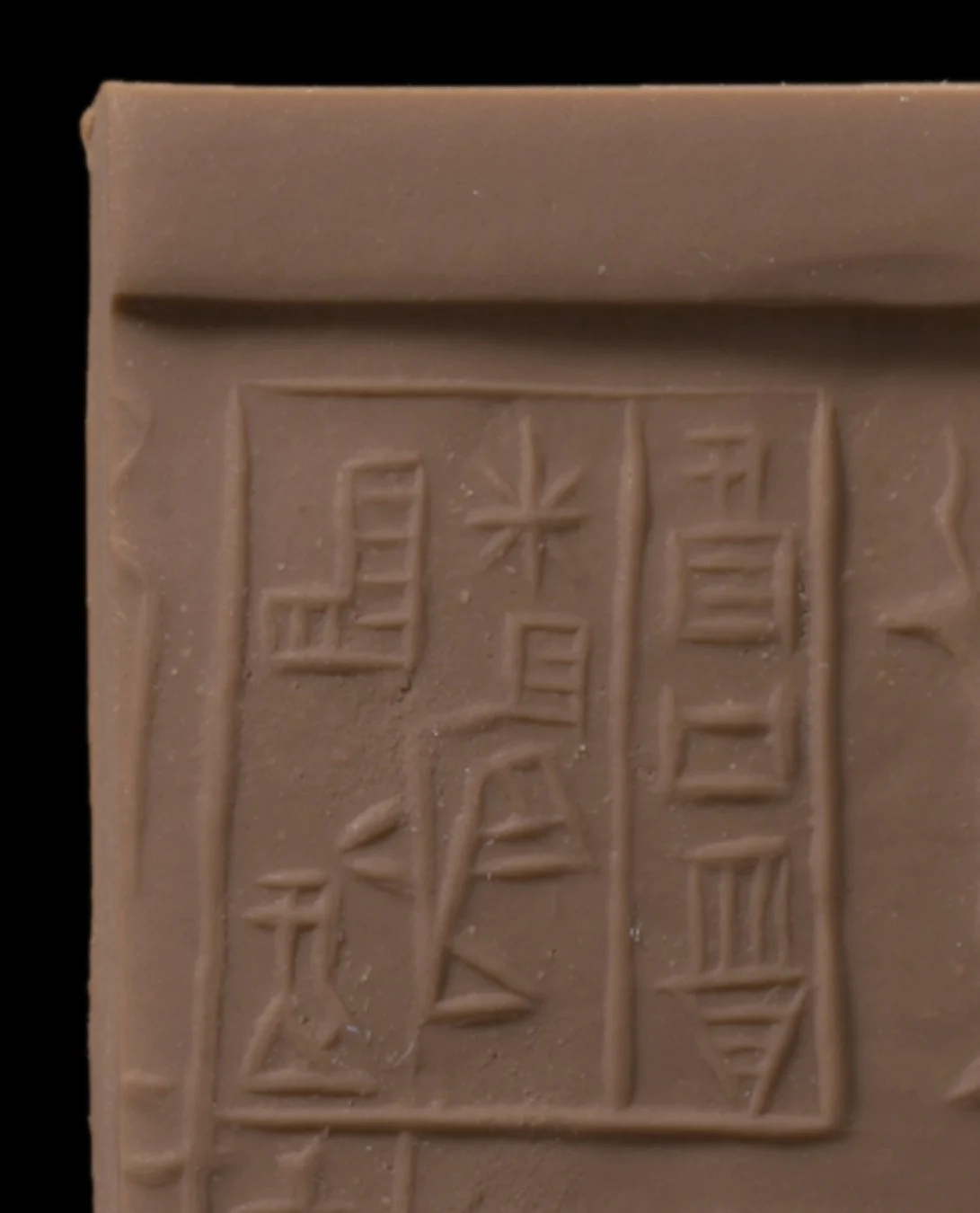
The writing runs in three short columns. The Cuneiform Digital Library Initiative transliterates it dub-si-ga, dingir-il-la-at, ARAD-su: Dubsiga, Ili-illat, his servant. Moortgat read the last word as "your servant." Two names and a formula of service: on the usual reading, Ili-illat, servant of Dubsiga.
The museum dates the seal to the Akkadian period, the second half of the third millennium BC; the CDLI narrows it to about 2340 to 2200 BC. Where it was found is not recorded. In 2011 the museum photographer Olaf M. Tessmer photographed it from five sides, each time beside a fresh rolling in modern clay with a scale bar, and the museum has since put those photographs online under an open licence. They are the pictures on this page.
Twelve bodies
In The 12th Planet, published in New York in 1976, Sitchin set the seal's emblem beside a diagram of the solar system and read them as the same thing. The rayed ball at the centre was the Sun. The ring around it was the planets, with the Moon among them, which on his account the Sumerians counted as a body in its own right. Nine planets were known in 1976, Pluto included. With the Moon, ten. The eleventh globe was the one missing from every modern chart: Nibiru, the planet he called the twelfth, on an orbit that brings it back once in about 3,600 years.
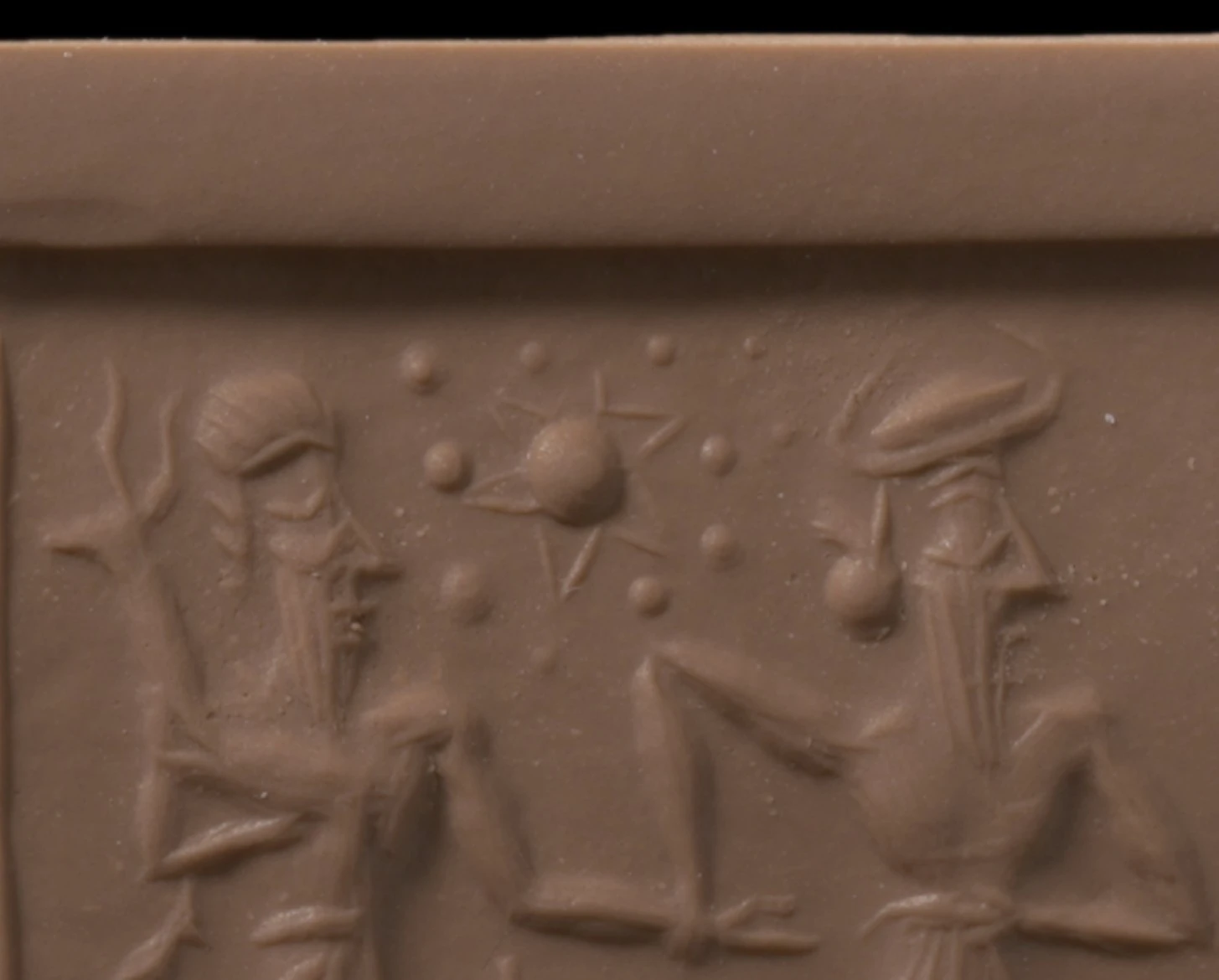
On that reading, the count is the message. A people with no telescope put down twelve members of the Sun's family, and three of them, Uranus, Neptune and Pluto, would not be found until 1781, 1846 and 1930.
The reading travelled further than the book. The seal's number became shorthand for the whole argument. In 2013 the Dutch blogger Karel Donk measured the globes on published photographs and argued they "were indeed drawn to scale," on what he proposed was "some form of logarithmic scaling," while holding that Sitchin had matched some of the globes to the wrong planets. In 2025 Kenyon College in Ohio added a replica to its art history study collection, catalogued as Sumerian Cylinder Seal VA 243.
On Sitchin's reading, a seal-cutter in Akkad, working a stone the size of a thumb, recorded the outer planets four thousand years early.
If the ring is the Sun's family
Set aside for a moment whether it is true. Ask the better question. What kind of history are we living in, if it is?
It would mean, first, that the seal is not a prayer but a diagram, and that its owner, Dubsiga or Ili-illat, signed his name with a piece of astronomy without needing to understand it.
It would mean that knowledge of the outer solar system existed in the third millennium BC and was then lost so completely that William Herschel had to find Uranus again in 1781.
It would mean something larger about us. If the ring is a chart, someone gave it, and our species did not climb from ignorance to Neptune on its own. The long story of astronomy, from the first clay star lists to the photographic plates of 1930, would be a story of remembering.
And it would leave one consequence still in front of us. On that reading the twelfth body is real and still on its orbit, out past every world we have counted, and the clue to it was cut in serpentine and rolled across clay long before anyone wrote a word about planets.
Whether a ring of drill-holes can carry that much is the question the seal hands over.
What the specialists read
The standard account of the emblem was set out most fully in a 2003 paper by Michael S. Heiser, then a doctoral student in Hebrew Bible and Semitic languages at the University of Wisconsin-Madison, titled The Myth of a 12th Planet: A Brief Analysis of Cylinder Seal VA 243. Heiser was not a seal specialist; he built the case from the specialists' work, the reference books of Jeremy Black and Anthony Green, the seal study of E. Douglas van Buren, and the readings of the seal scholar Rudi Mayr. It rests on four points.
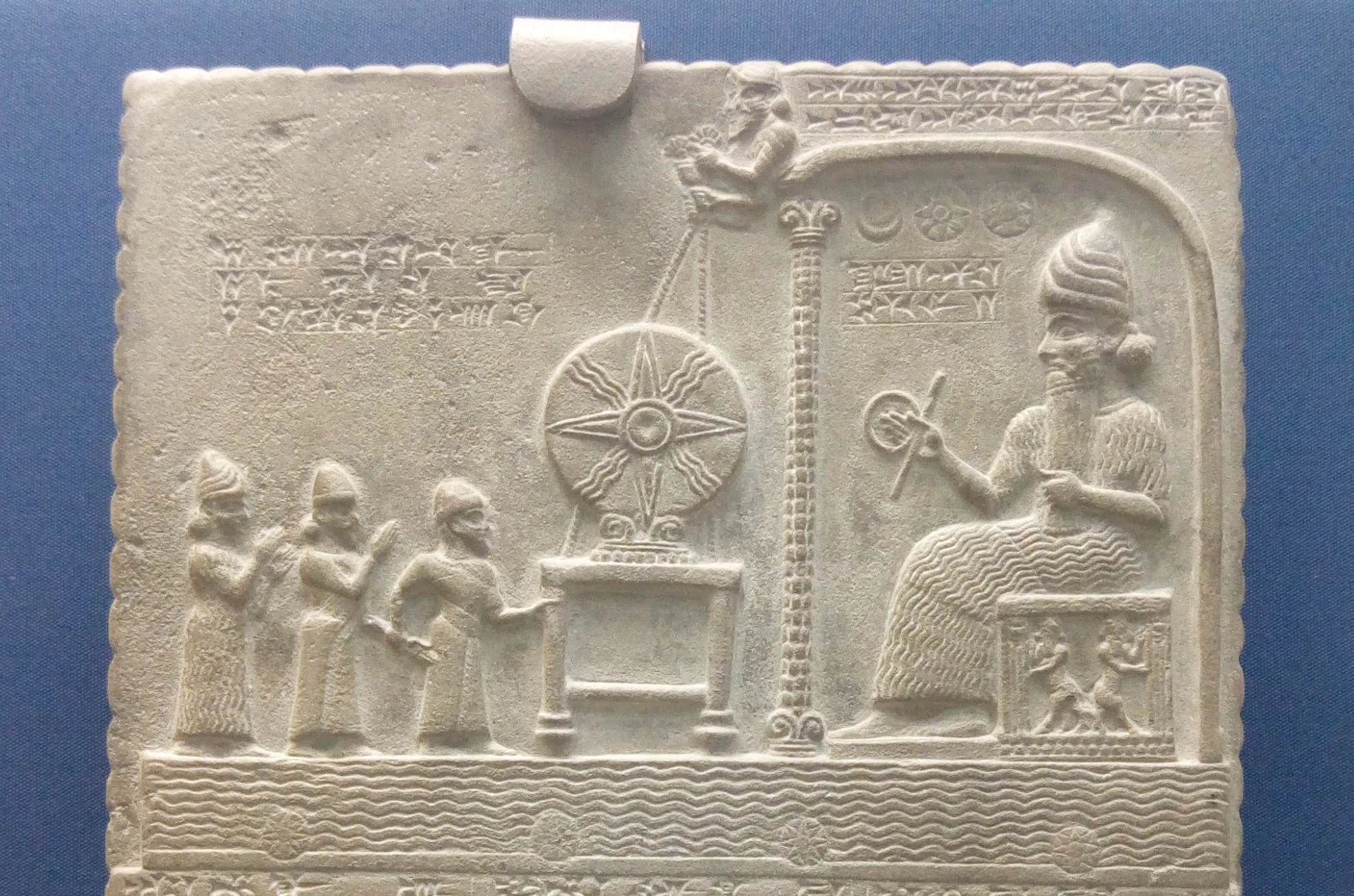
First, the sun has its own drawing. Citing Black and Green's Gods, Demons and Symbols of Ancient Mesopotamia (1992), Heiser shows that Mesopotamian art draws the sun god's emblem as a disc with four arms and wavy rays between them, nearly always inside a circle. Stars are drawn with six, seven or eight points, usually without one. On his reading, the emblem on VA 243 is a six-pointed star, with neither the wavy rays nor the circle. His examples of the sun's disc come mostly from Babylonian and Kassite art more than a thousand years younger than the seal.
Second, dots are stars. Frankfort noted in 1939 that the Pleiades "occur very frequently as additions to the seal design, rendered by seven drill-holes," and E. Douglas van Buren's 1941 study of the seven dots found early groups arranged as a ring around a central point.
Third, the inscription names people. Dubsiga and Ili-illat are an owner and a servant, not a list of worlds. And no cuneiform text, Heiser writes, citing the astronomical compendium MUL.APIN as edited by Hermann Hunger and David Pingree in 1989 and the work of Francesca Rochberg, names more than five planets: Mercury, Venus, Mars, Jupiter and Saturn, the ones visible to the eye.
Fourth, the scene is a type. Frankfort filed the seal among the fertility gods; Heiser counts "literally hundreds" of such presentation scenes, a god enthroned, a leading deity, a worshipper, with symbols in the field above. He also passes on an objection from the astronomer Tom Van Flandern: the globes' sizes do not follow the planets' sizes, and their spacing shows nothing of orbits.
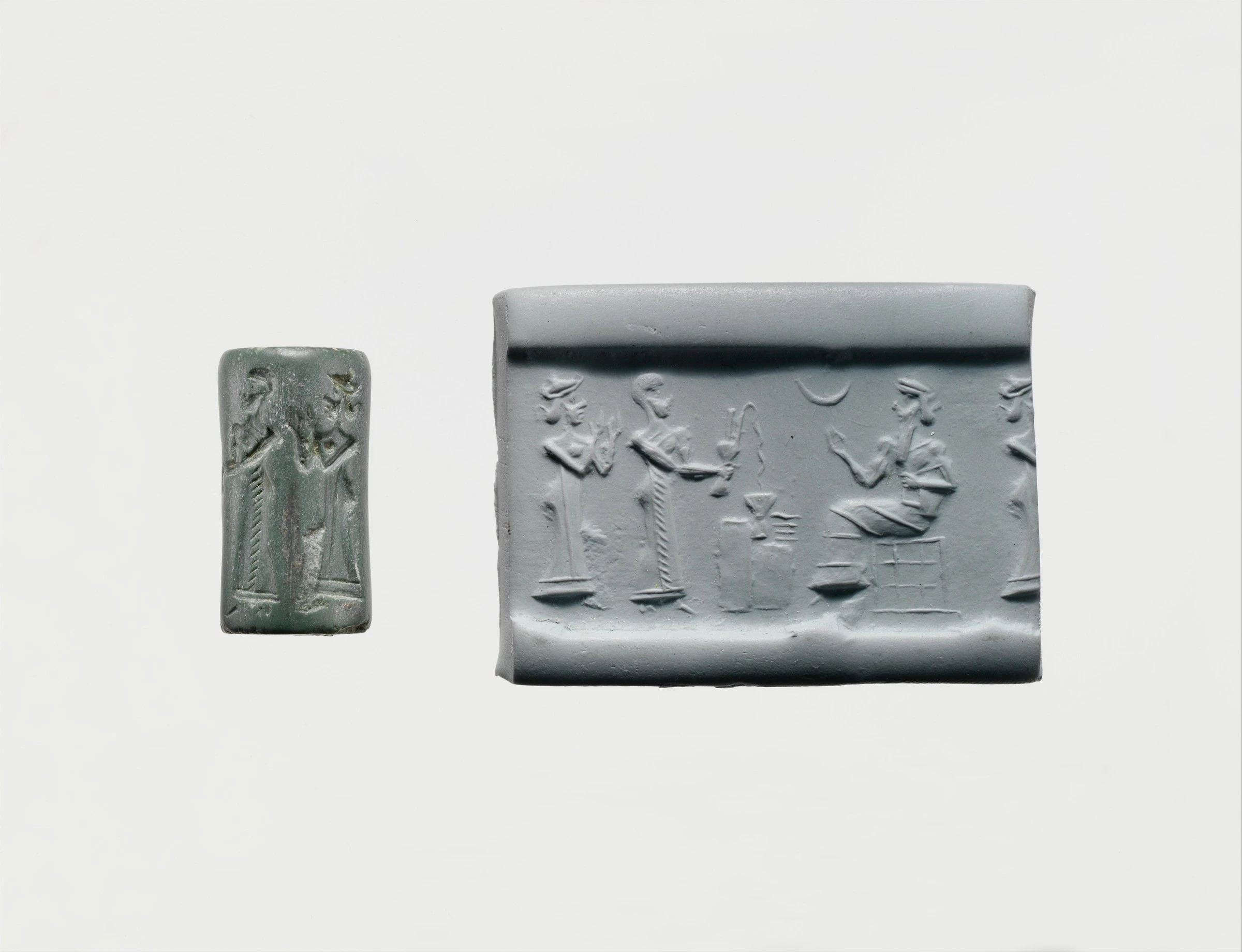
The standard account holds that the emblem is a star or a star-god with a cluster of stars, set above a scene of worship, as on many seals of its age.
What the account does not settle
The explanation covers the star and the dots in general. The number is harder.
The Pleiades are seven. VA 243 has eleven. Heiser sets out three possible meanings: a special star among others, a deity tied to fertility, or the head of a divine council with eleven other members, twelve gods in all. The third would account for the count. He calls all three "admittedly subjective," and of the astronomy he wrote: "Since I don't know astronomy well, I'll let the reader ponder that one." In the sources it read, Official X found no second seal cited with the same emblem, a rayed centre ringed by eleven balls.
The museum's photographs add a second detail. Heiser described the emblem as a six-pointed star. On the 2011 photograph of the rolling, its centre is not drawn like the star in the writing box beside it. That one, the cuneiform sign that opens the name Ili-illat, is the sign for "god," and it is drawn as a flat star of eight crossing strokes. The emblem in the field is a raised ball, larger than any of the balls around it, with its rays standing out behind.
The seal carries two stars. They are not drawn the same way.
Neither difference proves a planet. The ball-and-rays form may be one seal-cutter's way with a divine star, and the rays are not the sun's wavy rays. But Heiser's paper of 2003 came eight years before the museum's photographs were taken, and the questions it leaves, the count and the large central ball, are questions about the object itself.
Neither Heiser nor anyone since has cited a second seal with the same eleven.
Where the seal is now
VA 243 is not on view. The Pergamonmuseum, which houses the Vorderasiatisches Museum, is closed for its first full renovation in more than 90 years. The Berlin museums announced in May 2026 that it will reopen on 4 June 2027; the Near Eastern collection's main holdings stay in the still-closed south wing, planned to open in 2037, with an interim showcase until then.
What changed is the record. For most of fifty years the argument ran on Frankfort's plate, Moortgat's catalogue and copies of copies in Sitchin's books. Since the museum put Tessmer's photographs online, anyone can open the seal from five sides, beside a scale bar, at full resolution. Donk measured the globes on published pictures in 2013; the claim that they were cut to the planets' relative sizes can now be measured again against a scale bar, on the object's own photographs. That could show whether the sizes vary more than a hand drill's do. It could not show what the seal-cutter meant by them.
On the star, on the sun's drawing and on the planets the Babylonians named, the record leans to the standard reading. What it leaves is the number.
And the number stays where it was.
A star. A ring. Eleven.
Questions This Leaves You With
Is there anything a person actually does with this?
Not in a practical sense, and it is worth being plain about that. Nothing on this seal tells anyone where to look in the sky tonight, or when, and anyone who reads a date or a warning off it is reading in something that is not there. What it does hand you is a test you can run yourself: the museum's photographs are free to open, with a scale bar beside the rolling. You can count the balls, compare their sizes, and decide whether they look cut to a plan or to a drill. Few ancient arguments let a reader check the object at home.
Does this sit against a religious account of the world?
It cuts both ways, and serious people have taken it in both directions. Sitchin's reading makes the gods of Mesopotamia into visitors with a planet, which some readers take as an account of where religion came from and others as a challenge to it. The standard reading leaves the seal as an act of worship: a man led by the hand to a god, carrying a lamb. Some readers find that the more moving of the two. Where your own faith sits in this is yours to decide. This site will not tell you which way it falls.
Does this change what a human life is?
Hold the seal in proportion first. It is the size of a thumb, made for one man to sign his name with, about 4,300 years ago. If the ring is a chart, a life could feel smaller, one more generation in a story somebody else began. Or larger: one man's seal carried something across forty-three centuries, intact, to a museum photograph beside a scale bar in 2011. Both reactions are honest. Which one did you have?
What would change your mind, in either direction?
Name it now, before you are committed, because it is harder later. Toward Sitchin: a second seal or tablet with the same rayed centre and the same eleven, in a context that ties it to the sky rather than to a god; a careful published measurement showing the globes' sizes follow the planets' order. Toward the standard reading: other Akkadian presentation seals with a ball-and-rays star and a dot ring of a different number; a text from the period that counts more than five wandering stars, or explains a group of eleven. Every item on both lists is something a person could find and publish.
Why eleven?
That is the open problem, and it is a real one. The standard account explains why a seal would carry a star and a ring of dots. For the eleven it has candidates, a council of twelve gods among them, and the scholar who wrote the fullest answer called his own options subjective. Somewhere in the thousands of seals in the world's museums there may be another with the same count, or a text that names a group of eleven in the sky. Until one turns up, the number on VA 243 has explanations on offer and none that is settled.
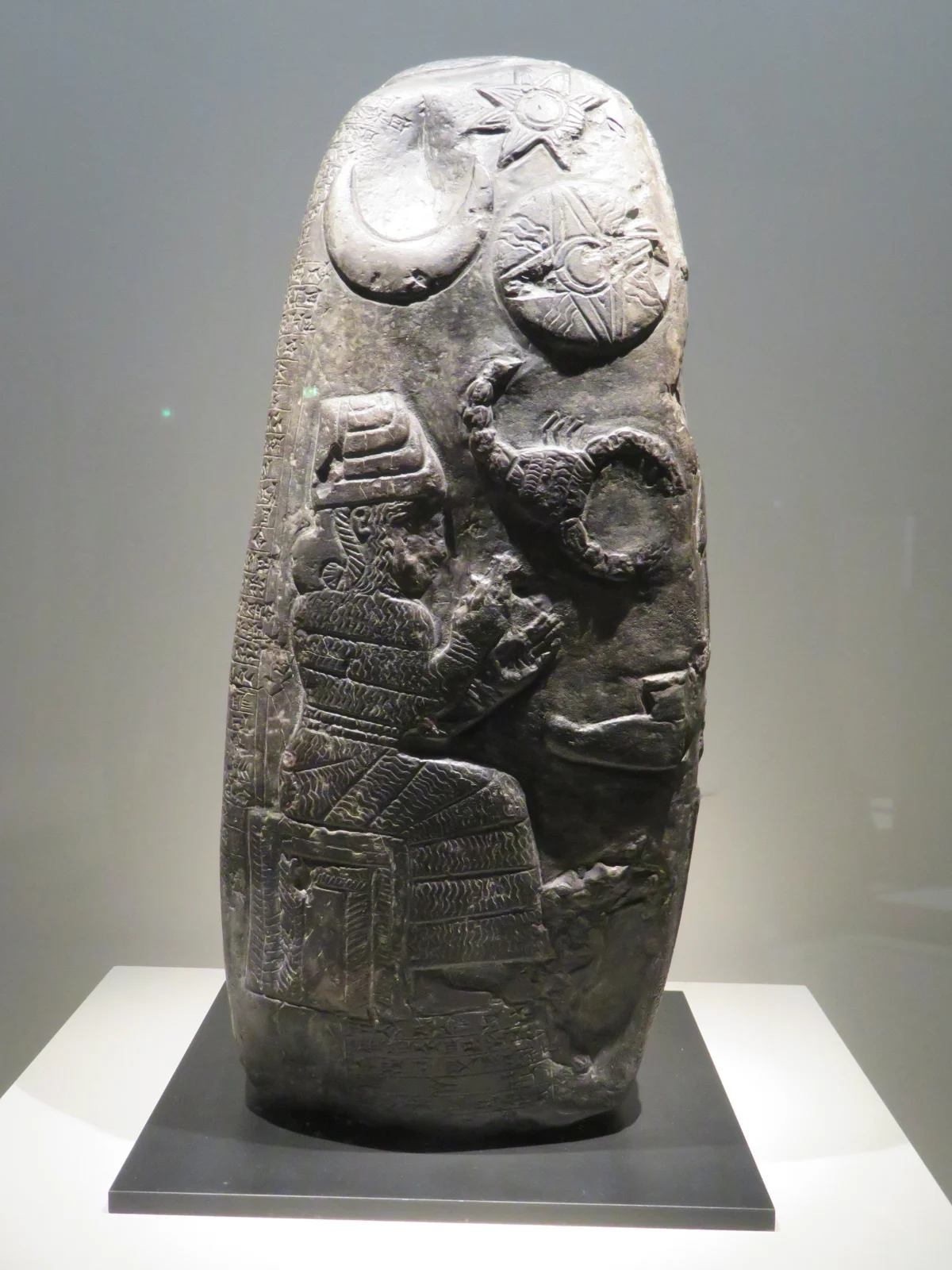
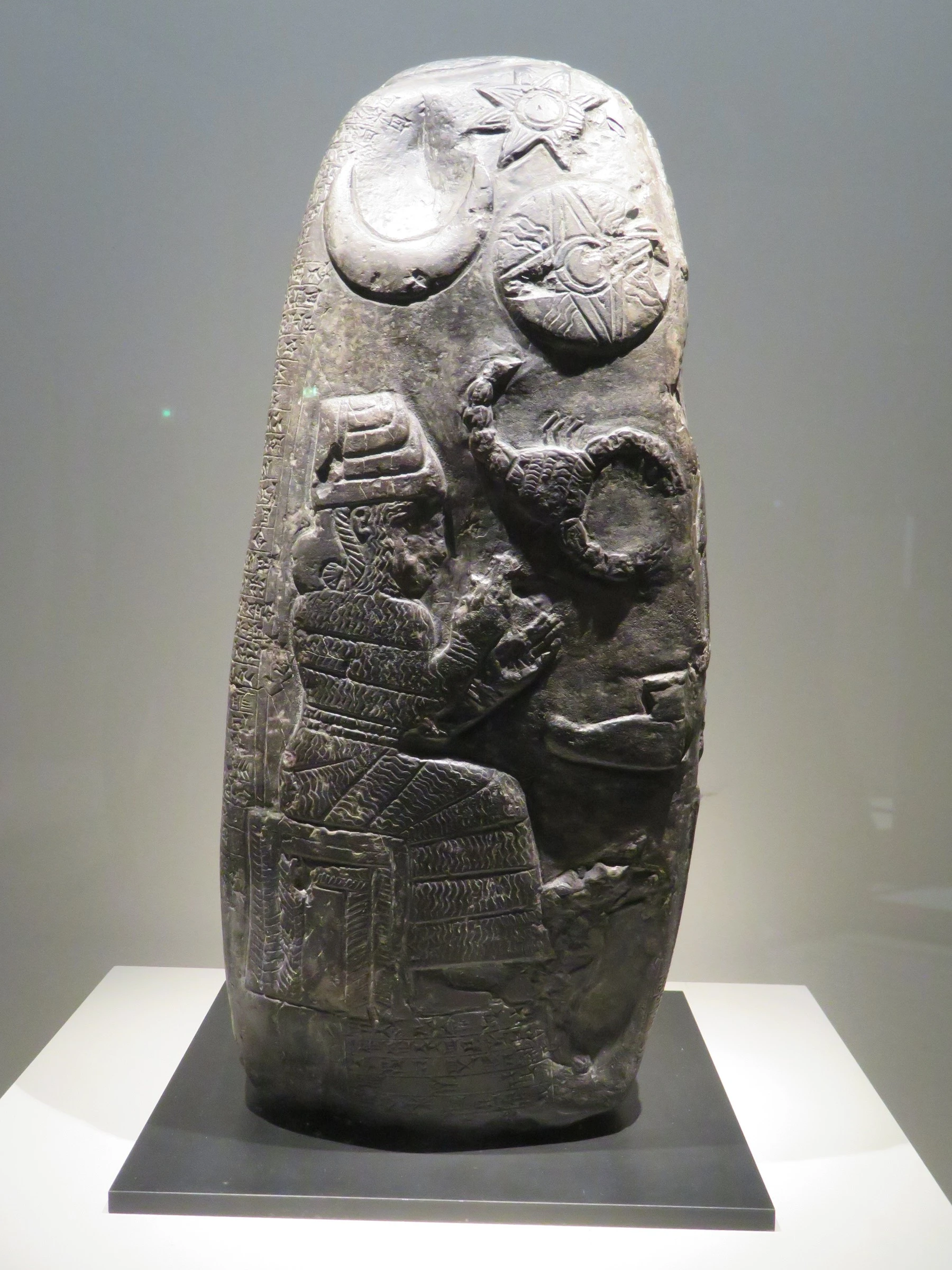
Moon, sun and star carved side by side as three separate signs at the top of the boundary stone of the Kassite king Nazi-Maruttash. Louvre, shown at the Grand Palais, Paris, in 2019. Boundary stone (kudurru) of the Kassite king Nazi-Maruttash, Louvre, shown in the exhibition Lune at the Grand Palais, Paris, 2019. Photo: Sukkoria, CC BY-SA 4.0 (creativecommons.org/licenses/by-sa/4.0), via Wikimedia Commons. Rotated upright and resized.
Sources
- Einfuehrungsszene, cylinder seal VA 243 (object record and photographs by Olaf M. Tessmer, 2011) Staatliche Museen zu Berlin, Vorderasiatisches Museum Primary record
- CDLI Seals 011438 (physical) (P478232), VA 00243 Cuneiform Digital Library Initiative Primary record
- Cylinder Seals: A Documentary Essay on the Art and Religion of the Ancient Near East (London, 1939) Henri Frankfort, Macmillan Primary record
- The Myth of a 12th Planet: A Brief Analysis of Cylinder Seal VA 243 (2003) Michael S. Heiser Study
- Planet X / Nibiru: An analysis of Akkadian Seal VA/243 (2013) Karel Donk Study
- Sumerian Cylinder Seal VA 243 (replica) Kenyon College, Art History Study Collection General reference
- Zecharia Sitchin (encyclopedia entry, read 2026) Wikipedia General reference
- The Pergamonmuseum returns: Opening on June 4th 2027 (4 May 2026) Staatliche Museen zu Berlin Primary record
- Uranus: Facts NASA Science Primary record
- Neptune: Facts NASA Science Primary record
- Pluto: Facts NASA Science Primary record
- Dingir (encyclopedia entry, read 2026) Wikipedia General reference