
The Missing Diary of Admiral Richard E. Byrd is a short text, sold as a booklet since the 1970s and copied across the internet since the 1990s, that presents itself as the admiral's secret record of a flight on 19 February 1947. In it Byrd flies north from an Arctic base, past the pole and over the rim of the world into a green land inside the earth, where he meets its rulers and is sent home with a message.
It reads like a log. Times down the left margin, the hum of two engines, the instruments checked one by one.
"0740 Hours- Note slight oil leak in starboard engine, oil pressure indicator seems normal, however."
Then the ice below gives way. A green valley where there should be snow. A shape on a ridge that looks, the text says, like a mammoth. The outside temperature reads 74 degrees. Ahead, a city.
A booklet from Missouri
The text is usually traced to a book of 1990, The Missing Diary of Admiral Richard E. Byrd, published by Abelard Productions. It is older than that.
The historian of hollow-earth ideas Walter Kafton-Minkel, in Subterranean Worlds (Loompanics, 1989), describes the man who sold it. "Captain Tawani Wakawa Shoush" led "an organization, based in rural Missouri, called the International Society for a Complete Earth," whose emblem was "the crest of the Thule Society: a sword in front of a swastika ringed with oak leaves." Shoush, Kafton-Minkel wrote, "sold copies of what he claimed was a suppressed diary kept by Admiral Byrd during his North Pole flight of 1947." The booklet carried "a preface by one 'Dr. William Bernard, D.D., Ph.D.'"
Shoush said, in a 1978 newspaper interview Kafton-Minkel cites, that the society's swastika was a "Nordic symbol" with nothing to do with the Nazis. Kafton-Minkel read the booklet and wrote to Shoush to ask whether the government had ever tried to check it. The answer came back: "the Government sent an Expedition, it was met and destroyed." He dates the exchange: "At that time (1978)." The booklet itself carries no date. Its title, in his bibliography: A Flight to the Land Beyond the North Pole, or, Is This the Missing Secret Diary of Admiral Richard Evelyn Byrd?
So the diary was in print by 1978, twelve years before the book usually named as its source.
The flight beyond the pole
The diary tells its story at full speed. "I must write this diary in secrecy and obscurity," it begins. "It concerns my Arctic flight of the nineteenth day of February in the year of Nineteen and Forty Seven."
The log is headed "BASE CAMP ARCTIC, 2/19/1947." The plane is airborne at 0610. By 1000 hours, "There should be no green valley below! Something is definitely wrong and abnormal here! We should be over Ice and Snow!" At 1130, "Ahead we spot what seems to be a city!!!!" Disc-shaped craft come up alongside, marked with what the text calls a swastika. A voice on the radio, in English "with what perhaps is a slight Nordic or Germanic accent," takes control of the plane and lands it.
Byrd is taken to "the Master," who tells him he is in "the domain of the Arianni, the Inner World of the Earth." The Arianni, the Master says, had sent their flying machines to the surface "just after your race exploded the first atomic bombs over Hiroshima and Nagasaki," and they have a warning for humanity. Byrd flies home. On 11 March 1947, the diary says, he reports it all at the Pentagon: "I am ORDERED TO REMAIN SILENT."
The last entry is dated December 1956, a few months before his death. "I have seen that land beyond the pole," it ends, "that center of the great unknown."
The text did not arrive from nowhere. Byrd really did fly "beyond the pole" in February 1947, and the newspapers said so. In 1959 the writer F. Amadeo Giannini printed, in Worlds Beyond the Poles, words he attributed to a Byrd radio announcement from an "arctic base" that February, with no source the researcher David Pratt could trace: "I'd like to see that land beyond the Pole. That area beyond the Pole is the center of the great unknown." That December Ray Palmer's magazine Flying Saucers took up the same words, and the writer Raymond Bernard built a book on them in 1964, The Hollow Earth. The diary reads like the story those writers told, given to the admiral in his own voice.
If the log were Byrd's
Set aside for a moment whether Byrd wrote it. Ask the larger question. What would it mean if he had?
It would mean the most famous polar explorer of his century flew through one of the openings Symmes had drawn in 1818, the holes at the poles told in Symmes's Circular and the Holes at the Poles, and came back alive.
It would mean the earth is not what the geologists say. There would be a lit, warm, inhabited world inside the planet, and every map ever drawn would show only the outside of it.
It would mean we share our planet with an older, more advanced people who have watched us since the first atomic bombs and chosen, so far, not to interfere. Our history since 1945 would have been lived under observation.
And it would leave a question that is still in front of us. If the admiral was ordered silent, his own papers and the Navy's would hold the trace: a flight plan, a radio log, an order. On this reading the most important record of the twentieth century is sitting in an archive, unread.
Where Byrd was on 19 February 1947
The standard account starts with the calendar. No dispatch dated 19 February itself was found for this investigation, but the press was with him on the days either side.
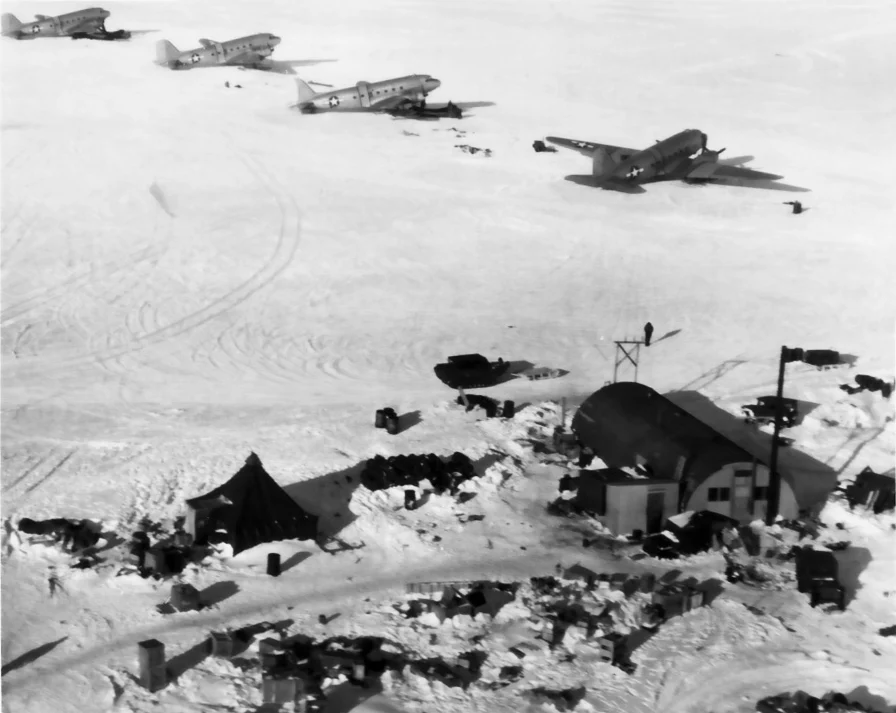
Byrd spent February 1947 in Antarctica, at Little America IV on the Bay of Whales, as officer in charge of Operation Highjump; the expedition is the subject of Admiral Byrd, Operation Highjump and the warning on page 23. Wire reports printed in Washington put him there day by day. On 14 February he flew within 170 miles of the South Pole and turned back, the Associated Press reported, "because of low oil pressure in one engine." He flew again, and early on Sunday 16 February two Navy transports "roared across the Pole at exactly 5 a. m. Little America time," then on 81 miles beyond it. "I believe that the limitless plateau extends beyond the Pole," Byrd said, "the biggest and highest in the world." The Washington Evening Star's correspondent wrote that he had continued "for a few miles into the complete unknown which lies beyond."
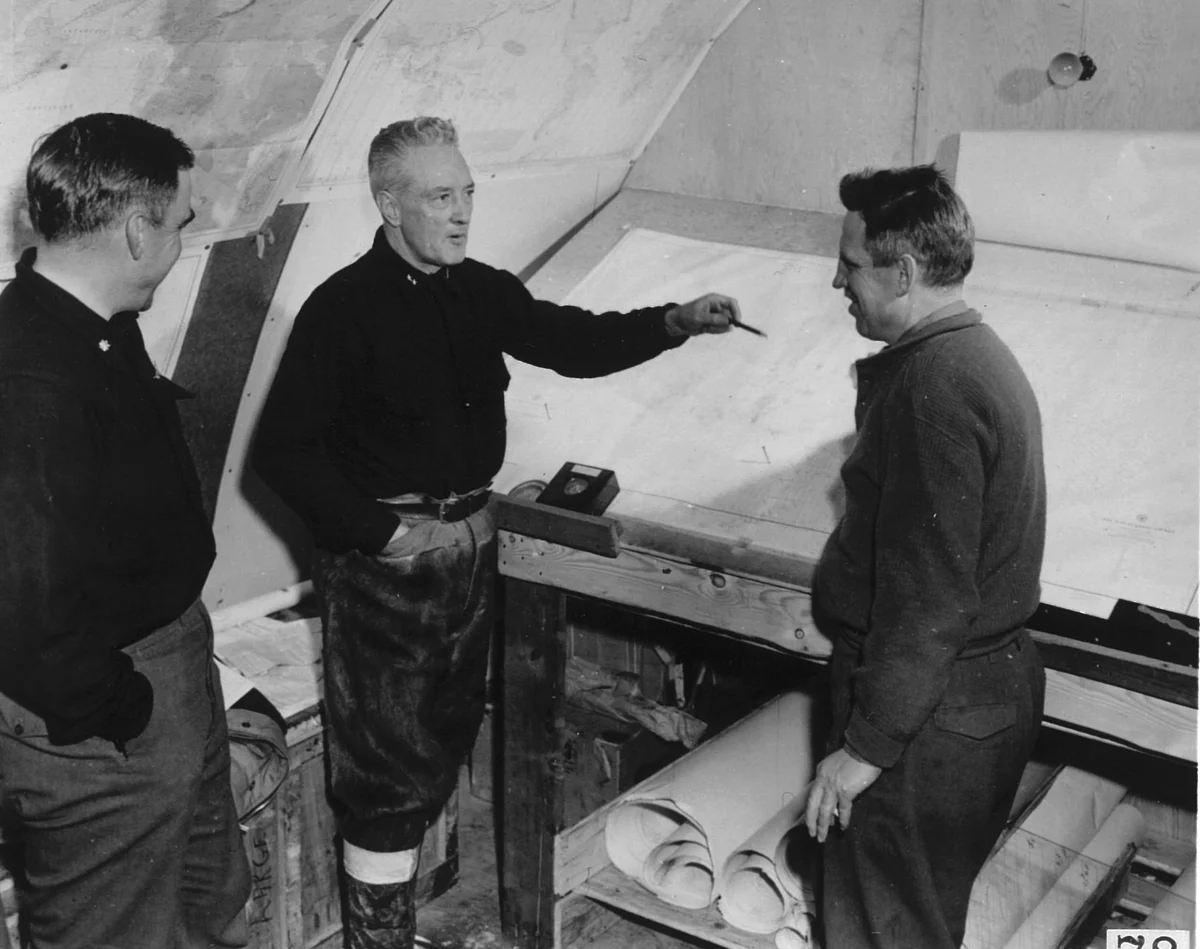
On 17 February he led a flag-raising at Little America. On 21 February the camp, "where 200 men in Army tents await evacuation," was struck by cold. On 22 February he ordered the base evacuated, and on 23 February he left aboard the icebreaker Burton Island. An Arctic flight on the 19th would have meant being near the North Pole, on the far side of the planet, two days after a flag-raising at the Bay of Whales and two days before a cold snap there. On 7 March, four days before the diary's Pentagon meeting, his flagship reached Wellington, New Zealand.
In 2017 Ohio State's archives, which hold Byrd's papers, wrote about hollow-earth theories in general that the Papers of Admiral Byrd "hold no evidence supporting" the idea that he flew into a polar opening.
What the record does not reach
The newspapers place Byrd. They do not say who wrote the diary.
Nobody has produced a manuscript. No handwritten page, no typescript, no library, no chain of custody has been offered by anyone who has published the text, on either side. The Hollow Earth Research Society says only that its director received it "by Ritter von X in 1984," six years after Kafton-Minkel was already reading it.
The booklet's own preface is signed by a "Dr. William Bernard," a name close to Raymond Bernard's, who had died in 1965. Kafton-Minkel thought the real author of that preface was a "Wilhelm Bernhardt" in Shoush's own circle. Whether Shoush wrote the diary himself, or bought or copied it from someone else, is not known.
And one dispatch is missing. No wire story dated 19 February itself has turned up in the archives searched for this investigation; the record runs from 17 February to 21 February, both at Little America. The gap is two days wide, and the camp was waiting on the ice for its ships.
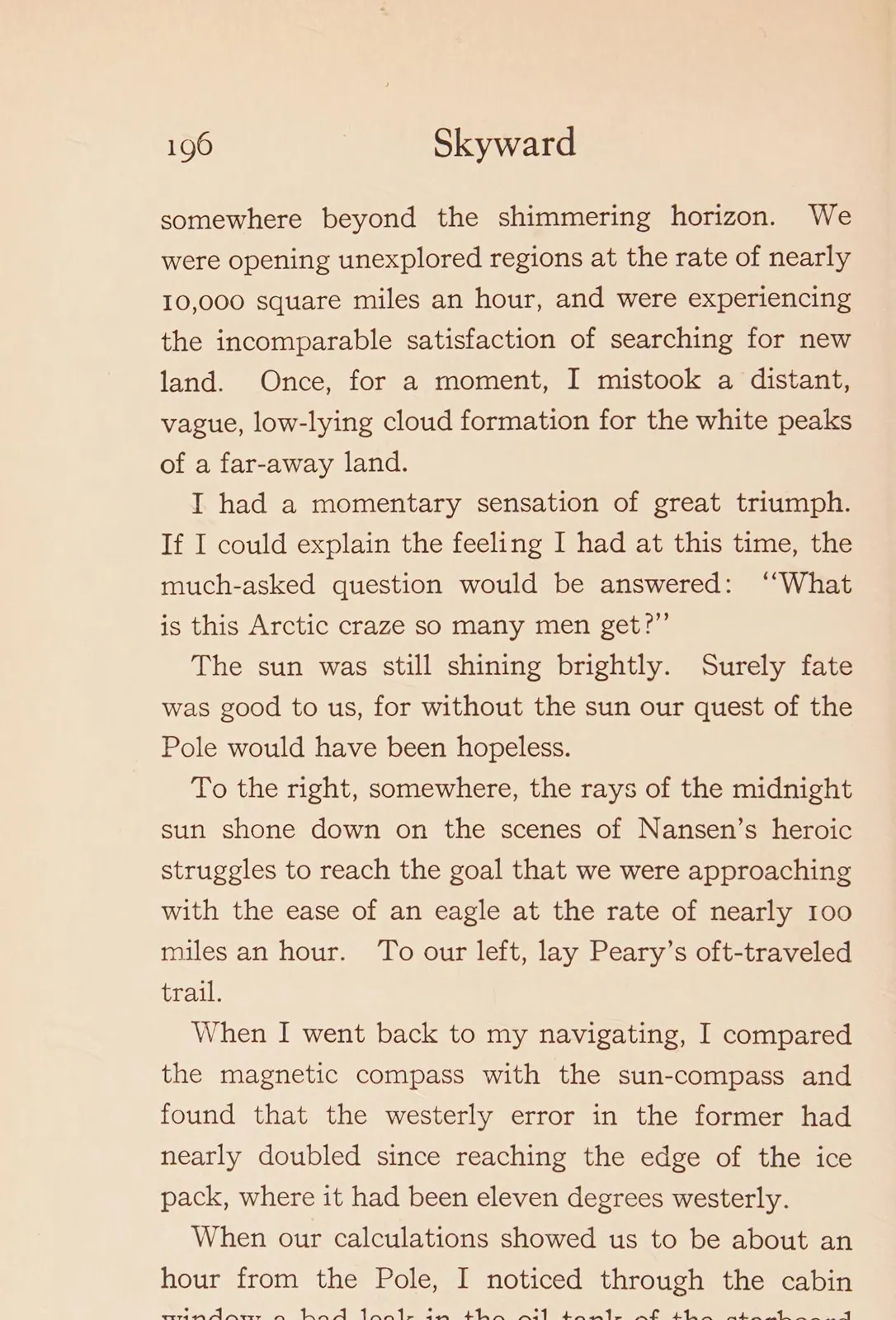
And the text itself carries echoes that a careful reader can weigh. Its oil leak in the starboard engine, with the oil-pressure indicator watched, resembles Byrd's account of his 1926 North Pole flight in Skyward (1928): "a bad leak in the oil tank of the starboard motor," and "I kept my eyes glued on that oil leak and the oil-pressure indicator"; and his real plane did turn back for low oil pressure on 14 February 1947. Its last line closely matches the words Giannini printed in 1959. A 1956 entry speaks of "the monstrous military industrial complex," a phrase that reached the public through President Eisenhower's farewell address of January 1961. Each is consistent with a later writer working from these; none, alone, shows which way the borrowing went.
A text without a page
The diary has outlived its seller. It has been reprinted, translated into German and quoted as Byrd's own words by people who never saw the booklet. It is short, vivid and written in the first person, and it answers a question many readers already had: what did the admiral mean by the land beyond the pole?
The record gives another answer. The land past the pole that Byrd described to reporters that February was the ice beyond the South Pole, a plateau he called "the biggest and highest in the world," flown over early on 16 February 1947.
What the diary needs, and has never been shown with, is a page. One sheet in Byrd's hand, or a typescript from his office, with a history of where it has been since 1947. The admiral's papers are in a public archive in Ohio, box by box, with his radiograms and the expedition's records. A page like that would not prove a flight by itself, but it would show the words were his.
Questions This Leaves You With
Is there anything a person actually does with this?
Not with your own life, honestly. The diary's warning has no date and asks nothing of you, and anyone who sells you urgency about it is selling something. The larger question is how a text without an author becomes, over forty years, a famous man's own words. That happens in every field, and it is not yours alone to answer. What you can do is ask, of any document you are shown, where the original is.
Does this sit against a religious account of the world?
It can be read both ways, and serious people have read it both ways. Some readers hear in the diary's wise Master and its warning to humanity an echo of older stories of hidden teachers. Others, with equal faith, find nothing in it that touches what they believe, and some are troubled by its swastikas. This site will not tell you which way it falls for you. The diary itself is a story about a flight, and it can be tested as one.
Does this change what a human life is?
Hold your own life against the scale of this story: a man who flew to both ends of the earth, and a text that now speaks for him decades after his death. One way of seeing it makes a life smaller; anyone's words can be written over. The other makes it larger; his real flights, logged and photographed, are still there to be checked by anyone who looks. Which did you feel?
What would change your mind, in either direction?
Name it now, before you are committed, because it is harder later. Toward the diary: a manuscript or typescript traced back to Byrd's office or family, on paper and in ink of the period, matching an entry in his orders or radio log for an Arctic flight that winter. Toward the standard account: Highjump's daily flight records and the ships' logs for 17 to 21 February 1947, showing where each aircraft was, alongside the wire reports already in hand. Notice that both are documents in archives, not arguments.
Who wrote it?
This is the real gap. By 1978 a booklet was on sale in Missouri; its preface carried the name "Dr. William Bernard," which Kafton-Minkel took to be a pen name of a Wilhelm Bernhardt who wrote for a magazine called Search; and nobody has said where the text came from before that. Shoush is the first known seller, not a proven author. Between Giannini's book of 1959, if the diary does echo it, and the Missouri booklet of 1978, someone wrote this text. Their name is not in the record.
Sources
- Secret Diary of Admiral Byrd? (online copy with 1995 forwards) V-J Enterprises Primary record
- Subterranean Worlds (Loompanics, 1989), pp. 238-240 Walter Kafton-Minkel; catalogue record, Open Library Study
- Evening Star (Washington), 15 February 1947, p. A-5 (AP) Library of Congress, Chronicling America Primary record
- Washington Daily News, 18 February 1947, p. 4 Library of Congress, Chronicling America Primary record
- Evening Star (Washington), 17 February 1947, p. A-1 Thomas R. Henry; Library of Congress, Chronicling America Primary record
- Evening Star (Washington), 19 February 1947, p. A-12 (AP) Library of Congress, Chronicling America Primary record
- Evening Star (Washington), 21 February 1947, p. A-7 Thomas R. Henry; Library of Congress, Chronicling America Primary record
- Wilmington Morning Star, 24 February 1947, p. 1 (UP) Library of Congress, Chronicling America Primary record
- Evening Star (Washington), 25 February 1947, p. A-3 (AP) Library of Congress, Chronicling America Primary record
- Skyward (1928), pp. 196-197 Richard E. Byrd, G. P. Putnam's Sons; Internet Archive Primary record
- Hollow-earth theories, part 3 (2001, revised 2016) David Pratt Study
- Frozen Fridays: 'Q' is for Questionable Theories! (2017) John Hooton, Ohio State University Archives Study
- Operation Highjump, 1946-47, Byrd Papers finding aid Ohio State University Libraries Primary record
- President Dwight D. Eisenhower's Farewell Address (1961) National Archives Primary record
- Operation Highjump, Evening Post (Wellington), 7 March 1947 Papers Past, National Library of New Zealand Primary record
- Adm. Byrd's Diary Hollow Earth Research Society Primary record