
The Nazca lines are hundreds of figures, straight lines and long trapezoids scraped into the desert of southern Peru, most of them made between about 500 BC and AD 500. Some are animals, a hummingbird, a monkey, a spider. Many are lines running for kilometres. In 1968 Erich von Daniken wrote that, seen from the air, the plain gave him the impression of an airfield. The "runway" has been part of the story ever since.
The ground is dark. Stones coated in rust-coloured iron oxide lie across the pampa in a thin skin. Lift them away, a hand's depth or less, and the paler earth beneath shows through.
That is all a line is. A path where the dark stones were moved aside.
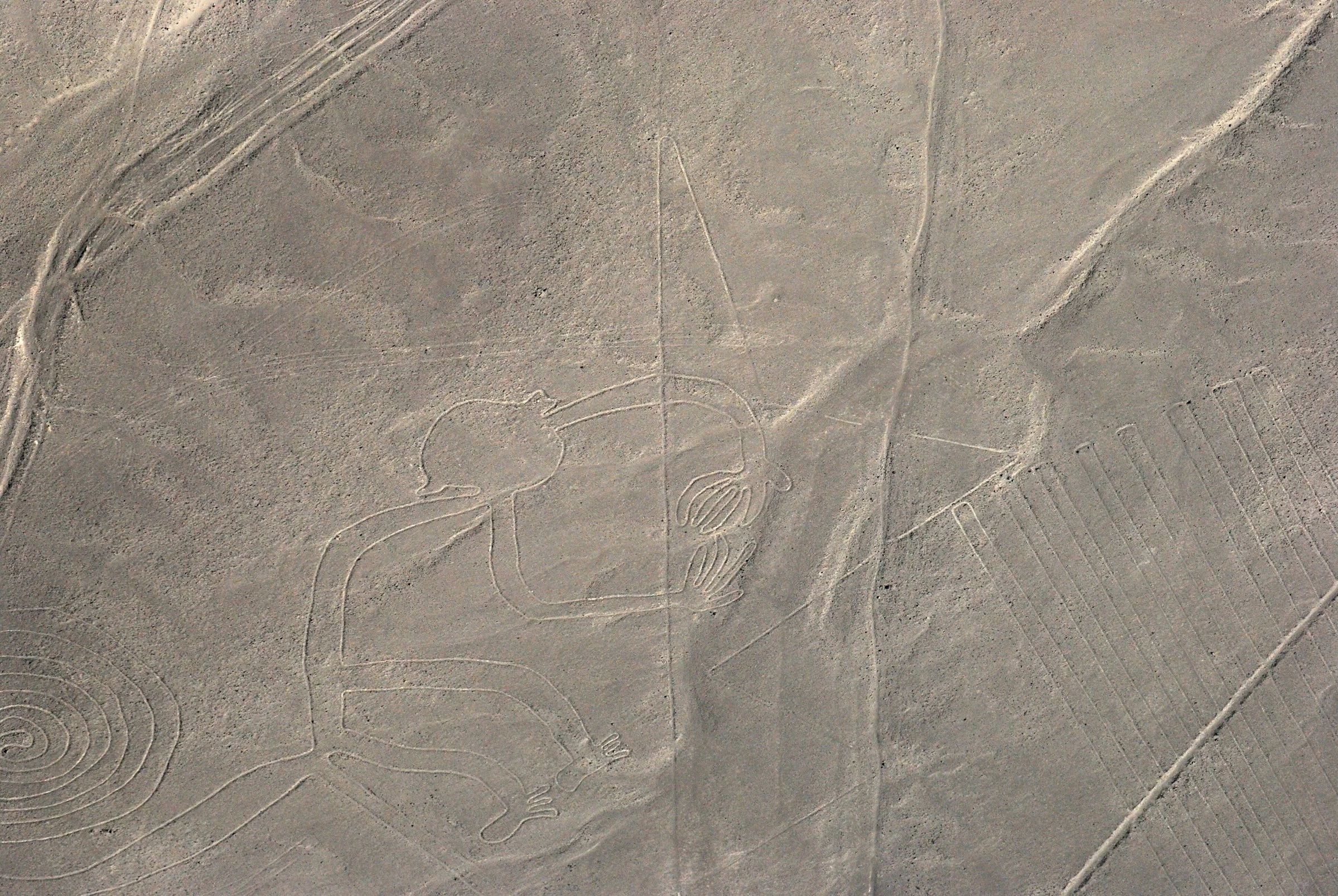
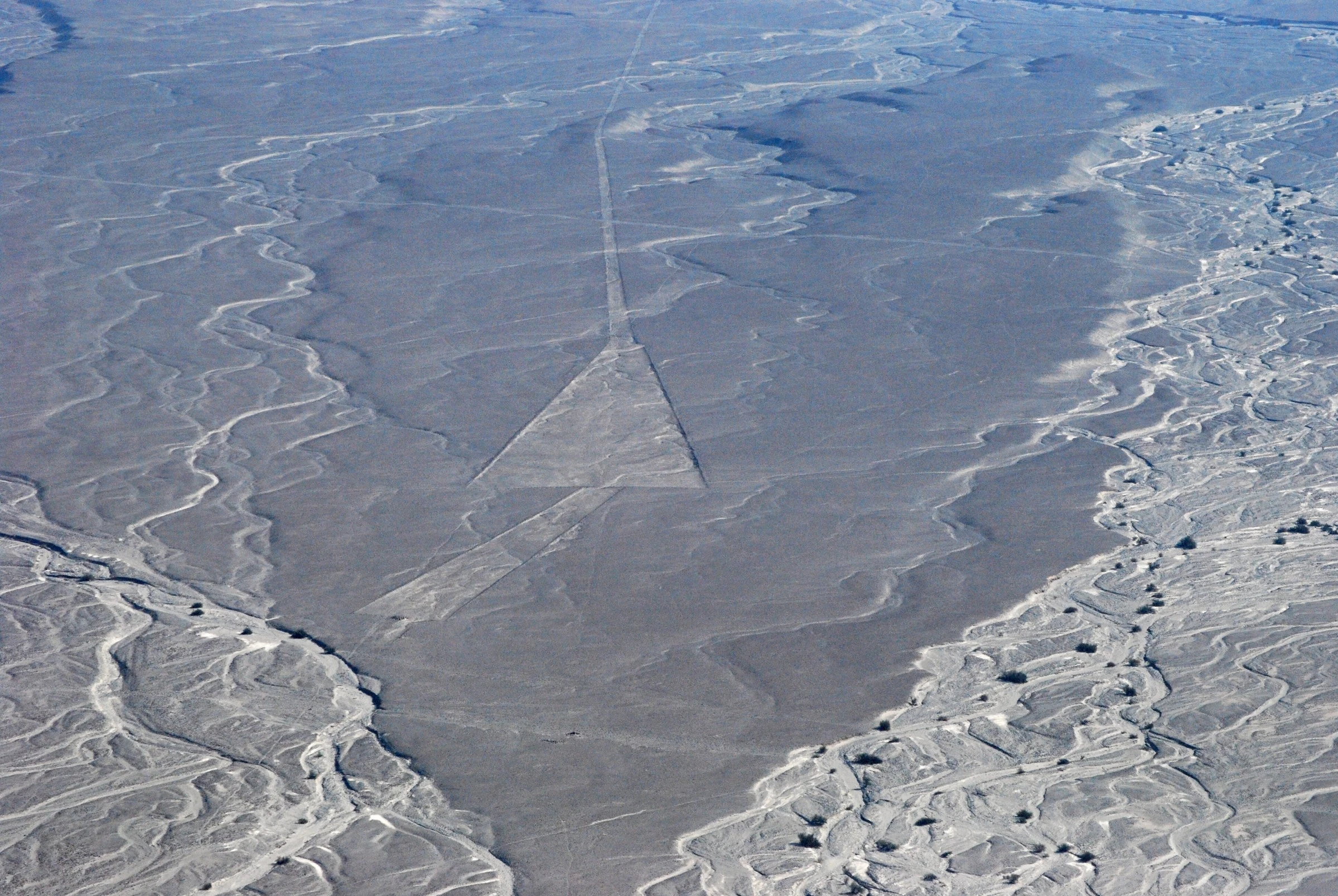
From the ground the lines are tracks across the desert. From the air they become something else: a hummingbird nearly a hundred metres from beak to tail, a monkey with a spiral tail, and broad cleared strips running straight to the horizon, side by side, which von Daniken read as runways.
Straight, cleared, and from the air strikingly regular.
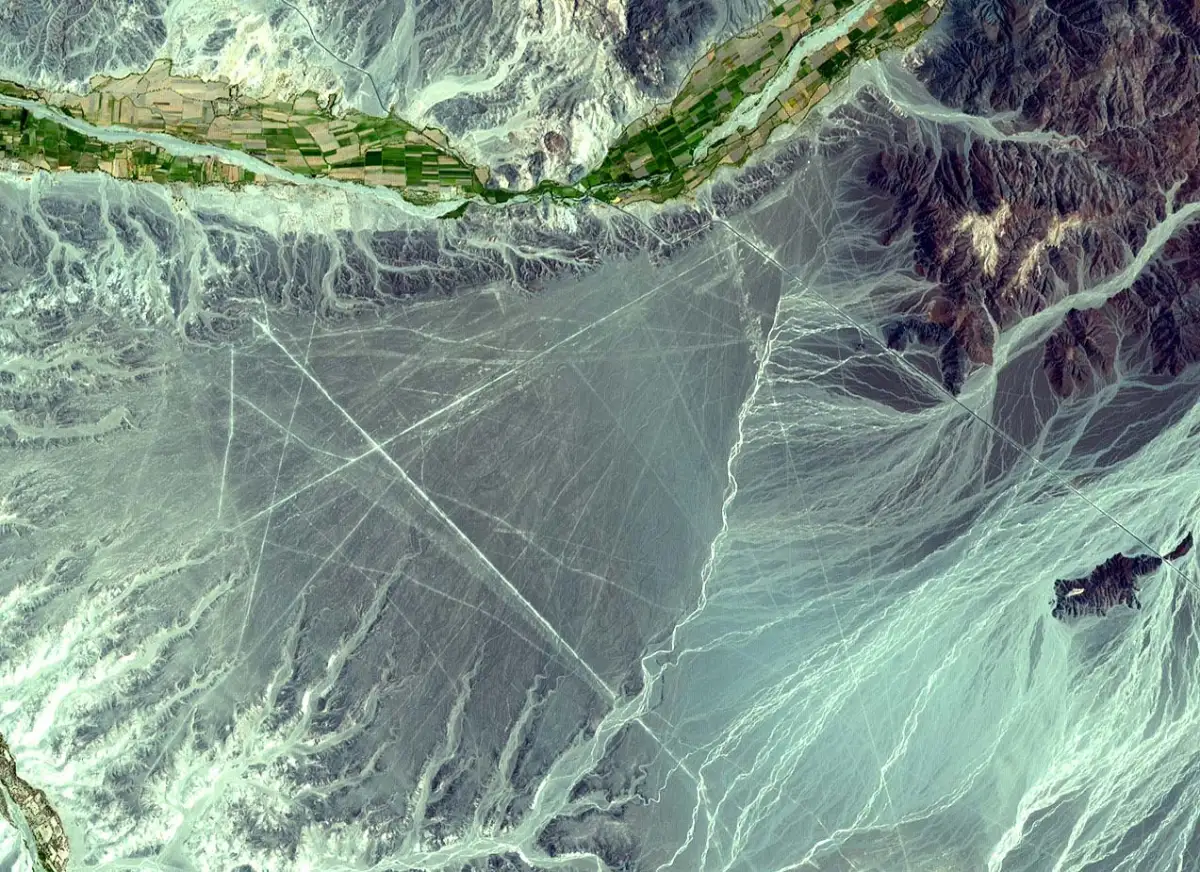
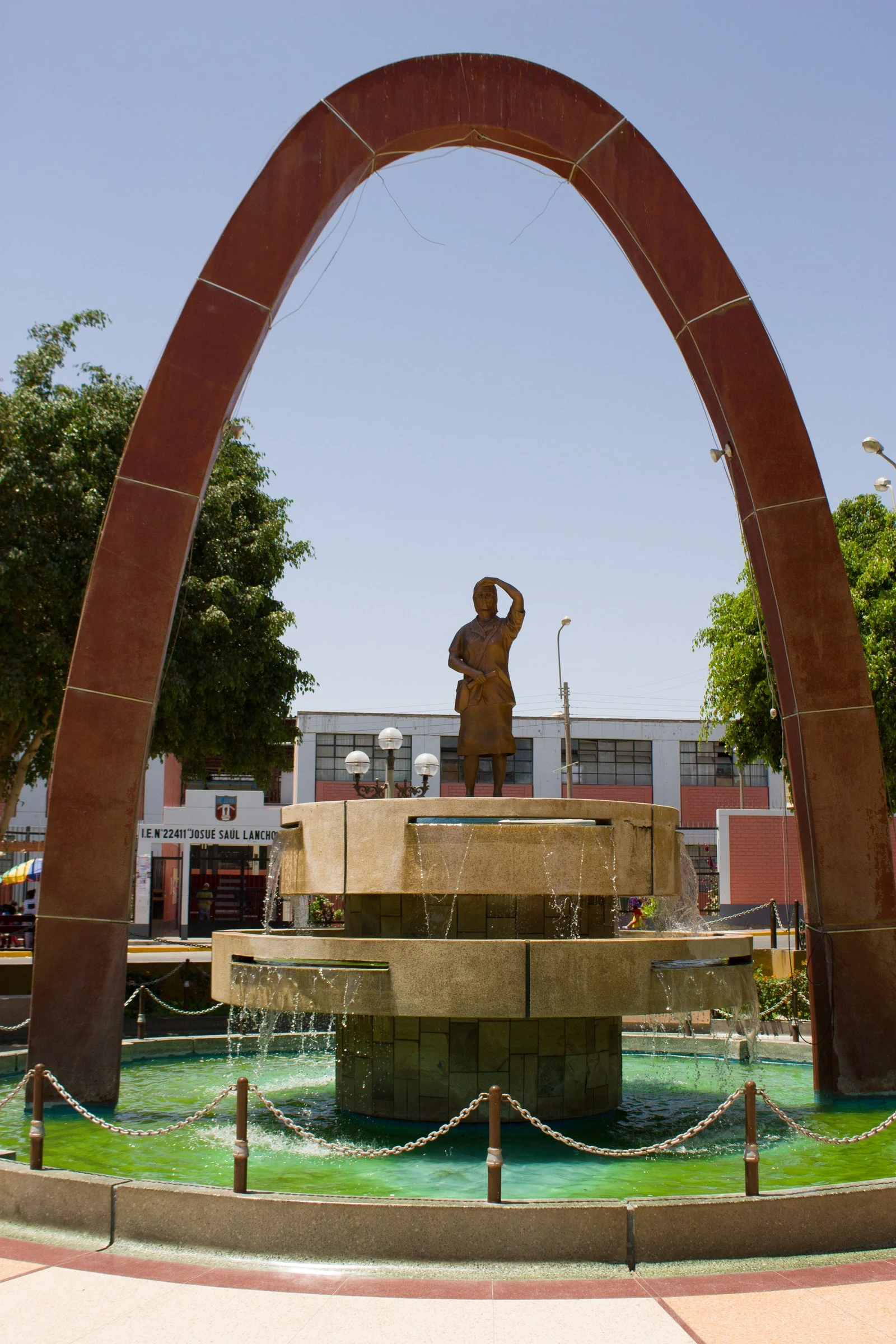
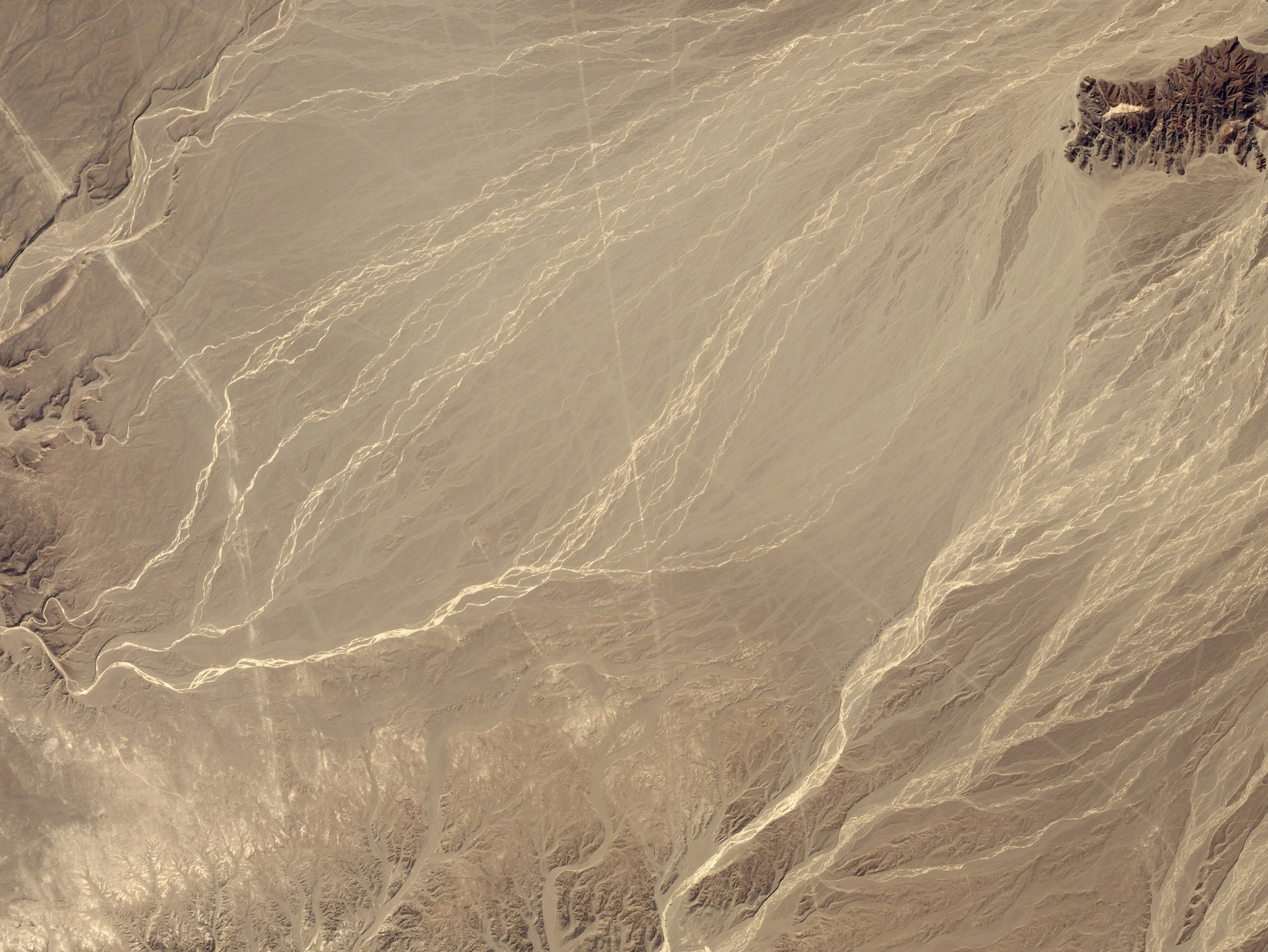
The plain from the air
The lines were first reported by Peruvian pilots and archaeologists in the 1920s; the archaeologist Toribio Mejia Xesspe saw them in 1926 or 1927. Paul Kosok of Long Island University studied them in 1940 and 1941, and on 22 June 1941, the southern winter solstice, watched the sun set almost exactly at the end of one long line. He called the pampa the greatest astronomy book in the world.
Maria Reiche, a German who had come to Peru in 1932 as a governess, joined the work at Kosok's request in the mid-1940s and stayed with the lines alone, for the rest of her life, measuring and mapping them, until her death in Lima in 1998. In 1994 UNESCO listed the lines as a World Heritage Site; the protected area now covers more than 75,000 hectares.
The figures are large. The hummingbird is about 93 metres long, the condor about 134. The monkey is about 93 metres by 58. The straight lines run for kilometres and the trapezoids are hundreds of metres long. All of it was made by removing stones.
Kosok recorded something else. Writing in Natural History magazine in 1947, he noted that when first seen from the air the lines "were nicknamed prehistoric landing fields."
An airfield in the desert
Erich von Daniken made the nickname a thesis. In Chariots of the Gods?, published in German in 1968 and in English in 1969 and 1970, he described the plain and then wrote: "Seen from the air, the clear-cut impression that the 37-mile-long plain of Nazca made on me was that of an airfield!"
He did not leave it at an impression. The archaeologists, he wrote, said the lines were Inca roads: "A preposterous idea!" He asked "what can have induced the pre-Inca peoples to build the fantastic lines, the landing strips, at Nazca?" and offered an answer as a question: "What is wrong with the idea that the lines were laid out to say to the 'gods': 'Land here! Everything has been prepared as you ordered'?"
The book carried a photograph of one marking, captioned: "This is very reminiscent of the aircraft parking areas in a modern airport."
He was careful in one sentence: "It is not yet possible to say with certainty whether the plain of Nazca was ever an airfield." The reading did not need certainty to travel. Chariots of the Gods? sold in the millions, and the Nazca runway became one of its most famous images, returned to in his later book Arrival of the Gods in 1998, and in documentaries ever since, beside other readings of ancient visitors such as Zecharia Sitchin's Twelfth Planet. This site has followed his reading of the Palenque lid, the other image the book made famous.
The core of the argument is simple and strong. The figures are enormous, and they are best seen from above. On von Daniken's reading, a people with no flight drew for an audience in the sky.
If the plain was an airfield
Set aside for a moment whether it is true. Ask the better question. What kind of past are we living in, if it is?
It would mean, first, that the Nazca people knew something flew, and that they prepared the ground for it with the care the figures show: the straight edges, the cleared strips, the signs.
It would mean that the people of the Peruvian coast two thousand years ago had seen craft that could land, and organised their labour around them for generations.
It would mean something about us. If visitors came and were waited for, then the history of our species includes a long relationship with someone else, and the earth itself carries the marks of it, scraped into a desert where it never rains.
And it would leave one question in front of us. The figures are still being found, 303 in a single survey in 2024. If the plain was prepared for someone, what else made for the same eyes is still lying under the stones?
Stones on soft ground
The standard account begins with the ground. The lines are clearings, centimetres deep, in loose desert soil. In a 1975 National Geographic article by Loren McIntyre, Reiche's answer to the airfield was quoted, and the investigator Joe Nickell later repeated it: "I'm afraid the spacemen would have gotten stuck."
The photograph is smaller than it looks. The investigator Jim Woodman, in a 1977 book, identified the "parking area" in Chariots of the Gods? as a cropped view of the knee joint of one of the bird figures, and PBS's NOVA put the pattern at about 20 feet across, "too small to serve as a parking space for just about any kind of aircraft."
The making needs no flight. In August 1982 Nickell and five helpers laid out a full-size copy of the condor, 440 feet long, in a Kentucky field in about nine hours, with stakes, cord and a wooden T, and photographed it from the air. Archaeologists date the lines by the Nazca pottery on and beside them, as Helaine Silverman and David Browne did in the journal Antiquity in 1991, and the same animals appear painted on Nazca pots.
On purpose, there are several readings and no single answer. Kosok and Reiche read astronomy; the astronomer Gerald Hawkins tested it in 1968-69 and found no support for a general astronomical calendar, though some lines fell at solar and lunar extremes more often than chance. Anthony Aveni and Gary Urton found lines radiating from centres and tied to water. The anthropologist Johan Reinhard tied them to the worship of mountains and water. Aveni and others read many as paths, walked in procession.
What the account does not reach
The standard account answers the airfield. It does not answer every question the plain asks.
The trapezoids, the long cleared strips that look most like runways, have no single agreed purpose. Ritual paths, water, astronomy: each explains some lines and not others.
The figures are best seen from above, and the people who made them could not fly, so far as anyone knows. Woodman and the British balloonist Julian Nott flew over the plain in a balloon built from materials the Nazca could have had, to make the point that they might have. No evidence that the Nazca flew has been found.
The dating rests mostly on what lies near the lines, not on the clearings themselves, which hold little to date.
And the count keeps rising. A team led by Masato Sakai of Yamagata University, working with IBM researchers, reported in PNAS in 2024 that an AI-assisted survey had found 303 new figurative geoglyphs in six months, nearly doubling the 430 known. Most of the new figures are small, about nine metres on average, set beside ancient trails where small groups would see them from the ground. The great line figures, they suggest, were walked in community rituals. That answers the view-from-above question for the small figures. For the big ones it is a proposal.
Where it stands
The plain is still giving up figures. Archaeology magazine, reporting the 2024 survey, counted the rate: about 1.5 new figures a year from the 1940s to the early 2000s, about 18.7 a year from 2004 to 2020, and then 303 in a single study.
The lines are also fragile. In 2014 Greenpeace activists placed a banner inside a geoglyph during a climate protest; in 2018 a truck driver damaged three geoglyphs. A surface centimetres deep does not forgive.
Von Daniken's sentence is still the most quoted thing ever written about the place. The ground under it is still soft.
A hummingbird nearly a hundred metres long. A strip of cleared stone that runs to the horizon. And, so far as anyone knows, no one who flew.
Questions This Leaves You With
Is there anything a person actually does with this?
Not much, in a practical sense, and it is worth admitting. The lines are two thousand years old and predict nothing. No date or warning can honestly be read from them. What you can do is look: aerial photographs and satellite images of the pampa are freely available, and you can put a "runway" beside a hummingbird and decide for yourself what kind of ground each one is. You can also learn how a line is made, which you could do in a field yourself with a cord and some stakes.
Does this sit against a religious account of the world?
It cuts both ways. Most archaeologists read the lines as religious works themselves, made for gods of water and mountain, walked in ritual. Von Daniken read the "gods" as visitors, which some take as an explanation of religion and others as a challenge to it. Both readings put something sacred on the plain; they disagree on what it was. Where that leaves your own faith is for you to decide. This site will not tell you.
Does this change what a human life is?
People with no machines, over centuries, moved stones by hand to draw animals so large they are hard to see whole from the ground. That is either a sign they had help, or a sign of what patient people will do for something they believe in. You might find the plain humbling, a reminder of how much we do not know. Or you might find it the opposite: proof of what ordinary hands can make. Which one did you feel?
What would change your mind, in either direction?
Name it now, before you are committed. Toward the airfield: anything left on the plain that the Nazca could not have made, an object or a material out of place in the first millennium. Toward the standard reading: more trapezoids excavated and dated, with offerings or pottery showing their use in ritual, or a Nazca image of the lines being walked. Archaeologists working at Palpa and Nazca have excavated geoglyph sites; the question is what more digging finds. On the record so far, the evidence favours the lines as Nazca work for Nazca purposes; what remains open is what those purposes were.
What were the trapezoids for?
This is the real gap. The animals have proposals, and the 2024 survey gave the small figures a convincing setting beside the paths. The long trapezoids, the strips that made von Daniken think of runways, still have no agreed function. They are the largest things on the plain and the least explained. Until excavations tell more about what happened on them, the question stands where Kosok and Reiche left it, out on the stones.
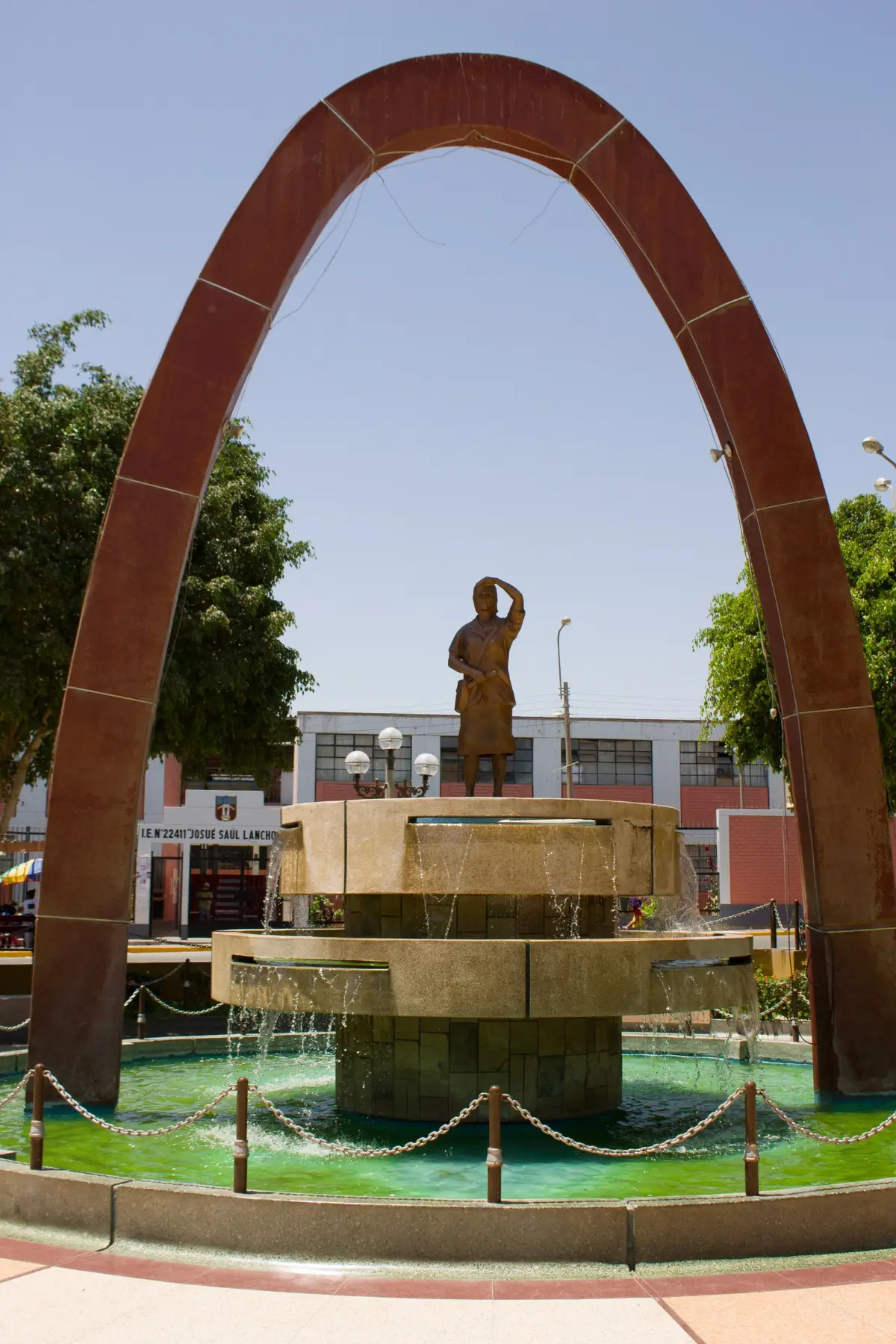
The statue of Maria Reiche in Nasca. She mapped the lines from the mid-1940s until her death in 1998. Statue of Maria Reiche, Nasca. Photo: Kevo287, CC BY-SA 4.0 (creativecommons.org/licenses/by-sa/4.0), via Wikimedia Commons. Resized. 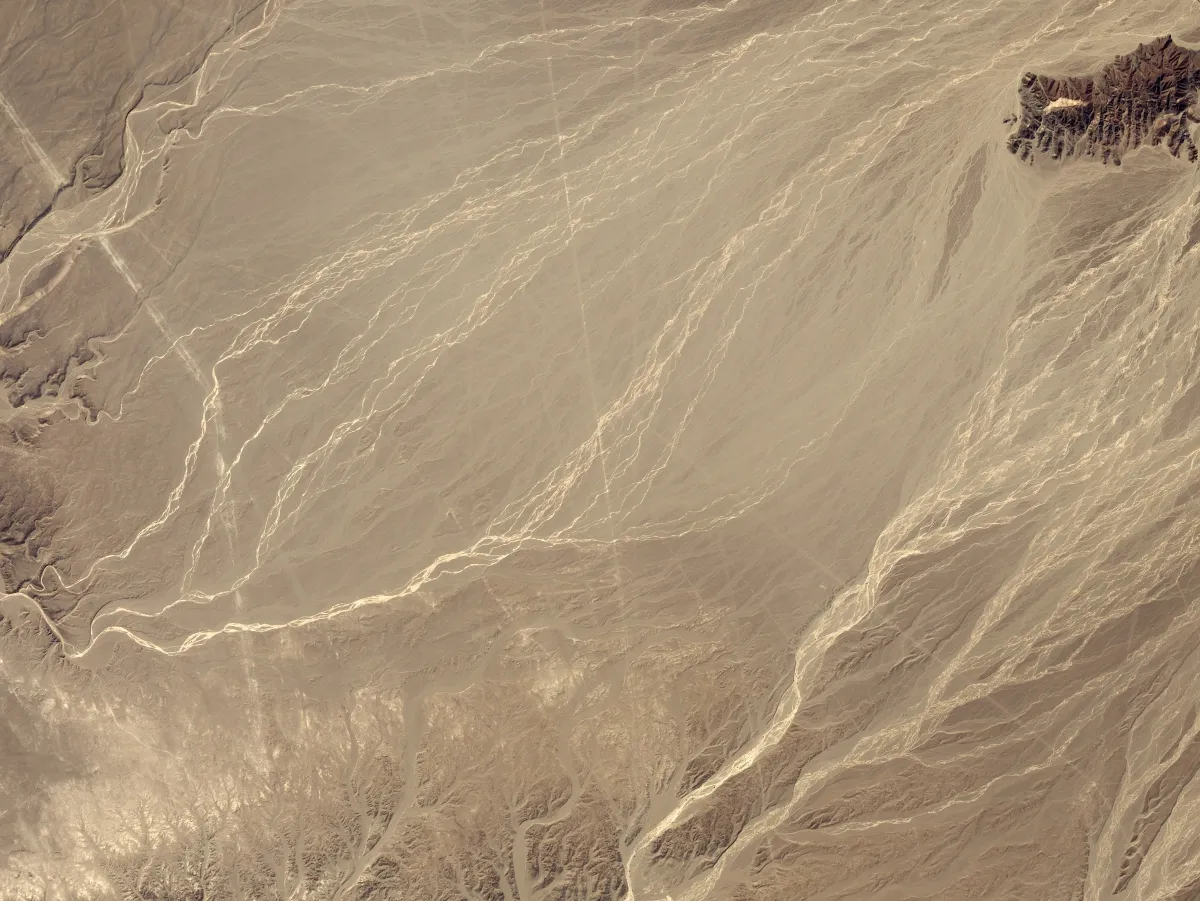
The Nazca pampa from orbit in 2016. Nazca Lines, Peru, 2 June 2016. Planet Labs, Inc., CC BY-SA 4.0 (creativecommons.org/licenses/by-sa/4.0), via Wikimedia Commons. Resized.
Sources
- Chariots of the Gods? (Bantam edition, 1971; complete text of the 1970 hardback) Erich von Daniken Primary record
- The Nazca Lines Revisited: Creation of a Full-Sized Duplicate (Skeptical Inquirer, 1983) Joe Nickell Study
- Alien Evidence? (1996) PBS NOVA / WGBH Study
- History of research Dr. Maria Reiche association / HTW Dresden Study
- Nazca lines (encyclopedia entry, read 2026) Wikipedia General reference
- Maria Reiche (encyclopedia entry, read 2026) Wikipedia General reference
- AI-accelerated Nazca survey nearly doubles the number of known figurative geoglyphs and sheds light on their purpose (PNAS 121(40), 2024) Masato Sakai et al. Primary record
- Nazca Ghost Glyphs (January/February 2025) Eric A. Powell, Archaeology Study
- New evidence for the date of the Nazca lines (Antiquity 65, 1991) Helaine Silverman and David Browne Study