
Roman concrete is the building material that made the Pantheon in Rome, the harbour piers of the Bay of Naples and thousands of Roman walls, vaults and breakwaters still standing two thousand years later. It was a mix of lime, volcanic ash and broken stone, and in seawater it did something modern concrete does not: it grew stronger.
The dome of the Pantheon is the proof everyone points to. About 43 metres across, with a round opening at the top about nine metres wide, it has stood since around 126 AD with no steel inside it at all. Rain falls through the hole onto the floor. The concrete overhead has held for nineteen centuries.
Look closely at a broken piece of Roman concrete and there are white specks in it. Millimetre-scale lumps of lime, scattered all through the mortar.
For a long time those lumps were taken for a mistake.
In January 2023 a team at the Massachusetts Institute of Technology argued they were the secret.
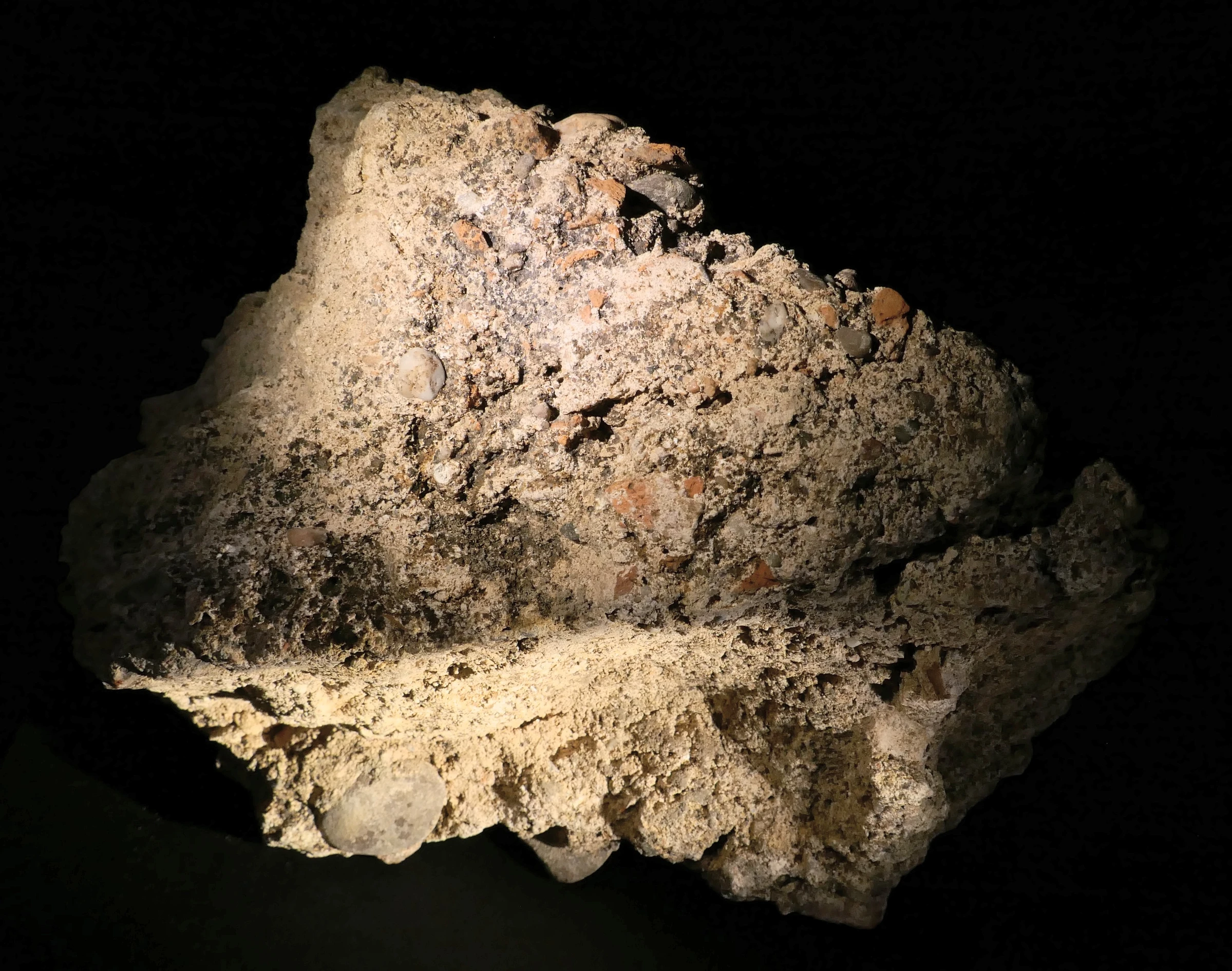
White lumps in a city wall
The samples came from the city wall of Privernum, a Roman town near Rome, by the modern Priverno. Linda Seymour, Admir Masic and their colleagues at MIT, with partners in Italy, Switzerland and at Harvard, took them apart with every instrument they had: electron microscopy and elemental mapping, X-ray diffraction, Raman spectroscopy. They published in Science Advances on 6 January 2023, under the title "Hot mixing: Mechanistic insights into the durability of ancient Roman concrete."
"Ever since I first began working with ancient Roman concrete, I've always been fascinated by these features," Masic told MIT News. "These are not found in modern concrete formulations, so why are they present in these ancient materials?"
The lumps turned out to be mostly calcite, a form of calcium carbonate, porous and cracked inside. The team read the cracks as a signature, and said so as an inference: the kind of damage done when quicklime, lime that has been burned but not yet wetted, reacts with water and heats up. The Romans, on this reading, did not only slake their lime in water first and then mix it, as the usual reading of Vitruvius has it. They threw quicklime straight into the mix. The paper's words: "compelling evidence for hot mixing of Roman mortar using quicklime instead of, or in addition to, slaked lime".
Then the test. The team made modern concrete, ordinary Portland cement with fly ash and sand, added quicklime to some batches, cured the cylinders, cracked them, and set the halves about half a millimetre apart. They ran water through the cracks for 30 days. Through cracks in the quicklime samples the flow, between 10 and 30 litres an hour at the start, fell over one to three weeks to almost nothing. Calcium had come out of the lumps and filled the crack with calcite.
The control samples, without the lumps, went on leaking.
Concrete that heals itself
The idea that came out of MIT is simple and striking. The lumps are reservoirs. When a crack opens and water gets in, it reaches a lump, dissolves calcium, and the calcium crystallises again as calcite, sealing the crack. Masic, describing the Pompeii work in 2025: "This material can heal itself over thousands of years, it is reactive, and it is highly dynamic."
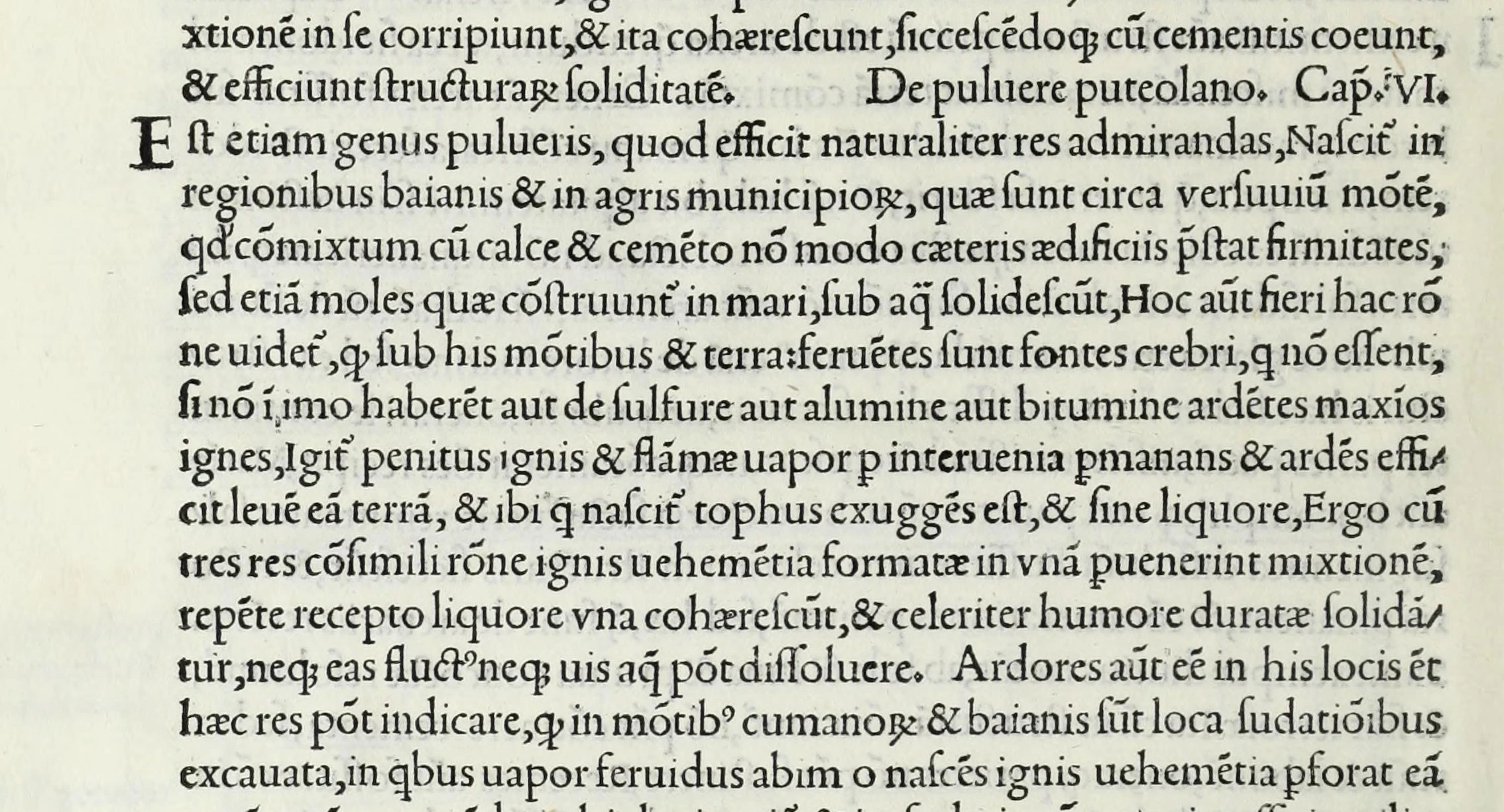
The Romans had written about something like it. Vitruvius, the architect who wrote On Architecture in the first century BC, described a powder from around Baiae and Mount Vesuvius that, mixed with lime and rubble, made piers that "set hard under water", and said that when the burned materials are suddenly soaked, "there is an effervescence of the heat latent in the bodies of them all." Pliny the Elder, who died in the eruption of 79 AD, wrote of the dust of the hills about Puteoli "becoming changed into stone the moment of its immersion, and increasing in hardness from day to day."
In December 2025 Masic's group went further. At Pompeii, in a house that was being repaired and renovated when Vesuvius buried it in 79 AD, the archaeologists had found a building site frozen in mid-work: tools, piles of rubble, and heaps of lime and volcanic pozzolan already dry-mixed, with granules of quicklime still in them. "We were blessed to be able to open this time capsule of a construction site," Masic said. The paper, in Nature Communications, concluded that hot mixing was a primary method for structural mortar there, with slaked lime used for repairs and finishing, and that the finding seems "to contradict the traditionally accepted interpretations of Vitruvius' writings."
Then, on the usual telling, the recipe was lost. The geologist Marie Jackson of the University of Utah, who has spent years on Roman harbour concrete, said in 2017, of the marine mortar: "The recipe was completely lost."
If the Romans knew
Set aside, for a moment, how much of this the Roman builders understood. Ask what it would mean if they understood it well.
It would mean that the most durable building material in human history was not an accident of good volcanoes. It was a method, taught on building sites, in which a deliberate choice, quicklime rather than slaked lime, gave every wall its own supply of repair.
It would mean that the lime the textbooks read as carelessness was the design. A crack in a Roman wall would not be the start of its end. It would be the moment the wall began to mend.
It would mean our species built, two thousand years ago, structures that have outlasted their builders by two thousand years, and then spent most of the twentieth century building in steel and Portland cement that, by one engineering account, can start deteriorating within 50 to 70 years. On that reading we did not progress from the Roman way of building. We traded one kind of strength for another and forgot what we gave up.
And it leaves a question in front of us. Cement making is one of the largest sources of greenhouse gas on earth; the 2023 paper puts it at up to eight percent of the global total. If concrete that heals can be made to last centuries rather than decades, the oldest recipe in the building trade may be one of the newest tools for the future.
What the specialists say
The standard account starts with strength. Roman concrete is not stronger than modern concrete. A careful reproduction of the mortar from Trajan's Markets in Rome, reported by Jackson's team in 2014, reached about 10 to 13 megapascals in compression. Ordinary modern concrete is specified from 17 megapascals for houses to 28 and more for commercial buildings. Roman mortar's tensile strength, the same study found, is about a tenth of modern structural concrete. It has no steel in it, so it cannot carry modern spans and towers.
Its gift is durability, and in the sea that comes mostly from the rock. Jackson's 2017 study of underwater breakwaters at Baiae and Anzio, and a pier above the waterline at Cosa, found new minerals, aluminous tobermorite and phillipsite, growing slowly inside the concrete through reactions with seawater and the volcanic ash. "We're looking at a system that thrives in open chemical exchange with seawater," she said. And she was blunt about the geology: "We don't have those rocks in a lot of the world."
The 2023 test, too, has limits its authors do not hide. The samples came from one site. Hot mixing was inferred from the chemistry and shape of the lumps, not seen. The healing was shown in modern Portland-cement mixes in a laboratory, over 30 days, not in Roman concrete over centuries. And four of the authors are named inventors on patent applications related to the work, two are stakeholders in a company, DMAT, with rights to commercialise them, and the Pompeii study came from the same research group, as the papers themselves declare.
What the cautions do not reach
The cautions reach the strength and the sample. They do not reach the lumps.
The lumps are there in Roman concrete from Privernum and from Pompeii, with the cracked, porous texture the team reads as the mark of quicklime. At Pompeii the quicklime itself was there, dry-mixed in a heap, with the marks of a shovel. Whatever else is argued, the Romans put quicklime into structural mortar on at least one building site in 79 AD.
And the two readings, Masic's and Jackson's, are not rivals. Jackson's own 2017 paper notes that aluminous tobermorite had already been recognised growing inside relict lime clasts. One way to read the two papers together: the lumps are where the healing starts, and the volcanic ash is what lets the sea keep building. Both explanations point at chemistry the Romans set up and the centuries finished.
Nor was hot mixing lost. Historic England's Alison Henry wrote in 2018 that mortars "were still generally made with quicklime well into the 20th century". The volcanic powder was not forgotten either: in 1756 and 1757 the engineer John Smeaton, testing mortars for the Eddystone lighthouse, found that a mix of Italian pozzolana and Aberthaw lime "exceeded in hardness any of the compositions commonly used in dry work". What has gone, on these accounts, is the Roman marine recipe and the Roman scale.
What has not been found is the recipe for the marine mortar itself, the proportions and handling that made a breakwater that has lasted two millennia. Jackson, by the University of Utah's account, has not recovered the exact mixing method.
The wall that mends
The work goes on in two directions at once. Masic's group wants a modern concrete with the Roman trick inside it: "We don't want to completely copy Roman concrete today," he said in 2025. Jackson's group wants the full chemistry of the marine structures, and has pointed to projects such as a proposed tidal lagoon in Swansea, meant to last 120 years: "You can imagine that, with the way we build now, it would be a mass of corroding steel by that time."
Vitruvius is being reread, line by line. The word he used for the lime, extincta, has been translated for centuries as slaked, wetted before mixing. The Pompeii paper suggests his descriptions "may only reflect the practices of the late Republic, and should not be assumed to be exhaustive". The lumps, on the MIT reading, are the part of the recipe the book left out.
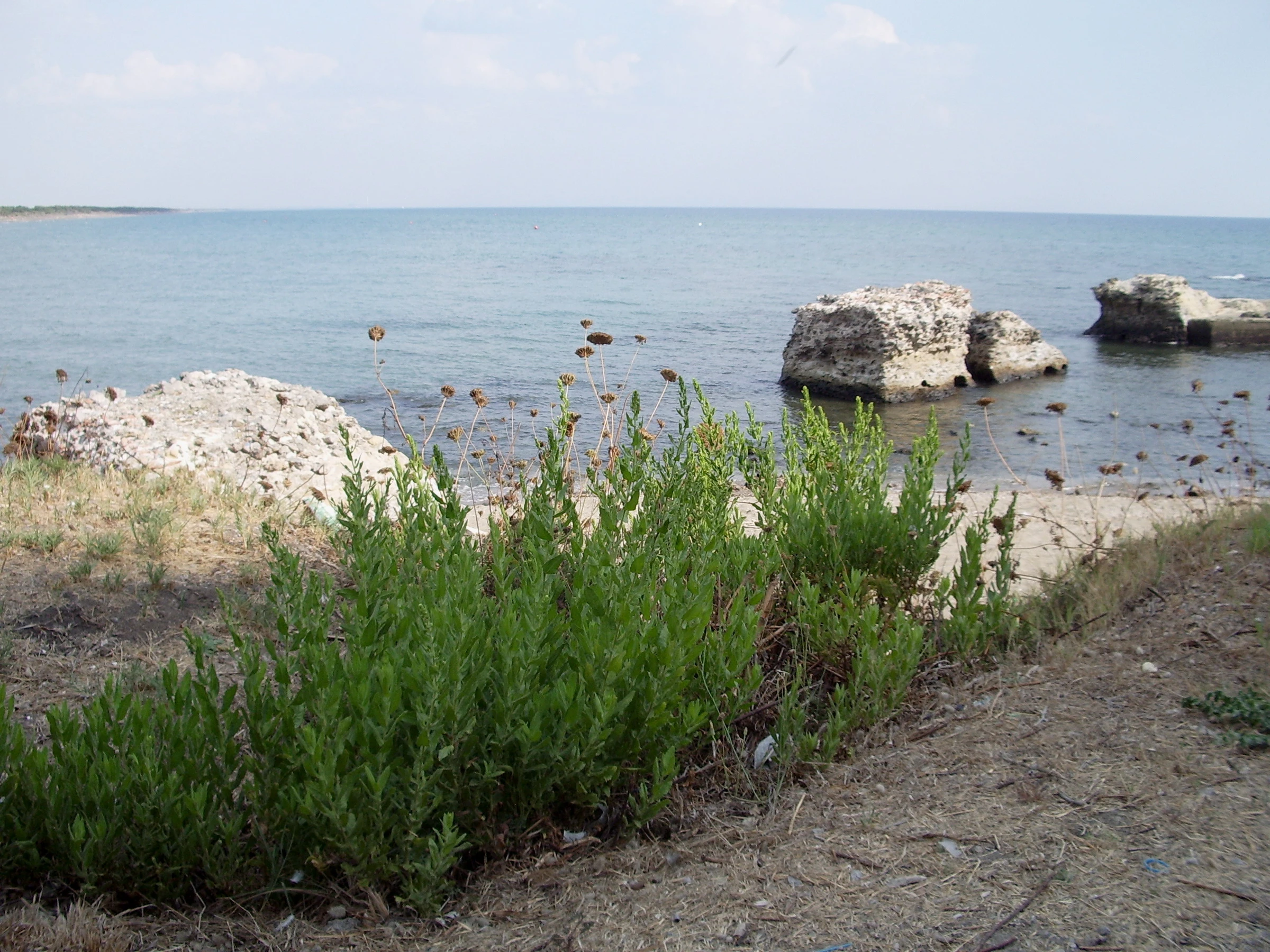
The Pantheon is still there. So are the remains at the old port of Cosa, on the Tuscan coast.
Roman concrete belongs to a small company of old materials that modern laboratories are still taking apart. The patterned steel of Damascus blades is another, and so, in a different way, is the fire weapon of Byzantium, Greek fire. In each case the object survived, or its effects were written down, and the knowledge of how it was made did not survive with it.
What nobody knows is how much of their endurance the Romans planned, and how much they kept, generation after generation, only because it worked.
Questions This Leaves You With
Is there anything a person actually does with this?
For your own life, very little, and it is worth saying so. Roman concrete is not something to buy or to mix in a garden, and it is weaker than the concrete in a modern driveway. Anyone selling a date or a cure from this story is selling something. If a Roman-style concrete reaches the market, it will be judged the way any concrete is, by tests that take years. The question that is genuinely open belongs to everyone: whether the buildings and sea walls of this century should be designed to last a few decades or a few centuries, and who pays the difference.
Does this sit against a religious account of the world?
Not directly, and it can be read both ways. The Pantheon was built as a temple to the Roman gods and has been a Christian church since the seventh century; one reader sees in its survival something more than chemistry, another sees only good lime and good ash. The concrete makes no claim about either. This site will not tell you which reading to hold. That is yours to weigh.
Does it change what a human life is?
Think of a Roman labourer at Pompeii, shovelling quicklime into a heap of ash on a morning in 79 AD, with no idea the work would be read two thousand years later. One reaction is that it makes a life small: the name gone, the house buried, only the heap remaining. The other is that it makes a life large: one ordinary morning's work, preserved so exactly that a laboratory could learn from it. Which did you feel first?
What would change your mind, in either direction?
Name it now. Toward the idea of a deliberate, lost method: hot-mixed quicklime found across many Roman sites and periods, with ancient concrete samples showing cracks sealed by calcite that can be traced to the lumps. Toward the more ordinary account: hot mixing turning up only now and then, or ancient cracks showing no sign of that healing, with the sea-grown minerals doing most of the work. Watch for tests on real Roman concrete, not modern copies; they carry more weight. And notice that the two explanations, the lumps and the sea-grown minerals, can both be right at once.
Where does the open problem actually sit?
It sits between the laboratory and the ruin. The healing has been shown in modern cylinders over a month. The durability is shown in Roman walls over two thousand years. Calcite-filled microcracks have been seen in ancient Roman mortar, the 2023 paper notes, at the tomb of Caecilia Metella in Rome; what the paper does not show is that the calcite came from the lumps rather than from elsewhere in the mortar. Until then the lumps are a strong suspect, not a proven cause, and the recipe for the marine mortar is still missing. Ancient concrete is sampled with care, because every core taken is a piece of a monument.
Sources
- Seymour, Maragh, Sabatini, Di Tommaso, Weaver and Masic, Hot mixing: Mechanistic insights into the durability of ancient Roman concrete (2023) Science Advances 9(1), eadd1602 Primary record
- David L. Chandler, Riddle solved: Why was Roman concrete so durable? (2023) MIT News Study
- Vaserman et al., An unfinished Pompeian construction site reveals ancient Roman building technology (2025) Nature Communications 16, 10847 Primary record
- Zach Winn, Pompeii offers insights into ancient Roman building technology (2025) MIT News Study
- Jackson et al., Phillipsite and Al-tobermorite mineral cements produced through low-temperature water-rock reactions in Roman marine concrete (2017) American Mineralogist 102(7) Primary record
- How seawater strengthens ancient Roman concrete (2017) University of Utah Study
- Jackson et al., Mechanical resilience and cementitious processes in Imperial Roman architectural mortar (2014) PNAS 111(52) Primary record
- CIP 35 - Testing Compressive Strength of Concrete National Ready Mixed Concrete Association Study
- Concrete knowledge (2013) UC Berkeley College of Engineering Study
- Vitruvius, The Ten Books on Architecture, tr. M. H. Morgan (1914) Project Gutenberg Primary record
- Pliny the Elder, Natural History 35.47, tr. Bostock and Riley (1855) Perseus Digital Library Primary record
- Alison Henry, Hot-mixed mortars: the new lime revival (2018) IHBC Context 154, via Designing Buildings Study
- Aberthaw Lime and Cement Works (listing) Cadw, via British Listed Buildings Study
- Pantheon, Rome Wikipedia General reference
- Vitruvius, De architectura, ed. Fra Giovanni Giocondo (Venice, 1511) Getty Research Institute, via Internet Archive Primary record