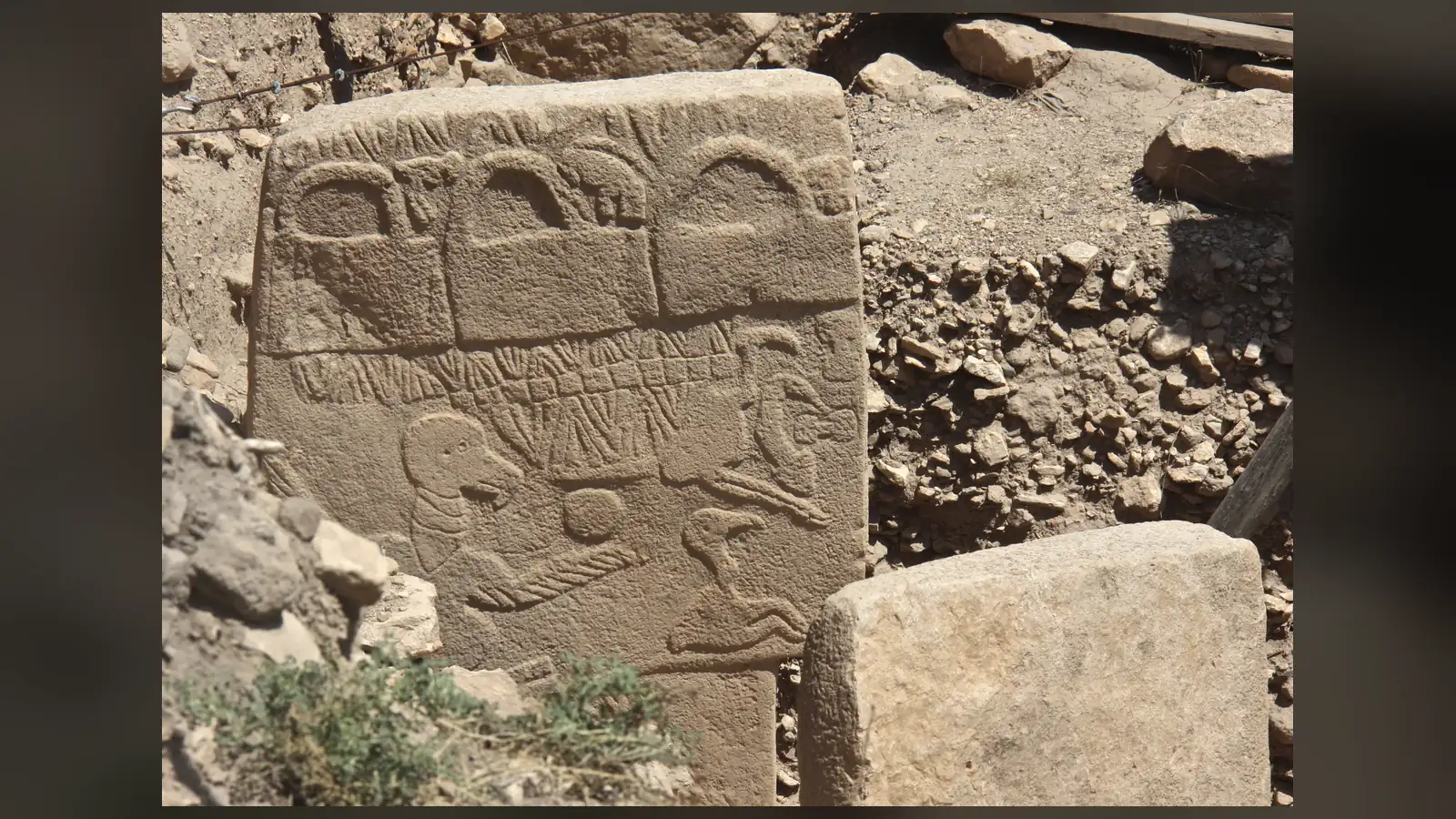
Gobekli Tepe is a hilltop in southeastern Turkey, near the city of Sanliurfa, where hunter-gatherers raised rings of carved stone pillars more than eleven thousand years ago, before farming, pottery or writing. One of those pillars, number 43, is carved with a vulture, a scorpion, birds and a headless man. In 2017 two engineers at the University of Edinburgh read it as a date: the record of a comet strike in 10,950 BC.
The pillar is limestone, T-shaped, taller than a person, set into the wall of a ring of stones the excavators call Enclosure D. Its face is crowded. Rows of V shapes along the top. Three small bags, each with an animal above it. A bird with wings spread, one raised, one held level.
And beside the level wing, a circle.
Below them a scorpion. Below the scorpion, half hidden, a small man without a head.
Eleven thousand years old. A picture made before anyone wrote a word.
The pillars on the hill
The German archaeologist Klaus Schmidt of the German Archaeological Institute began excavating at Gobekli Tepe in 1995 and worked there until his death in July 2014. What he uncovered changed the picture of the Stone Age: great circular enclosures of T-shaped pillars, some weighing many tonnes, carved with foxes, snakes, scorpions, birds and vultures, built by people who did not yet farm.
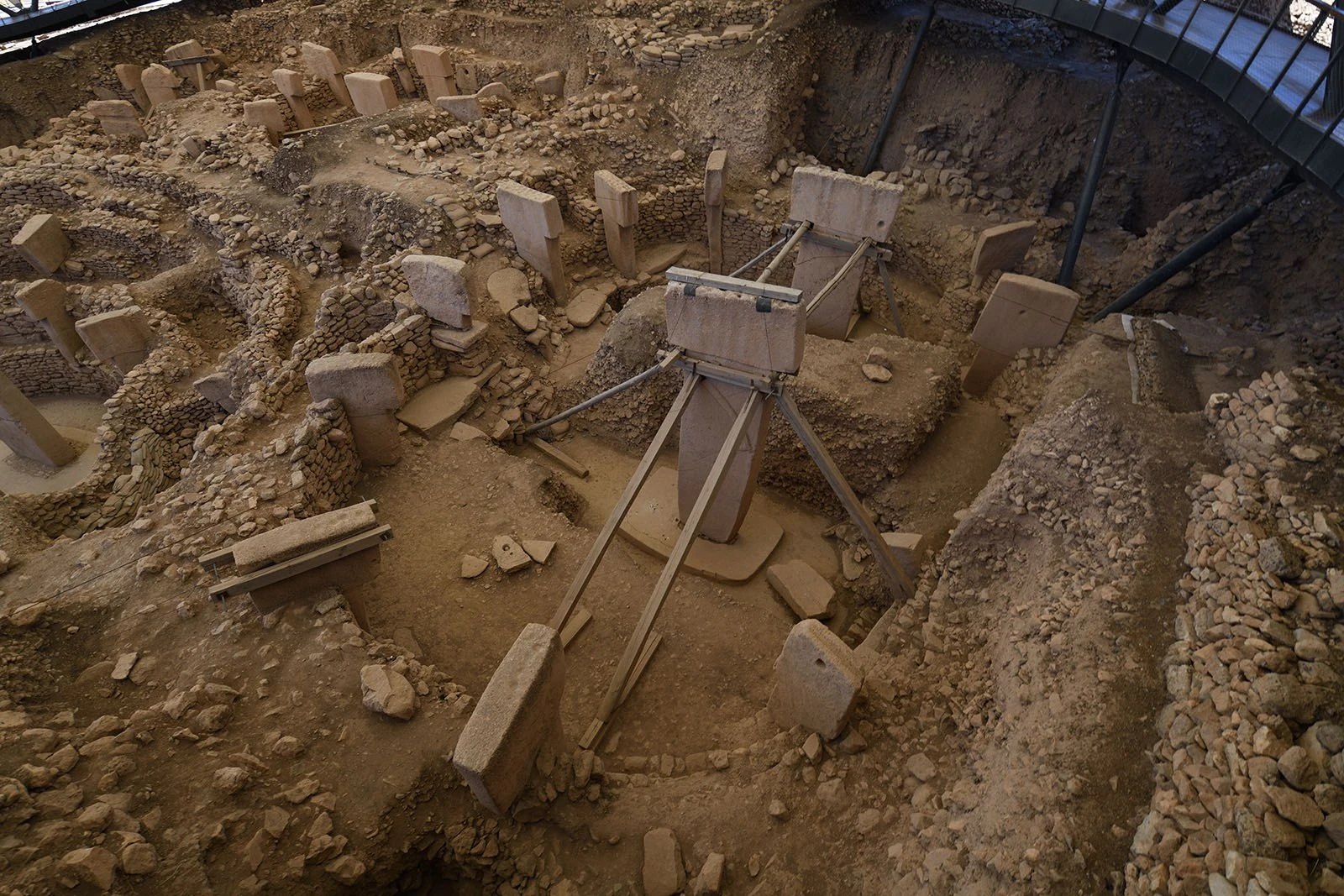
Enclosure D is the best known. In a 2017 paper describing it, the Edinburgh researchers wrote of "a rough circular wall with eleven large upright megaliths embedded into its inner surface (once there were perhaps twelve)" and two central pillars "each weighing around 15 tonnes." A 2020 study in the Cambridge Archaeological Journal by Gil Haklay and Avi Gopher gives the date of the clay mortar in Enclosure D as 9745 to 9314 BC. UNESCO made the site a World Heritage Site on 1 July 2018.
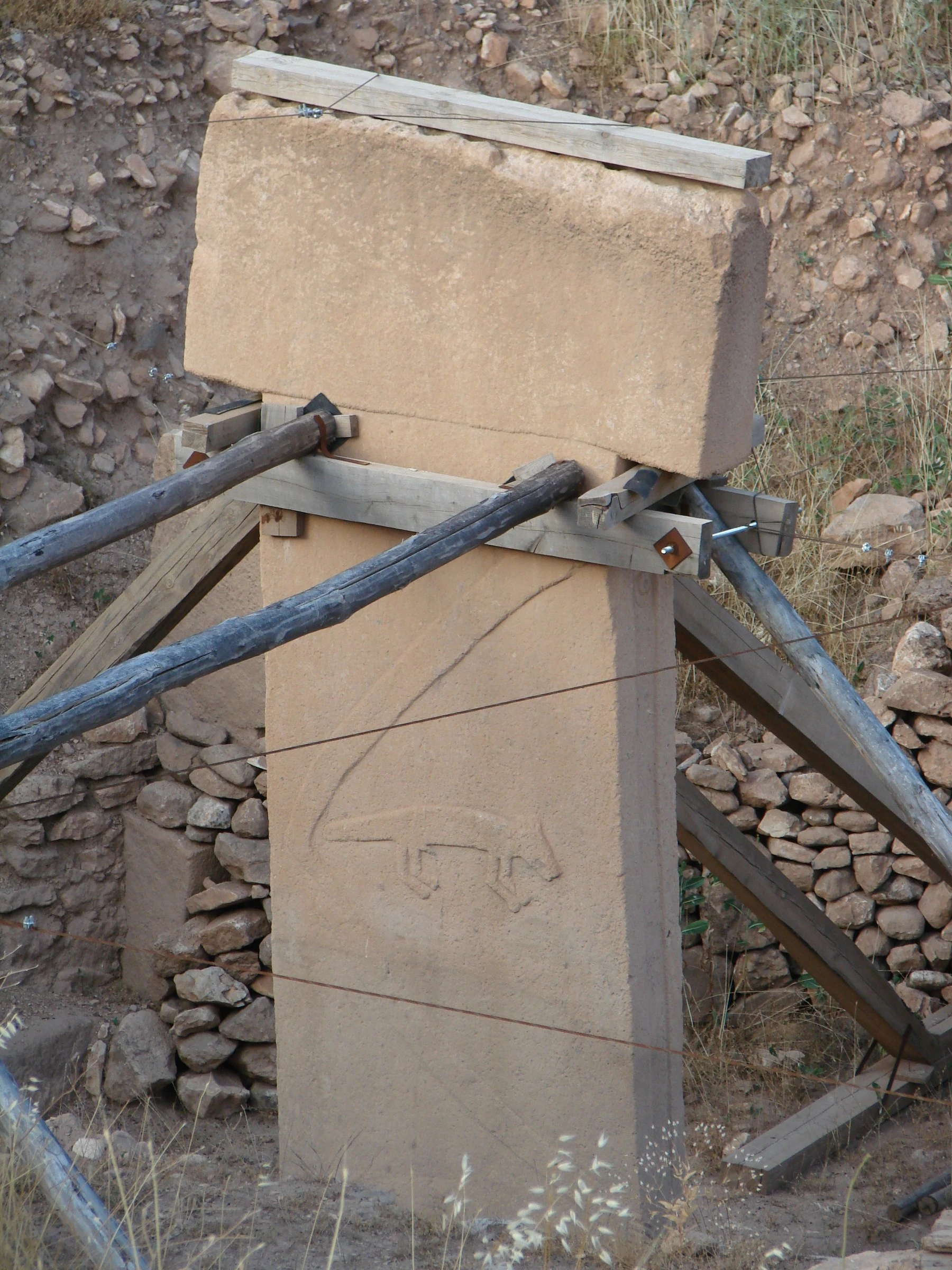
Pillar 43, the Vulture Stone, stands in the north-west of the wall. The 2017 paper describes its main face from top to bottom: rows of nested V shapes, three "handbags" with small animals, a vulture or eagle with its left wing raised and its right wing horizontal, a bird bending over a "downward wriggling snake or fish," a scorpion, the head and front legs of "perhaps a dog or wolf," and at the bottom "a small headless man." And, it adds, "a circle is carved into the visual centre of the pillar, and placed just above the right-hand part of the right-most horizontal wing of the vulture."
Schmidt himself wrote on the pillar in 2006, in a short paper titled Animals and a headless man at Gobekli Tepe.
A date stamp
In March 2017 Martin Sweatman and Dimitrios Tsikritsis, of the University of Edinburgh's School of Engineering, published "Decoding Gobekli Tepe with archaeoastronomy: What does the fox say?" in the journal Mediterranean Archaeology and Archaeometry.
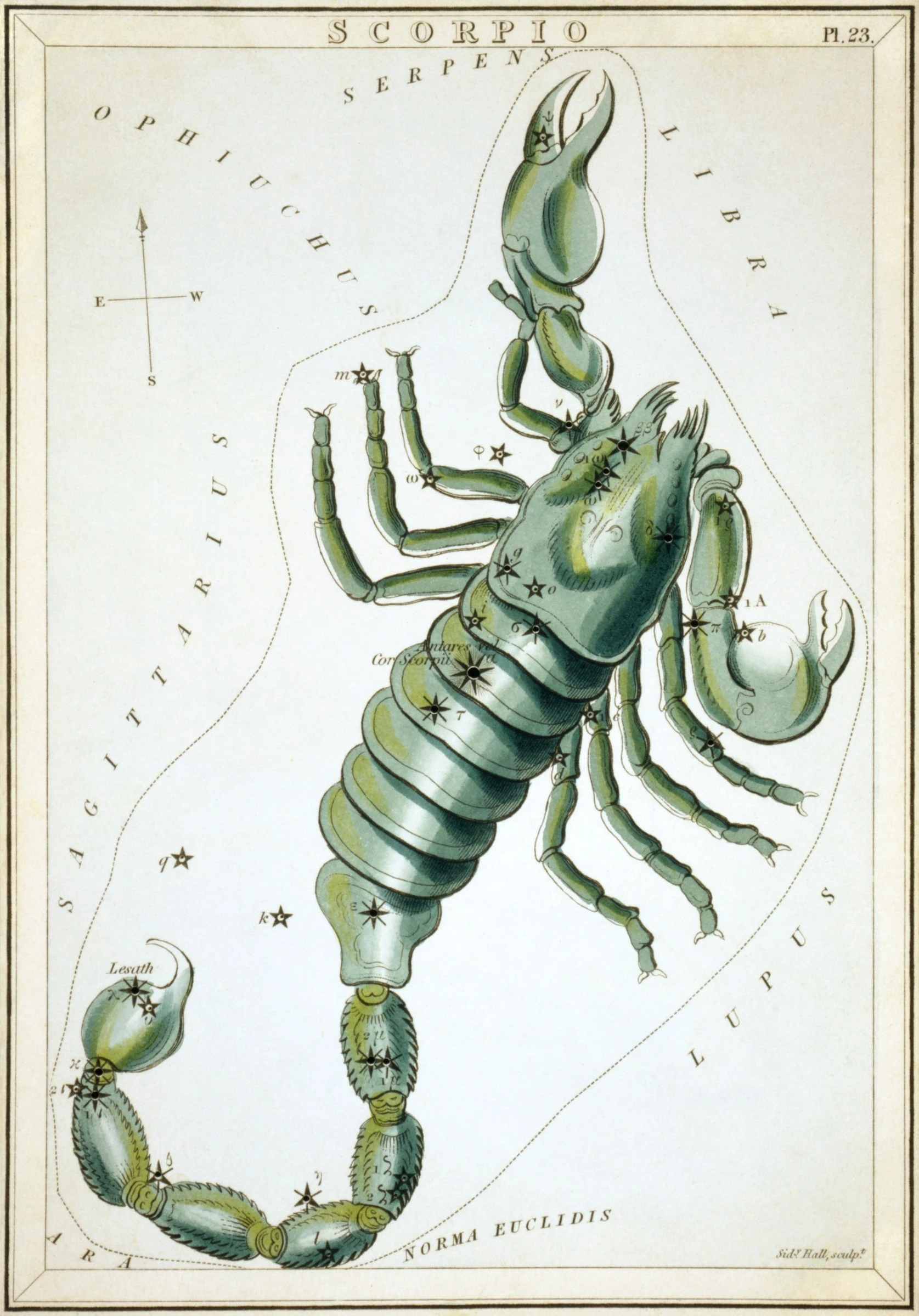
They matched the animals to the stars. Using the free astronomy program Stellarium, set to the sky over Sanliurfa, they read the vulture as Sagittarius, the scorpion as Scorpius, and the other figures as Libra, Ophiuchus, Lupus and more. Then they asked when the sun would have stood where the circle sits, on the vulture's wing. Their answer: the summer solstice of 10,950 BC, give or take 250 years.
That date sits close to an event already argued over in the geology journals: the Younger Dryas, a sudden return to near ice-age cold about 12,900 years ago, which a group of scientists led by Richard Firestone proposed in 2007 was set off by a comet. The Edinburgh paper put the proposed event at 10,890 BC.
"By matching low-relief carvings on some of the pillars at Gobekli Tepe to star asterisms," the authors wrote, "we find compelling evidence that the famous 'Vulture Stone' is a date stamp for 10950 BC +/- 250 yrs, which corresponds closely to the proposed Younger Dryas event." They put the chance of the matches being coincidence at "less than one in 5 million." And the headless man, on their reading, indicated "probably the worst day ever in human history since the end of the ice age."
The university's press release, on 21 April 2017, was titled "Ancient stone carvings confirm date of devastating comet strike." Sweatman said: "One of its pillars seems to have served as a memorial to this devastating event."
The paper credits earlier work by the writer Andrew Collins, whose 2014 book had tied the site to a comet. Gobekli Tepe reached a far larger audience in 2022, in an episode of Graham Hancock's Netflix series Ancient Apocalypse.
If the pillar remembers
Set aside for a moment whether it is true. Ask the better question. What kind of past are we living in, if it is?
It would mean, first, that the people of Gobekli Tepe watched the sky closely enough to fix a day in the year by the stars, and carved it in stone for people they would never meet.
It would mean that they saw something come out of the sky and change the world, the cold returning, and set down a record of it some seven thousand years before anyone anywhere wrote a word.
It would mean something about our species. On that reading, the first monument may also be the first history: humanity's memory beginning not with a king or a god but with a catastrophe, survived and recorded.
And it would leave one question in front of us. If one pillar on that hill is a record, what else the other pillars remember is still unread.
What the excavators read
The archaeologists who excavate the site answered in the same journal later in 2017, in a reply titled More than a vulture, by Jens Notroff, Oliver Dietrich, Lee Clare and colleagues at the German Archaeological Institute.
The first objection was the date, and it can be read in the 2017 paper itself. Sweatman and Tsikritsis cited the enclosure wall's own date as about 9,530 BC, within 220 years, and so had to propose that Pillar 43 was carved centuries before the wall it stands in, "possibly just before the rough stone wall." According to published summaries of the reply, the radiocarbon dates of Enclosure D fall 700 to 1,000 years after the proposed comet.
The second was the method. The constellations matched are the Western ones, inherited from the Greeks and the Babylonians; the reply, as reported, did not accept that the same star pictures could be assumed for hunter-gatherers eleven thousand years earlier. The third was selection: the pillar has carvings on its narrow sides that the reading left out, and, as Notroff wrote in a critique quoted by Vice magazine in 2017, the reading meant "silently omitting the emphasised phallus" of the headless man, which sits awkwardly with a picture of death alone.
The fourth was the comet. In 2023 a team led by Vance Holliday, with Mark Boslough, Christian Koeberl and others, published in Earth-Science Reviews a paper titled Comprehensive refutation of the Younger Dryas Impact Hypothesis, noting that "No craters have been identified that date to the onset of the Younger Dryas."
The excavators read the vultures and headless figures as part of a symbolic world of wild animals and the dead, found on many pillars at the site.
What the reply does not settle
The reply answers the date and the method. Some things remain.
The circle. Carved beside a bird's wing, at the visual centre of the stone, it has no reading that both sides accept.
The pillar's own age. Radiocarbon dates the mortar, the plaster and the fill around the pillars, not the carving itself. Whether a pillar could be older than the wall it was set into, reused or reset, is not settled by the dates alone.
The statistics. The one-in-five-million figure is the authors' own, and it rests on which carvings count as matches and which are left out: the selection the excavators questioned. A probability cannot settle the choice it was computed from.
Sweatman and Tsikritsis answered the excavators in a comment in the same journal, keeping to their reading. And Sweatman has gone on: in 2024 he read the V shapes carved on a Gobekli Tepe pillar as a calendar of 365 days, twelve lunar months and eleven extra days, with the summer solstice marked by a V around the neck of a bird-like beast.
Where it stands
Each pillar uncovered at the site adds animals to a vocabulary nobody can yet read. Other readings on this site set ancient pictures against the sky, from the lines at Nazca to a star and eleven globes on a Mesopotamian seal.
The date that started this, 10,950 BC, now sits in two places at once: in a geology debate about a comet, and on a stone with a bird and a circle. The two have not been joined by anything but a reading.
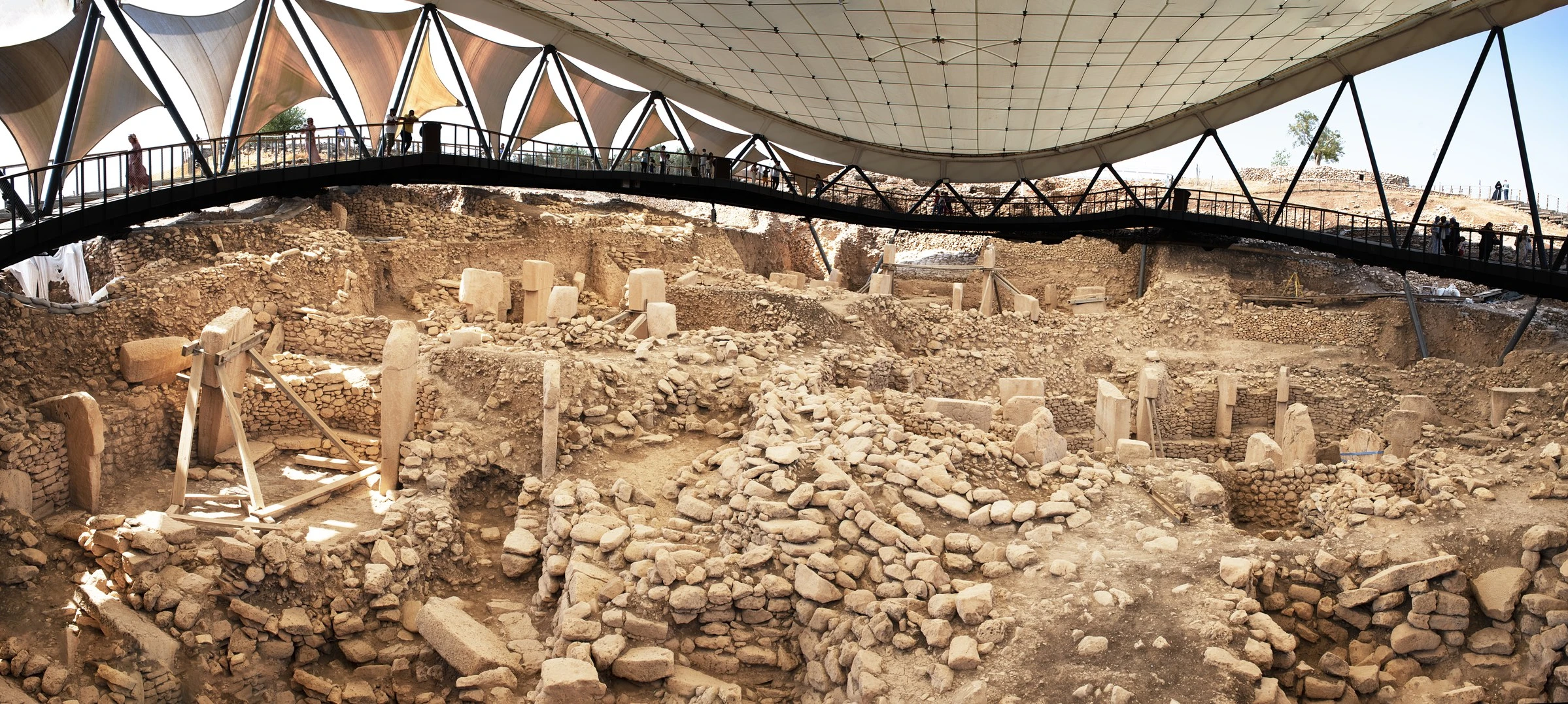
Pillar 43 stands where it was found, under a roof built to protect it. The vulture's wing still points at the circle.
A wing. A circle. And a headless man.
Questions This Leaves You With
Is there anything a person actually does with this?
Not in a practical sense, and it is better to say so. Nothing on the pillar predicts anything; the comet, if there was one, struck about 12,900 years ago. No date or warning can honestly be read from it. What you can do is look at the stone yourself, in the free photographs, and try the matching: open a planetarium program, set it to the sky over southeastern Turkey eleven thousand years ago, and see whether the animals line up for you.
Does this sit against a religious account of the world?
It can be read both ways. Gobekli Tepe has been called a temple, and many archaeologists read its pillars as religious works, figures of ancestors or spirits. Sweatman reads one as a record of something seen in the sky. Some find either reading a challenge to their faith; others find in the hill a sign of how old the religious impulse is. Where it leaves your own faith is for you to decide. This site will not tell you.
Does this change what a human life is?
The people of Gobekli Tepe had no farms, no metal, no writing, and they moved stones of many tonnes and carved them with a whole world of animals. Whatever the pillar means, that is a long reach for people we once imagined as simple. You might find it humbling, how little we know of them. Or you might find it the opposite: how much a human life can make with very little. Which did you feel?
What would change your mind, in either direction?
Name it now, before you are committed. Toward the comet reading: a radiocarbon date that puts Pillar 43's carving near 10,950 BC, or another pillar or site that carries the same star pictures pointing to the same date. Toward the excavators' reading: dates that tie the carving firmly to the enclosure's building, or more sites where vulture, circle and headless man belong plainly to a scene of burial. On the record so far, the dates favour the excavators; the circle is the part still open.
What is the circle?
This is the open problem. Everyone who has read the pillar agrees it carries a circle at its visual centre, by the vulture's wing. To Sweatman it is the sun on a solstice day. The excavators read the pillar as a scene from a world of animals and the dead, and do not accept the date. No inscription will settle it, because the people who carved it left none. The answer, if it comes, will come from more pillars, more circles, and a pattern nobody has yet seen.
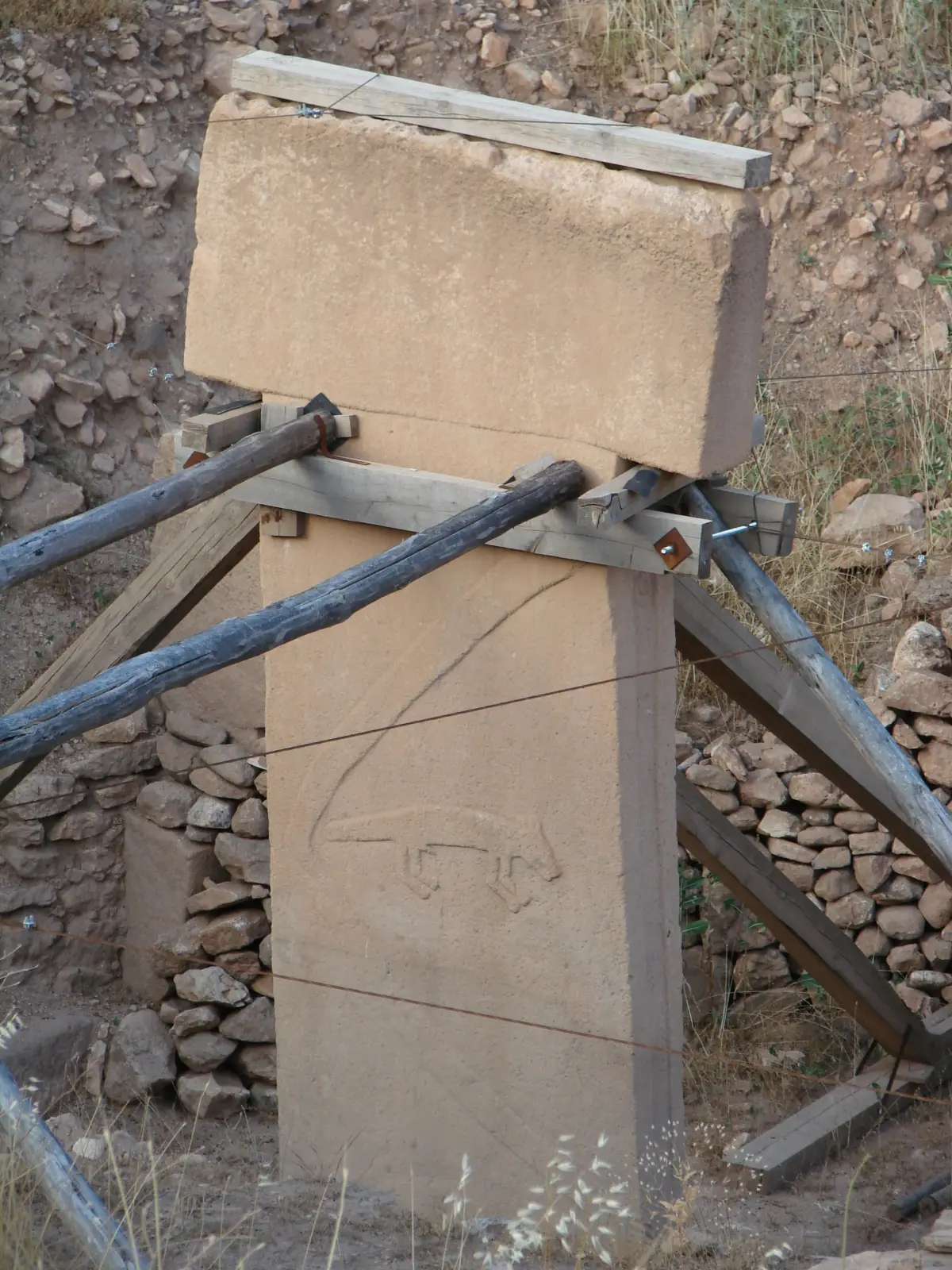
Enclosure D from the visitors' walkway in 2019: the two great central pillars, braced with timber, inside a ring of wall pillars. A central pillar of Enclosure D with arm and fox, 2011. Photo: Guerin Nicolas, CC BY-SA 3.0 (creativecommons.org/licenses/by-sa/3.0), via Wikimedia Commons. Resized.
Sources
- Decoding Gobekli Tepe with Archaeoastronomy: What Does the Fox Say? (Mediterranean Archaeology and Archaeometry 17(1), 2017) Martin B. Sweatman and Dimitrios Tsikritsis, University of Edinburgh Primary record
- Ancient stone carvings confirm date of devastating comet strike (21 April 2017) University of Edinburgh Primary record
- Geometry and Architectural Planning at Gobekli Tepe, Turkey (Cambridge Archaeological Journal 30(2), 2020) Gil Haklay and Avi Gopher Primary record
- Press Release No. 176 on the inscription of Gobekli Tepe (2018) Ministry of Foreign Affairs of Turkey Study
- Gobekli Tepe excavator Klaus Schmidt passes away (2014) archaeology.wiki Study
- Comment on 'More than a vulture: A response to Sweatman and Tsikritsis' (MAA 17(2), 2017) Sweatman and Tsikritsis, University of Edinburgh Primary record
- Gobekli Tepe comet reading (3 May 2017) Becky Ferreira, Vice Study
- Comprehensive refutation of the Younger Dryas Impact Hypothesis (Earth-Science Reviews 247, 2023) Vance T. Holliday et al. Primary record
- Sweatman's calendar reading (7 August 2024) University of Edinburgh via ScienceDaily Study
- Ancient Apocalypse (encyclopedia entry, read 2026) Wikipedia General reference