
On 9 September 1991 the British newspaper Today put two men in their sixties on its front page under the words "Men Who Conned The World". Doug Bower and Dave Chorley, two Hampshire artists, said they had been making the crop circles of southern England for thirteen years, at night, with two wooden boards, a length of string and a sighting device fixed to a baseball cap.
The circles they described had become one of the great puzzles of the 1980s: perfect rounds of flattened wheat and barley appearing overnight in the fields of Wiltshire and Hampshire, the stalks laid in a smooth swirl, the edges sharp, the crop around them standing untouched.
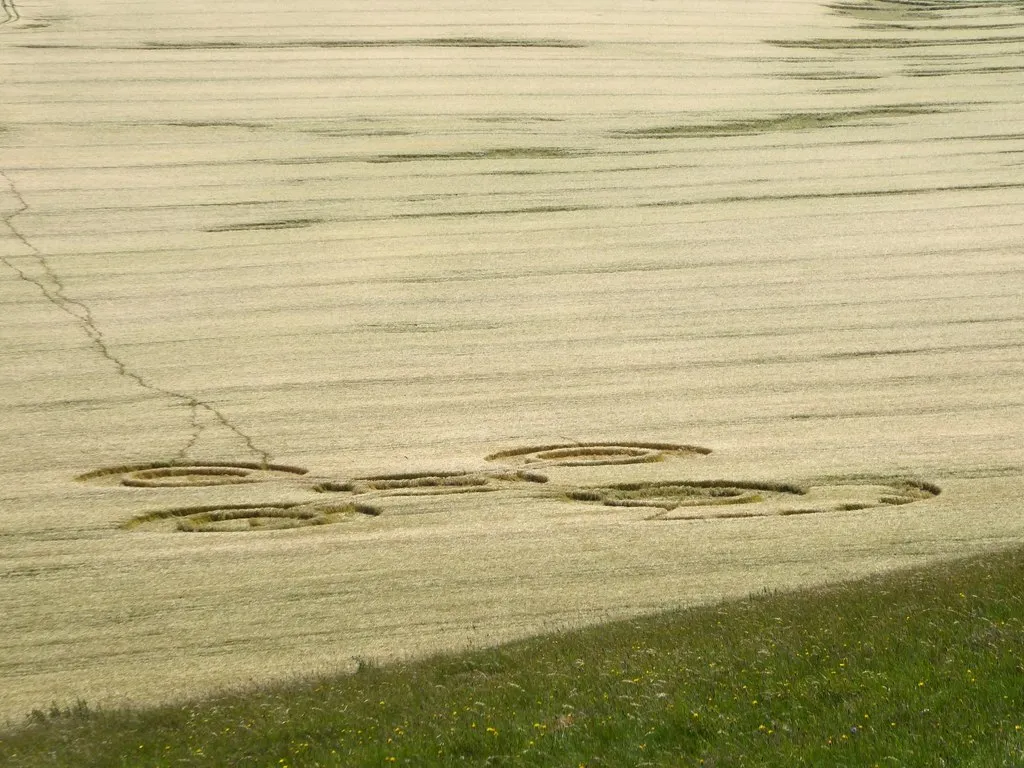
To prove it, the two men made one more. In a wheat field near Sevenoaks in Kent, with Today's reporters watching, they laid a large circle with two smaller ones and a corridor between. Then a leading researcher of the circles was invited to look.
He said no human could have done it.
Two men, a plank and a pub
Bower told Today's reporter Graham Brough that the idea had come in a pub near Cheesefoot Head, outside Winchester. "The first one we did was in the summer of 1978," he said. Their first circle went into a field halfway between the pub and the Head. Later ones went into the Punchbowl, the natural bowl of land at Cheesefoot Head itself.
The method was simple. A plank, held by a loop of rope at each end, was pushed forward to press the crop flat, and the string set out the circle from its centre. The sighting device on the cap kept the straight lines straight. By their count they made about two hundred circles. Chorley told a Canadian radio programme the same day that it had been "anything from 20 to 25 to 30 a year."
They signed their work. The Sevenoaks test carried two letters laid into the wheat: a D and a D, for Doug and Dave.
The researcher was Pat Delgado, who with Colin Andrews had written the book Circular Evidence in 1989. Today's account has him standing in the Sevenoaks circle and saying: "No human could have done this." When he was told who had, his words, as the paper printed them, were: "We have all been conned. Thousands of lives are going to be wrecked over this."
The second day's story added the human detail. Bower's wife Ilene, seeing the car's mileage climb by about four hundred miles a week, had suspected another woman. She believed him only when he predicted where a circle would appear.
Something in the fields
The circles had not waited for Doug and Dave to become a mystery. By the late 1980s they had a literature, a research movement and two leading explanations, both of them extraordinary.
Delgado and Andrews, in Circular Evidence, gathered photographs and field reports of the formations. Time magazine in 1989 called the book handsomely illustrated but largely anecdotal, and reported the authors' suggestion of an "intelligent force being directed toward earth".
The meteorologist Terence Meaden, who ran a group called Circles Effect Research, argued against both human makers and an intelligence: a natural force no one had yet described, a whirlwind steered by the hills, a spinning, electrically charged vortex of air that flattened the crop in a single swirl. "Those who like to fantasize that something from outer space is responsible can be excluded," he told Time.
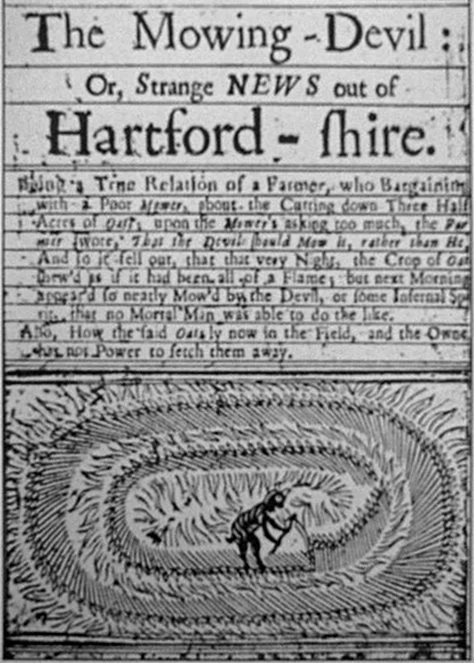
And the circles seemed to have a past. In 1880 a letter to the journal Nature from J. Rand Capron described circular flattened patches in wheat near Guildford, the stalks laid "in a direction forming a circle round the center", which he put down to "some cyclonic wind action". In 1989 the magazine Fortean Times brought a pamphlet of 1678 into the argument, The Mowing-Devil, whose woodcut shows the Devil with a scythe at the centre of a field of rings.
By 1990 there was even a stakeout. Operation Blackbird, funded mainly by the BBC and Nippon Television, watched a Wiltshire hillside through July nights. Late that month a formation appeared in the field under watch. In its centre were a horoscope board game and a wooden cross. "Somebody had a joke," Andrews said, "but it has actually set our research back."
If they were not all made
Set aside Doug and Dave for a moment. Ask what follows if some of the circles were never made by anyone.
It would mean that a force of nature, a vortex of a kind meteorology had never recorded, came down on English fields night after night and drew rings, and that the farmers of 1880 and perhaps of 1678 had seen it before us.
It would mean, on the stronger reading, that something was choosing. The circles grew more complex year by year through the 1980s, from single rounds to rings to sets of circles in lines. If no one was making them, then something was learning.
It would mean our species had been sent a message in the one medium every agricultural people on earth can read: a field. Not radio, like the 1977 Wow signal, not light, but the crop itself, laid down in patterns, in a landscape of barrows and stone circles thousands of years old.
And it leaves a question in front of us. If even a few of those patterns were not made by human hands, then what made them is still out there, and still has not been seen at work.
What the confession settled
The standard account is the one Bower and Chorley gave. Two men with a plank, a rope and a cap, starting from a pub, making a few dozen circles a year and adding new shapes whenever the weather theories caught up with them. Bower's obituary in Fortean Times in 2018 says the shapes grew, from couplets and triplets to groups and, in 1990, pictograms, in response to each new explanation. By 1991 other makers had joined in.
Then the makers proved what could be done in competition. On the night of 11 July 1992, on Sir Francis Dashwood's estate at West Wycombe, a contest organised by the biologist Rupert Sheldrake, with John Michell and Richard Adams, and sponsored by the Guardian and the magazine The Cerealogist, offered a prize for the best formation made by hand. Three engineers from Westland Helicopters won it, using a roller made of plastic pipe, stepladders and a plank, and a telescopic pole with string. Sheldrake, who chaired the organisers, wrote: "The experiment was conclusive." People could make every feature of the formations of the time, he added, though that did not show every formation had been made.
Meaden conceded, by the end of 1991, that the complex formations were made by people. Artists such as John Lundberg and Rod Dickinson, of the group Circlemakers, went on to make formations far larger and more intricate than anything Doug and Dave attempted.
And the precedents weakened. The Mowing-Devil's own title page, shown above, says the oats were "neatly Mow'd": cut, not bent, in a field said to have seemed on fire. The writer Jim Schnabel is among those who reject it as a crop circle. Capron's 1880 patches, which he put down to the wind, were plain flattened rounds, nothing like the designs that came after 1980.
What the confession did not settle
The confession reaches Doug and Dave's circles. It does not reach every circle.
Bower and Chorley claimed about two hundred formations, over thirteen years. Many others were being reported in the same years. No one has ever said they made them all, and by 1991 others were already at work. Which circles were theirs, which were other makers', and whether any were made by no one at all was never sorted, field by field.
Some researchers said there was a physical test. The biophysicist W. C. Levengood published papers in the journal Physiologia Plantarum from 1994, the later ones with Nancy Talbott of BLT Research, reporting that plants from some formations had stretched stem joints and small blown-out holes in the nodes, which he called expulsion cavities, and argued these pointed to brief intense heating. On 9 August 2000 Colin Andrews said that an estimated 80 percent of crop circles in Britain were made by people, and that the other 20 percent showed no sign of it, citing magnetometer readings that followed the shape of the pattern.
Those claims were tested in turn. Joe Nickell wrote in 1996 that Levengood's reasoning was circular, since no formation known to be genuine existed to test against, and that he found no sign the work had been done blind. In 2005 the Italian group CICAP argued that the plant data showed only what any mechanical flattening would produce. The arguments over those papers are already set out in the site's account of the 2001 Chilbolton formation.
No independent, blind repeat of Levengood's tests, by people with no stake in the answer, comparing plants from formations whose makers were known and unknown, has been found in print. CICAP said Physiologia Plantarum declined to publish its critique.
The plank and the cap
Dave Chorley's death is usually given as 1996; no obituary has been found to confirm it. Doug Bower lived to be 94. He died at West End in Hampshire on 21 July 2018, eight months after Ilene. In his later account he put the first circle not in 1978 but in June 1976, on the Longwood Estate near Winchester, thirty feet across, made with an iron bar.
He was a painter, a birdwatcher, a wartime radio operator in the Royal Air Force. He told the filmmaker John Lundberg in 2005 why he started: "I figured that I wouldn't live long enough to see an alien visitation so it was up to us to get something down and make it happen for ourselves."
The circles still appear every summer in Wiltshire. Most are signed by nobody.
And the field researcher's sentence stands in the record, said in good faith in a circle made by two men with a plank, before the world found out.
"No human could have done this."
Questions This Leaves You With
Is there anything a person actually does with this?
Not much for your own life, and that is worth saying. Crop formations are not dangerous and they do not predict anything; anyone selling a date or a prophecy in them is selling something. If you visit one, the farmer owns the field and the crop, so ask before you walk in. The larger question is about evidence: how a whole movement of careful people could be shown a hand-made circle and call it unmakeable. That is worth carrying into any field where an expert is shown something new and asked to judge it on sight. The useful habit is to ask what the expert would expect to see if the thing were made, and whether anyone has checked.
Does this sit against a religious account of the world?
It can be read both ways. Some visitors find in the formations a sense of the sacred, especially near the old stones of Wiltshire, whoever made them. Others see human art made at night, and find the meaning there. The fields make no claim either way. Bower himself said he started because he did not expect to live to see an alien visitation. This site will not tell you which reading to hold. That is yours.
Does it change what a human life is?
Think of two friends walking off a dark field with their boards and string, having made something that thousands of people would come to see. One reaction is that it makes a life small: a joke that fooled the world and was gone. The other is that it makes a life large: two ordinary men who made an art form that is still practised every summer. Delgado's life is part of it too: a man who had written a book on the circles, standing in a field in Kent, told that this one was made by two men with boards and string. Which did you feel first?
What would change your mind, in either direction?
Name it now. Toward something unexplained: a formation appearing under continuous, recorded watch with no one entering the field, or a blind test of plants in which the unusual changes appear only where no maker is known. Toward human making for all of them: the same blind test showing no difference at all. Notice that a blind test of the plant claims has been asked for since at least 1996, and that even a positive result would show only that some plants changed, not who or what made the formation. It needs no new instrument: only plants from known and unknown formations, labelled by someone else, and a laboratory that does not know which is which.
Where does the open problem actually sit?
It sits in the difference between "some were made" and "all were made". Doug and Dave settled the first beyond doubt. Nobody has settled the second, because nobody has gone back through the record formation by formation, and many of the makers have never said which were theirs. A confession, however complete, can only cover the work of the person making it, and nobody keeps a public register of who made which. Whether there is anything left once every maker has spoken is a question the confession of 1991 opened rather than closed.
Sources
- Graham Brough, Men Who Conned The World, Today, 9 September 1991 (transcription) Today (London), reproduced at menwhoconnedtheworld.weebly.com Primary record
- Today, 10 September 1991 (transcription) Today (London), reproduced at menwhoconnedtheworld.weebly.com Primary record
- Dave Chorley on CBC Radio, As It Happens, 9 September 1991 (transcript) Patrick Gross, ufologie.patrickgross.org Primary record
- Rob Irving, Necrolog: Doug Bower, Fortean Times 371 (2018) Fortean Times, via circlemakers.org Study
- Doug Bower tribute and timeline Circlemakers Study
- Going Forever Around in Circles (Time, 11 September 1989, reprinted) NZ Skeptics Study
- Paul Fuller on J. Rand Capron, Storm Effects, Nature 22 (1880) Circlemakers Study
- Thea Applebaum Licht, The Mowing-Devil (1678) The Public Domain Review Study
- Mowing-Devil Wikipedia General reference
- Alex Boese, Operation Blackbird Museum of Hoaxes Study
- Rupert Sheldrake, The Crop Circle Making Competition (2025) Rupert Sheldrake Primary record
- Crop circle Wikipedia General reference
- BLT Research published papers BLT Research Team Primary record
- Zack Van Eyck, Hot clue on crop circle: high heat was involved (1997) Deseret News Study
- Colin Andrews, statement of 9 August 2000 Circlemakers Primary record
- 80% of crop circles are fakes (2000) Farmers Weekly Study
- Joe Nickell, Levengood's Crop-Circle Plant Research (1996) Skeptical Briefs 6(2) Study
- CICAP press release on Grassi, Cocheo and Russo, Balls of Light (2005) CICAP Study
- Alan Boyle, crop circle makers (2002) MSNBC Study