
The Winged Globe in this story is a bright mark in a SOHO image of the space around the Sun. Two white extensions spread from its center. A point drops beneath them. Farther right, another bright object carries a much straighter horizontal bar. Both occupy the same blue field, beneath the light streaming past a dark disk.
That disk hides the Sun. The small white circle inside it indicates where the solar face belongs. The much larger circle around it is an instrument's view of the corona and the sky beyond. Across the bottom, the frame gives a date and a time: 2009/03/27 03:18.
The mark has a name because a photograph became part of a larger story. At ZetaTalk, it joined the record of Planet X, a body Nancy Lieder's site identifies with Nibiru. The wings were read as the outline of a planet and its surrounding material. The gaps between appearances became part of the account too.
The striking part survives a return to the archive. The shape is present in the official image. It is also present in the corresponding science-format exposure. Neither fact identifies the object. Both make the original worth opening.
One frame. Two bright shapes.
The exposure behind the name
SOHO, the Solar and Heliospheric Observatory, is an ESA/NASA mission launched on 2 December 1995 to study the Sun. Its LASCO coronagraphs suppress direct sunlight so that fainter surrounding structures can register. The mission's own image guide explains the dark central disk, its support extending toward the lower left, and the coronal streamers reaching into the field. This is an artificial eclipse inside a telescope.
ZetaTalk's newsletter of 5 April 2009 gives the capture its precise identity: LASCO C3, 27 March, 03:18 UTC. It places the Winged Globe near four o'clock relative to the Sun and draws attention to its absence in earlier and later images. The claim is attached to a reproducible exposure, rather than a picture with its timestamp cut away.
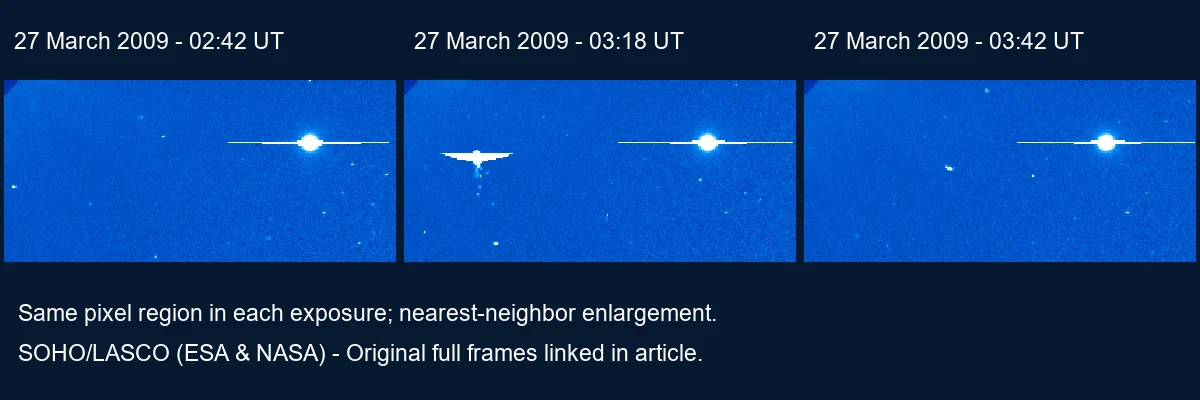
The official archive for that day contains the 03:18 JPEG and exposures labeled 02:42 and 03:42 on either side. In the central image, the wing-shaped mark lies below and right of the occulting disk. A separate bright object appears farther right. In the two flanking images, the same region contains no comparable wing-shaped mark. The brighter object farther right remains visible.
The Level 0.5 file index connects the central exposure to 32206694.fts, with a start time of 03:18:19 and a recorded exposure of approximately 19.4 seconds. The neighboring files are 32206693.fts and 32206695.fts. The minute printed on a browse image and the seconds stored in its header are different levels of precision, not competing dates.
The archive has kept more than the familiar blue picture.
A planet, its wings, and the missing appearances
For Nancy Lieder's ZetaTalk, the image belongs to a continuing account of Planet X near the Sun. Newsletter 127 associates the winged outline with ancient imagery and interprets the surrounding extensions as part of the Planet X complex. Its comparison is visual and historical: a globe with material extending to either side, appearing in the vicinity where the site expects the body.
The newsletter also distinguishes the mark from the usual appearance of a bright planet in LASCO. Its sky-map argument places Mercury elsewhere to the right of the Sun. That matters to a fair statement of the case. The claim is not that the separate bright object with the long horizontal bar has been overlooked. It is that a second, differently shaped feature has appeared beside it.
The account extends beyond March. In newsletter 137, published on 14 June 2009, ZetaTalk presents captures from 25 May, 2 June and 5 June as further appearances, interpreting material behind the bright features as the body's tail. Recurrence is central to its reading. Those additional dates are leads for separate sequence tests; the three exposures analyzed here examine the March event, not the entire series.
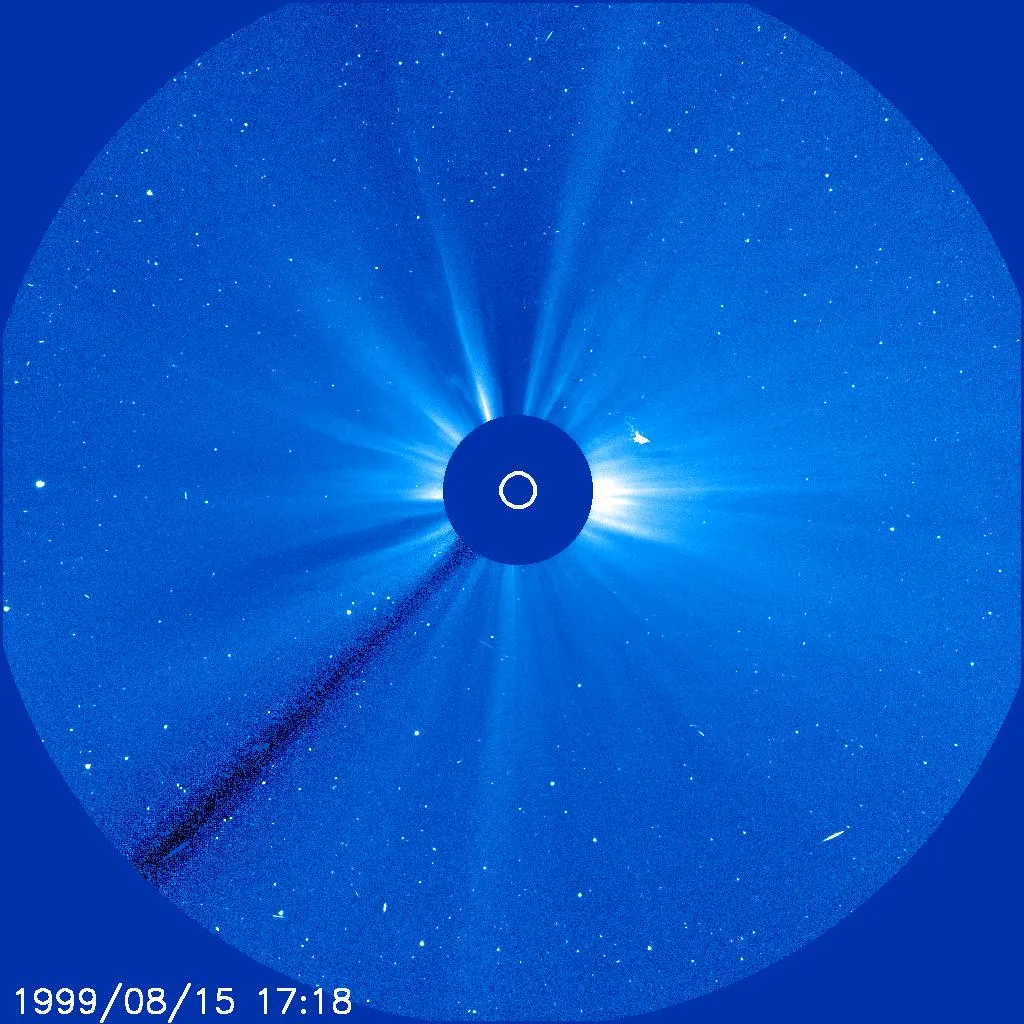
On this reading, the frame is a rare opening in an interrupted record. In newsletter 170, dated 31 January 2010, ZetaTalk argues that automated image editing normally removes Planet X and sometimes misses it. The site also challenges a similar-looking 1999 example, interpreting differences in color and texture as signs that the older image was altered. These are ZetaTalk's explanations of the record, including its accusation about the archive; they are not findings established by the image headers.
The distinction gives the case two separate parts. One concerns a bright structure that can be checked in an exposure. The other concerns how the public record was produced and whether it was changed to conceal something. A convincing account of the second would have to connect particular file differences with particular processing steps or interventions. It would need more than the shape itself.
That makes the website part of the subject. A changing image, an empty interval, or a block with a hard edge can become evidence about the publisher as well as about the sky. The same picture is carrying two arguments: something appeared near the Sun, and something happened on its way to the screen.
If the identification held
If the mark recorded the body ZetaTalk describes, the consequence would reach far beyond a striking silhouette. A known exposure would become a positional observation of an additional object. A story assembled from images and interpretations would acquire a measurement that other instruments could attempt to repeat.
That would change what followed from the picture. A second observation could establish motion. Observations from different positions could constrain distance. A sustained sequence could separate the object's path from the apparent movement of stars and planets. Each additional constraint would reduce the freedom to explain its place after the fact. The wings would have opened the inquiry; the orbit would have to carry it.
For the historical reading, the stakes would be different. A verified object resembling an ancient winged disk would make the comparison newly interesting. It would not, by itself, establish what a particular ancient artist meant. That would still depend on the object, its inscriptions, its setting, and the history of its interpretation. An observation in space and an interpretation of an old image would remain two records requiring their own evidence.
And if deliberate concealment were established, our relationship with an astronomical archive would change too. Public confidence would need to rest on independently retained data, processing histories and checks that survived outside a single institution. That is a conditional consequence of demonstrated concealment. It cannot be supplied by the suspicion that motivated the search.
The possible discovery is enormous precisely because it would have to survive so many independent ways of looking. Our place in the solar system would be redrawn by a body whose position could be measured again, not by an outline that had to remain alone.
A real new world would have more than a silhouette.
What the instrument team says
SOHO's published explanation identifies several causes of unfamiliar marks: bright-source saturation, energetic particles striking the detector, spacecraft debris and processing defects. In LASCO, excess charge can spread along detector rows. A shape's horizontal extensions therefore need not be a physical pair of wings. The NRL Sungrazer guide specifically notes that particle hits can also saturate the detector and produce horizontal spikes.
This is a mechanism, not a case-specific identification of the March mark. The consulted documentation does not attach a named instrument-team diagnosis to exposure 32206694.fts. The feature's appearance in only the central member of the three-exposure comparison is consistent with a transient detector event; that observation alone does not establish its exact cause.
SOHO's latest-image documentation also describes a publication process that can change the apparent record. Telemetry delays postpone images. Missing blocks can be filled from a previous frame for the public display, with retransmitted data becoming available later. Consequently a mark can appear to persist when a block has been carried forward. The web images are explicitly intended for visual inspection rather than scientific analysis.
The Sungrazer guide approaches an unfamiliar object through a sequence: consistent positions and motion across multiple exposures, with stars, planets and detector events distinguished. Its comet-search criteria are not a universal law for every possible phenomenon. They explain why an isolated shape, however suggestive, does not yet supply a track.
What survives the return to the files
The strongest result of a closer inspection is a limit on one possible explanation. The March feature is not created solely by enlarging the public JPEG. An examination of the corresponding Level 0.5 FITS array finds the broad bright structure at the same location. Its presence in that file rules out a later JPEG-only invention of the entire mark. It does not distinguish incoming light from a particle interaction in the detector.
Official X's own count comparison uses a fixed display-pixel box, x=585 through 660 and y=575 through 615, inclusive, measured from the upper-left corner of a 1024-pixel frame. In the before, central and after arrays, respectively, 0, 234 and 0 pixels exceed 8,000 recorded counts. FITS rows are flipped vertically to match that display convention. This chosen threshold does not define a physical object's edge. No planetary diameter or speed follows from it. The central header records compression and rectification: Level 0.5 is processed data, not untouched photons.
The website question produces another concrete comparison. Newsletter 159 associates a stack of dark rectangles with a spacecraft roll and interprets them as an automated concealment process failing. Its preserved image is stamped 27 October 2009, 11:18. The current official 512-pixel image at the linked date and time does not display those rectangles in the same place. There is a visible difference between the copies.
There is also a date problem inside the account. The roll notice quoted in the newsletter specifies 26 October; the illustrated frame is dated the following day. That mismatch needs to remain visible. It prevents the caption's timing from serving as proof of what the roll did.
The comparison does not reconstruct the history between those two files. Original publication logs, retained intermediate products, and the relevant telemetry would be needed to determine that history. The generic missing-block explanation is relevant, but it cannot be promoted into a diagnosis of these exact rectangles without that work.
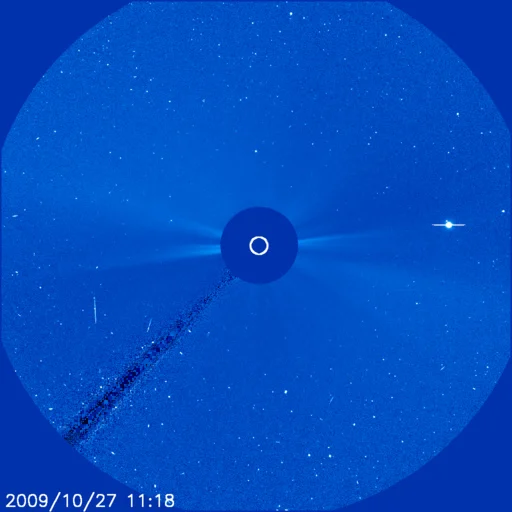
The images were found. A documented concealment operation was not.
The frame and the record around it
The SOHO latest-images page is a useful starting point for watching the Sun. It is a changing display. An investigation needs a fixed date, an instrument, an exposure, the files beside it, and a record of which version was examined. Otherwise a later comparison may be comparing different processing products without realizing it.
The 27 March sequence offers those anchors. It preserves a wing-shaped transient in both a browse product and Level 0.5 data, alongside a separate bright object. The small set examined here does not provide a continuing path for the wing-shaped feature. Nor does it supply a distance, a mass, or an independent observation from another spacecraft. Those missing measurements are the boundary between the visible mark and its identification as Planet X.
The larger archive deserves the same precision. A similar-looking mark in the official 15 August 1999 C3 image is relevant to how often such forms occur. Resemblance does not establish identical causes. A processing date in a FITS header likewise does not independently prove when a particular public copy first became available. Each proposition needs the record that can answer it.
The 1983 IRAS story and the Planet Nine search concern other evidence and other observing programs. Their inclusion under Planet X does not make them observations of the same body. Here, the question is narrower and unusually tangible: a winged mark, a timestamp, and a set of files that can still be opened.
The next useful exposure would have to add something the outline cannot.
Questions This Leaves You With
Does this mean anything has to change in everyday life?
Nothing in this three-frame comparison establishes a timetable or a personal action to take. Anyone selling a date is selling something. You can keep the personal question apart from the observational one: a bright transient in an archive does not supply a forecast. The larger question is how a public claim becomes a measurement that others can repeat. That transition matters whether your first reaction to the image is recognition, doubt, or curiosity. It asks for a record that can carry more than one interpretation until a test separates them.
Does the ancient winged-globe connection have to be religious?
You can approach a resemblance as a religious question, a historical question, or a question about images without making those approaches interchangeable. A likeness in a modern capture cannot determine what an ancient community believed. Nor does identifying a detector effect settle a religious understanding of the world. This site will not tell you which way your faith should fall. The useful distinction is between interpreting a symbol and establishing that two depictions have the same physical subject. Those are different questions, even when the same image brings both to mind.
Would a new world make a human life smaller?
You might feel the scale move in either direction. Another body in the solar system would make a familiar map less complete. It could also make the work of looking more valuable: a small instrument, an accessible archive, and a person returning to an old exposure would sit inside a much larger discovery. Neither response depends on pretending that this image has already established a planet. The conditional is part of the experience. A possibility can enlarge a question before the evidence is strong enough to enlarge the solar system.
What would change your mind in either direction?
You can name that before the next compelling image arrives. A repeatable track in independent exposures, a consistent position from another observing platform, and a model that predicts later positions would strengthen a celestial-object reading. A reproducible detector or compression process generating the same distinctive structure under comparable conditions would strengthen an instrumental one. A comparison would need to preserve its settings and explain its limits. Neither a familiar-looking shape nor an official assurance is a substitute for the steps connecting the proposed cause to the recorded result.
Can a changing public image tell you what happened to the data?
It can show that two copies differ. You still need their histories to establish why. For the October rectangles, the retained claimant copy and the current official copy are a starting pair, not a complete chain of custody. The unresolved task is to connect their creation times, input files and processing steps. That would distinguish an update after retransmission from another processing change or an intervention. You need not choose a motive to recognize the value of that reconstruction. The empty space is the documented path between the copies.
Sources
- About the SOHO Mission ESA/NASA SOHO Primary record
- ZetaTalk Newsletter 127 - Winged Globe (5 April 2009) ZetaTalk / Nancy Lieder Primary record
- ZetaTalk Newsletter 137 - Winged Globe Flight (14 June 2009) ZetaTalk / Nancy Lieder Primary record
- ZetaTalk Newsletter 159 - SOHO Revealed (15 November 2009) ZetaTalk / Nancy Lieder Primary record
- ZetaTalk Newsletter 170 - archive alteration argument (31 January 2010) ZetaTalk / Nancy Lieder Primary record
- LASCO C3 browse images, 27 March 2009 SOHO/LASCO consortium Primary record
- LASCO C3 Level 0.5 exposure index, 27 March 2009 SOHO/LASCO consortium Primary record
- LASCO C3 exposure 32206694.fts, 27 March 2009 SOHO/LASCO consortium Primary record
- SOHO instrument explanation: image artifacts (17 January 2003) ESA/NASA SOHO Primary record
- The Official Guide to SOHO Comet Hunting Naval Research Laboratory / Sungrazer Project Primary record
- About the Very Latest SOHO Images ESA/NASA SOHO Primary record
- LASCO C3, 15 August 1999 at 17:18 UT SOHO/LASCO consortium Primary record
- Current official C3 browse copy, 27 October 2009 at 11:18 UT SOHO/LASCO consortium Primary record
- ZetaTalk preserved October 27 SOHO display ZetaTalk Primary record
- LASCO data use and retrieval policies Naval Research Laboratory / LASCO Primary record
- The very latest SOHO images ESA/NASA SOHO Primary record