
On 6 August 1967 a pen on a chart recorder at the Mullard Radio Astronomy Observatory, outside Cambridge, drew its red line across green paper as it did every day. At about 19h20 by the sidereal clock the astronomers kept, which follows the stars rather than the Sun, the line gave a small ragged twitch.
The chart survives. A later hand has written beside the twitch "Pulsar CP 1919", and beside a second twitch a little to the right, "(Interference)". The two marks look almost the same.
The graduate student who read that chart, Jocelyn Bell, noticed it. Within four months she and her supervisor were looking at a signal so regular that the group, half joking, labelled it LGM, for Little Green Men. For a few weeks that December, by their own later accounts, Hewish and Martin Ryle, the senior men at the observatory, took seriously the question of whether it was artificial.
Then they tested it.
A quarter inch of chart
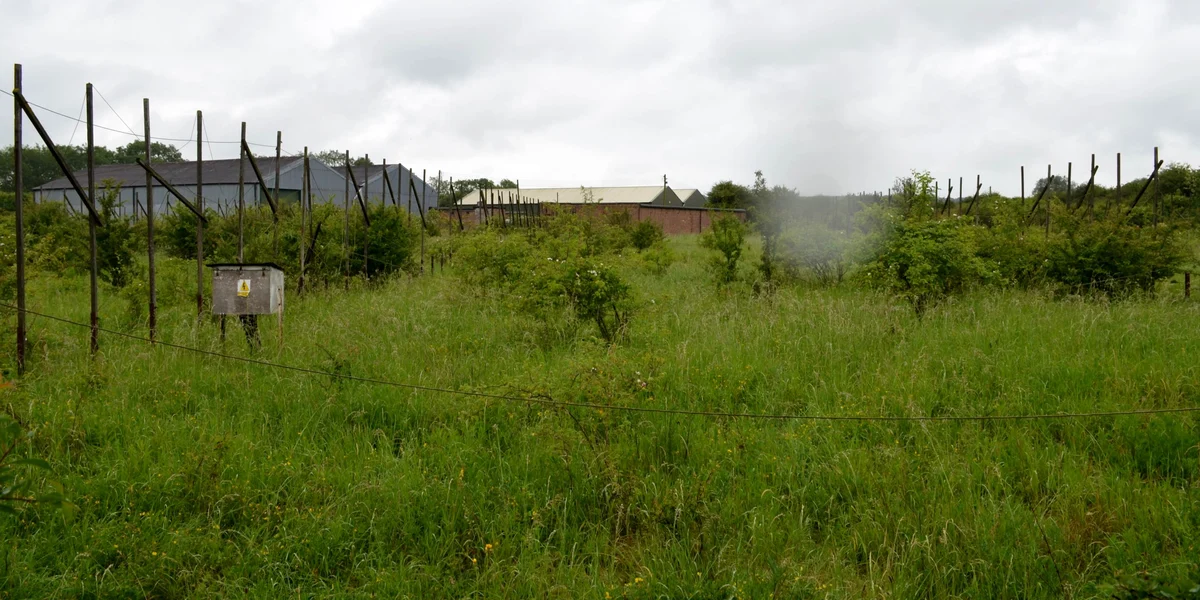
The telescope was new. Its own discovery paper describes 2,048 radio aerials in sixteen rows of 128, each row 470 metres long, working at 81.5 MHz; the whole array covered roughly four to five acres. It had been built over two years by a small team; Bell has said "six of us took two years to build the real thing". It came into use in July 1967, built to study the twinkling of distant radio sources, which gave it its name: the Interplanetary Scintillation Array.
Its four pen recorders produced, by Bell's account, 96 feet of chart paper a day, and Bell read all of it by hand. Six or eight weeks after the survey began, she said later, "I became aware that on occasions there was a bit of 'scruff' on the records". It turned up again at the same place in the sky, which meant it was moving with the stars, not with the Earth. Her supervisor, Antony Hewish, pointed out, in her telling, that it was "only occupying a quarter inch of space on the charts".
A faster recorder was put in to catch it. For about a month there was nothing. Then, at the end of November, it came back, and the fast chart showed what the slow one could not: a row of sharp pulses, evenly spaced, a little over a second and a third apart.
The paper in Nature that announced it, in February 1968, gives the period as 1.3372795 seconds, plus or minus 0.0000020, after correcting for the Earth's own motion. Nothing in astronomy was known to tick like that. Radio had brought odd timings before, such as the long-delayed echoes of 1928, but nothing this steady.

Something that keeps time
What made the signal unsettling was that it looked made.
Its period could be measured to within a few millionths of a second. Each pulse lasted about three-tenths of a second, and each was squeezed into a narrow band of radio frequencies, about 80 kilohertz wide, sweeping downward in frequency as it arrived. Alan Penny, in a 2013 study of those weeks, notes that this was much like the behaviour of military radars.
The Nature paper itself says the "remarkable nature of these signals at first suggested an origin in terms of man-made transmissions", from space probes, planetary radar or radio bounced off the Moon. The team ruled those out: the signal showed no shift against the background stars as the Earth moved, so it came from far beyond the solar system.
That left a harder possibility. Hewish said in his Nobel lecture in 1974: "We had to face the possibility that the signals were, indeed, generated on a planet circling some distant star, and that they were artificial." He added that he "felt compelled to maintain a curtain of silence" until he knew. Ryle wrote in March 1968 that "Our first idea was that other intelligent beings were trying to establish contact with us." Hewish later recalled, in accounts quoted by Penny, a lunch at which the geophysicist Edward Bullard told him that narrow-band signals were "probably intelligence", and a meeting on 21 December 1967 at which they discussed telling the Royal Society and Ryle, half joking, suggested burning the records. On the day the paper appeared, Hewish told the Daily Mail: "We still cannot rule out that possibility."
Bell has told it differently, and strongly disputes Penny's reconstruction. To her the label was "always tongue in cheek, or a joke". Hewish himself said in 2012, "We had no group discussions about the LGM possibility", and Paul Scott has said he was too junior to be in any high-level ones. But Bell also said, in a speech about nine years later, that the idea "had crossed our minds and we had no proof that it was an entirely natural radio emission", and that she went home that night "very cross" that "some silly lot of little green men had to choose my aerial and my frequency".
If it had been a beacon
Suppose, for a moment, that it had been what they feared.
A pulse every 1.337 seconds, as steady as the team could measure, from a fixed point among the stars, would have been a lighthouse: something built to be found. Its narrow band would have been a choice of channel. Its regularity would have been a clock that any listener could set by.
It would have meant that a civilization somewhere had spent energy on a scale no one on Earth could then match, to say one thing over and over: we are here. And it would have meant that the first people to hear it were a handful of radio astronomers in a field in Cambridgeshire, reading paper by hand, deciding whether to tell anyone.
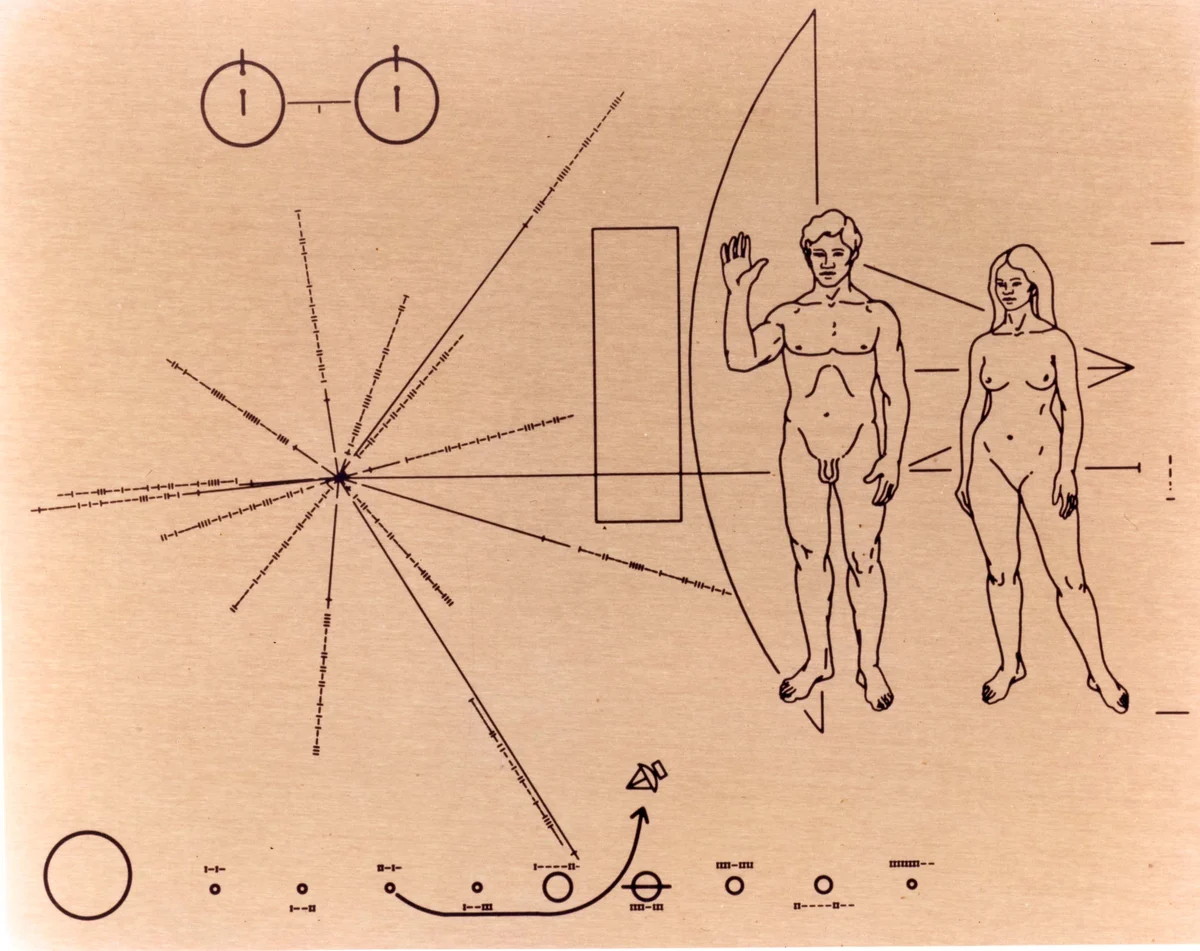
There is a strange echo of that idea in what happened next. Within five years pulsars themselves had become the beacons. The plaques fixed to Pioneer 10 and Pioneer 11, launched in 1972 and 1973, carry a map of fourteen pulsars radiating from the Sun, each line marked in binary with the pulsar's period. The covers of the Voyager records, launched in 1977, carry the same map. Humanity used the natural lighthouses of the galaxy to give its own address.
How the question was settled
The test the team chose came straight from the alien idea. A transmitter on a planet would orbit its star, and that motion would make the pulses arrive a little early and a little late through its year. Hewish began timing the pulses every day from 11 December 1967 against the national time signal. "It turned out," Hewish said in his Nobel lecture, "that the Doppler shift was precisely that due to the motion of the Earth alone". The Nature paper put it more cautiously: there was "no evidence for an additional orbital motion comparable with that of the Earth".
The frequency sweep had a natural reading too. Radio waves passing through the thin gas between the stars are slowed, the lower frequencies most, so a pulse arrives high notes first. The size of the sweep gave a distance: far outside the solar system, inside the galaxy.
Then a second source appeared. On the evening of 21 December, the day of the meeting, Bell found another one on a chart of a different part of the sky, pulsing about 1.2 seconds apart. "It was very unlikely," she said later, "that two lots of little green men would both choose the same, improbable frequency, and the same time, to try signalling to the same planet Earth." Two more followed in January.
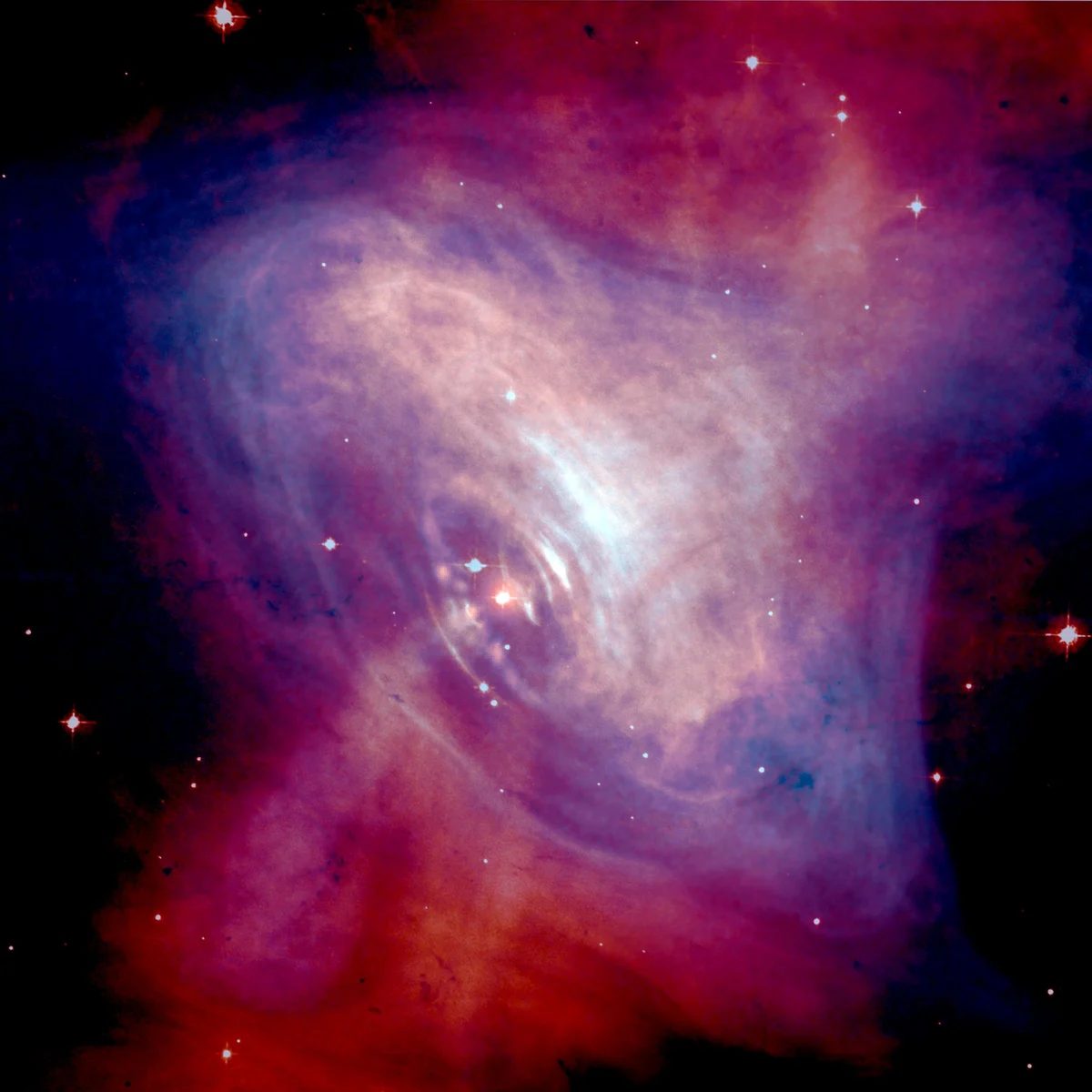
The Nature paper, published on 24 February 1968, with Hewish, Bell, John Pilkington, Paul Scott and Robin Collins as authors, proposed vibrating white dwarfs or neutron stars. Within months Thomas Gold argued, also in Nature, that they were rotating neutron stars, sweeping a beam past the Earth like a lighthouse; Franco Pacini had already suggested in 1967 that such a star could pour out energy. Hewish later wrote that "It was Gold who first suggested" rotation as the simplest mechanism. The best known of them now sits at the heart of the Crab Nebula, the remains of a supernova that Chinese astronomers recorded in 1054.
In 1974 the Nobel Prize in Physics went to Ryle and to Hewish, "for his decisive role in the discovery of pulsars". Bell was not included. The astronomer Fred Hoyle was among the most vocal critics of that choice. Bell herself said that it "would demean Nobel Prizes if they were awarded to research students, except in very exceptional cases, and I do not believe this is one of them." In 2018 she received a Special Breakthrough Prize of 3 million dollars and gave it to the Institute of Physics, to fund graduate students from groups under-represented in physics.
What the tests could not rule out
The tests settled CP 1919. They did not settle the general question the team had to face.
Penny, who reconstructed those weeks from letters and recordings, argues that the reasons for dropping the artificial idea were "not totally conclusive". A beacon need not sit on a planet; one placed far from any star would show no orbit. And more than one source would show only that such builders were common. But he concludes that "overall the judgement was reasonable": there was a plausible natural explanation in neutron stars, and the artificial idea rested solely on the sharpness and regularity of the pulses.
The tests worked because the signal behaved like nature in every way that could be checked. Researchers searching for signals from other civilizations, the hunt that produced the 1977 Wow signal, now use the same marks in reverse. Natural plasma always delays the low frequencies; a pulse that swept the other way would look made. A 2022 search of 1,883 stars by the Breakthrough Listen project looked for exactly that, and found nothing. A 2014 paper by Jayanth Chennamangalam and colleagues went further and asked whether a civilization might ride on a pulsar's own beam, switching it to carry a message.
What has not been worked out is how to tell a beacon apart if it was built to look natural.
The chart in the case
The chart from 6 August 1967 is held in Cambridge, and has been shown behind glass. The line still twitches where it did, a quarter inch of ink beside a mark labelled interference.
Bell, later Dame Jocelyn Bell Burnell, went on to a long career in astronomy. Hewish died in 2021. The source is now catalogued as PSR B1919+21, a neutron star turning once every 1.337 seconds, as it did when the pen moved.
And the joke label has outlived the joke. Many searches for a signal from another world work the way Bell's did: a mark on a record that does not belong, a second look, and the slow work of asking what nature can and cannot do.
Questions This Leaves You With
Is there anything a person actually does with this?
Not much in a daily sense, and it is fair to say so. Pulsars do not affect your life and they predict nothing about it; anyone selling a date or a message in them is selling something. What the story does offer is a working method: when something looks too strange to be natural, list the tests that would tell, run them, and say in advance what result would change your mind. The team in Cambridge did that in a few weeks, under pressure, with paper charts. Historians now reconstruct those weeks from letters and later recollections that do not always agree, which is part of the lesson: write down what you thought at the time.
Does this sit against a religious account of the world?
It can be read both ways. Some find in a spinning star that keeps better time than most clocks a kind of order that points beyond itself. Others see physics, and find the wonder there. For a few weeks in 1967 a group of scientists faced the possibility that the universe was speaking, and they took the possibility seriously enough to test it. Nothing in the result says what a reader should believe about meaning. This site will not tell you which reading to hold. That is yours.
Does it change what a human life is?
Think of a graduate student reading a quarter inch of anomaly in miles of chart, by hand, and refusing to let it go. One reaction is that it makes a life small: the credit, the prize, went to others. The other is that it makes a life large: one careful person, noticing, changed what astronomy knows about how stars die. Bell said of the prize, "I am not myself upset about it". Which did you feel first?
What would change your mind, in either direction?
Name it now. Toward an artificial source somewhere among the pulsars: a pulse that swept the wrong way in frequency, a timing pattern that carried information, or a beam switched on and off in a way no physics explains. Toward nature for all of them: decades more of searches like Breakthrough Listen's, finding nothing, across many more stars and many more frequencies. Notice that the tests the 1967 team ran, timing for an orbit and reading the frequency sweep, are still the ones in use.
Where does the open problem actually sit?
It sits in the gap between "behaves like nature" and "is nature". Every test the Cambridge team ran asked whether the signal did something nature could not. None could ask whether a builder had copied nature on purpose. A careful search can say how rare such beacons are, as the 2022 search did, but rarity is not the same as absence. That is the question the search for other civilizations still carries, and the Cambridge group was, in Penny's words, "perhaps the first group actually to face" it.
Sources
- Hewish, Bell, Pilkington, Scott and Collins, Observation of a Rapidly Pulsating Radio Source, Nature 217, 709-713 (1968) Nature Primary record
- Observation of a Rapidly Pulsating Radio Source (scanned pages) Penn State, Women in Astronomy Primary record
- S. J. Bell Burnell, Little Green Men, White Dwarfs or Pulsars? (speech of 1976, Annals NYAS 302, 1977) Cosmic Search, via Big Ear Radio Observatory Primary record
- Alan Penny, The SETI Episode in the 1967 Discovery of Pulsars, European Physical Journal H (2013) arXiv Study
- Antony Hewish, Pulsars and High Density Physics, Nobel Lecture, 12 December 1974 NobelPrize.org Primary record
- The Nobel Prize in Physics 1974 NobelPrize.org Primary record
- Louise Walsh, Journeys of discovery: pulsars University of Cambridge Study
- T. Gold, Rotating Neutron Stars as the Origin of the Pulsating Radio Sources, Nature 218, 731 (1968) Nature Primary record
- F. Pacini, Energy Emission from a Neutron Star, Nature 216, 567 (1967) Nature Primary record
- Dame Jocelyn Bell-Burnell awarded Breakthrough Prize (2018) The Royal Society Study
- William B. Ashworth Jr., Scientist of the Day: Jocelyn Bell Burnell (2019) Linda Hall Library Study
- Michael Banks, Nobel-prize-winning astronomer Antony Hewish dies aged 97 (2021) Physics World Study
- Pioneer Plaque NASA Science Primary record
- Wm. Robert Johnston, The pulsar map (2003, updated 2007) johnstonsarchive.net Study
- Golden Record cover NASA Science Primary record
- Chennamangalam, Siemion, Lorimer and Werthimer, Jumping the energetics queue (2014) New Astronomy, via arXiv Primary record
- Gajjar et al., Searching for broadband pulsed beacons from 1883 stars using neural networks (2022) Astrophysical Journal, via arXiv Primary record
- Chandra 25th anniversary images: Crab Nebula Chandra X-ray Center Primary record