
Worlds in Collision, the 1950 book by Immanuel Velikovsky, rests on a strange report from ancient Egypt. The Greek traveller Herodotus wrote down what the priests there told him about the sun. Four times, they said, it had left its course. Twice it came up where it now goes down. Twice it went down where it now comes up.
Take the sentence at its word and the morning it describes is an unnerving one. The Nile lies grey and flat under the eastern sky. The cliffs on that side stay dark, and the hour when the light should come over them goes by. Behind everything, over the western desert, on the side of the river where evening belongs, the horizon begins to pale.
Translators render the Greek differently. A. D. Godley has the sun rising "contrary to experience". G. C. Macaulay has it moving "from his accustomed place of rising".
For centuries it stayed where Herodotus left it, a puzzle for commentators, one strange line in a long book about Egypt.
In 1950 a book told America it was a report.
The round of eight publishers
Immanuel Velikovsky was born in 1895 in Vitebsk, in what is now Belarus. By his own account he took a medical degree in Moscow, studied psychoanalysis in Vienna, and practised in Palestine until 1939, when he came to New York to write a book about Freud. It changed under his hands. "In April 1940 I came upon the idea that the Exodus took place during a physical catastrophe," he wrote.
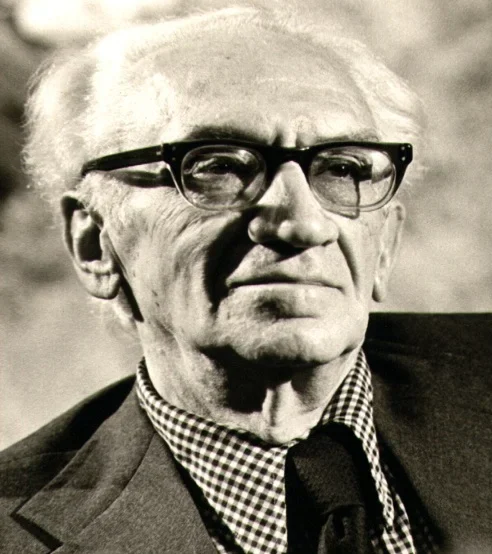
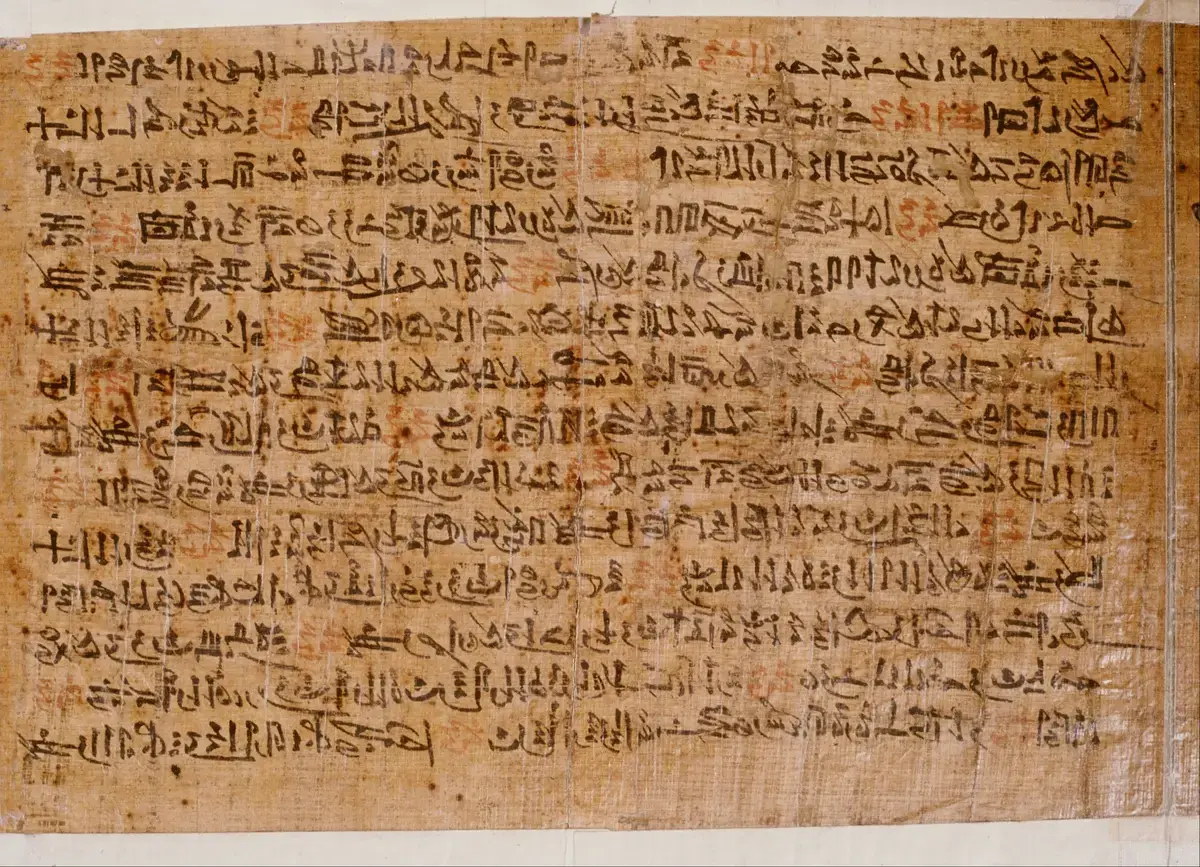
He read the records side by side. The Book of Joshua has the sun standing still over Gibeon. An Egyptian papyrus in Leiden, the lament of a man named Ipuwer, says "The river is blood". Velikovsky called Ipuwer "the Egyptian eyewitness of the catastrophe".
His answer was a planet. Venus, he wrote, had been "expelled as a comet" from Jupiter, and had passed close to the Earth before it settled into the orbit it holds now.
Albert Einstein answered him in July 1946 that "no expert will be able to take them seriously". That summer, by his own count, Velikovsky began "the round of eight publishers". Then James Putnam at Macmillan took it on.
The resistance came from Harvard. Harlow Shapley, the head of its observatory, wrote to Macmillan on 18 January that a rumour it might not publish "makes for sanity". "What books you publish is of course no affair of mine," he wrote, and then: "The earth did not stop rotating in the interests of exegesis." A week later he told Putnam that publication "must cut me off from the Macmillan Company. But this is a triviality."
Worlds in Collision appeared on 3 April 1950 and went to the top of the New York Times list. Textbooks were up to 70 percent of Macmillan's revenue. Within about two months it had handed the bestseller to Doubleday, a house with no textbook division. Velikovsky's word for what happened was "coerced".
One planet, every record
He was not the first to look there. In 1883 Ignatius Donnelly had laid a comet under the world's old disaster stories in Ragnarok. But Velikovsky's proposal, at full strength, was the one that reached the bestseller list, and it is enormous. If something happened in the sky, everyone under it saw the same thing and wrote it down in the terms they had. Read the records as one logbook, he argued, and the gods turn into an event.
The method outlived the planet. Line up old texts in that way and they begin to rhyme.
A Buddhist discourse, the Seven Suns, unfolds as slowly as a drought. A second sun appears, and "the streams and pools wither away and dry up". A third, and the great rivers go: the Ganges, the Yamuna. A fourth takes the lakes they rise from. With the fifth the ocean sinks, league by league, until it lies "here and there in puddles like cows' hoofprints" and there is not enough left "for the tip of the toe". With the seventh, "this great earth and Sineru the king of mountains erupt in one burning mass of fire."
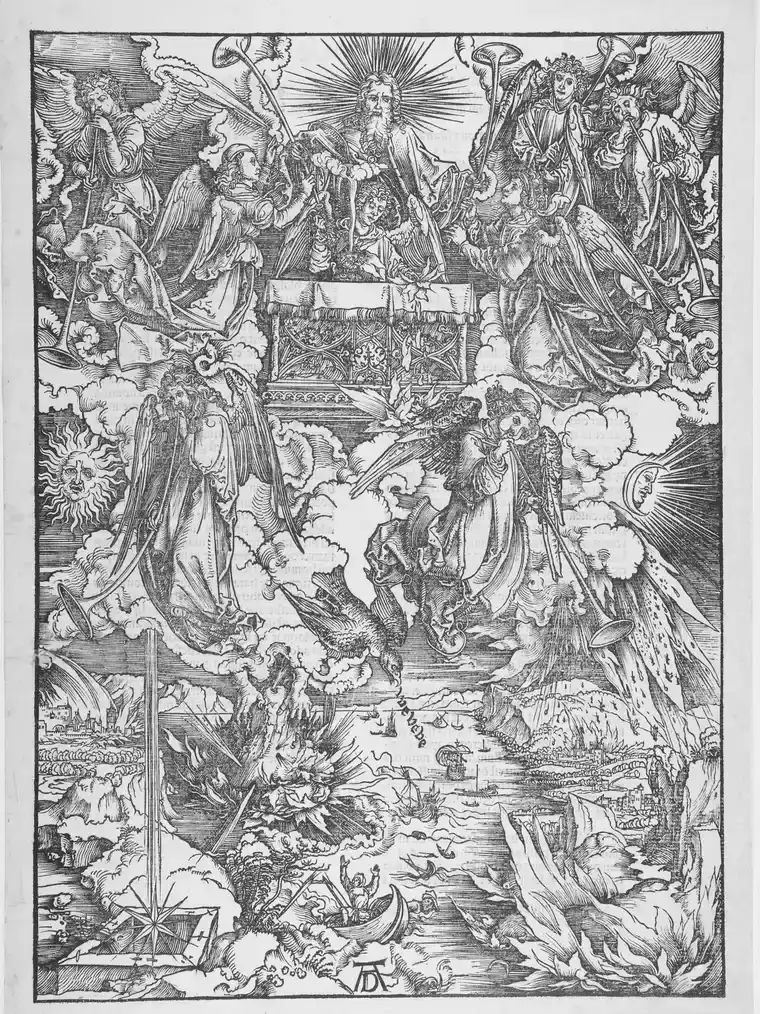
In Revelation a star falls, "burning as it were a lamp", and "the name of the star is called Wormwood". In the Talmud, at Sanhedrin 108b, the week before the Flood has "the sun rising in the west and setting in the east". And in a report in Sahih Muslim, told of a coming day as long as a year, the companions of the Prophet ask the practical thing: "would one day's prayer suffice"?
Then the Destroyer. The Kolbrin is a volume its publisher describes as survivors' texts, carried from Egypt to the priests of Glastonbury and smuggled to Scotland after King Henry II ordered an attack on the abbey in 1184. A 1994 printing from New Zealand was followed by later editions with Marshall Masters as contributor. Its Book of Manuscripts says: "Men forget the days of the Destroyer. Only the wise know where it went and that it will return in its appointed hour." The publisher's site names it plainly: "Planet X, a brown dwarf star in orbit around our Sun".
Frank Waters's Book of the Hopi supplied a star. In 1963 Waters, with Oswald White Bear Fredericks, printed a prophecy of the Saquasohuh [Blue Star] Kachina, who "represents a blue star, far off and yet invisible, which will make its appearance soon."
The assembly was finished on a website. Nancy Lieder's ZetaTalk maps traditions like these, the Kolbrin, the Hopi, Revelation, the Talmud's sun in the west, onto one returning body, Nibiru: "Throughout the ages various prophets have sought to warn the populace about the periodic passage of Nibiru." Her 2017 newsletter calls it "Same Message Many Voices". And Velikovsky is there in print: a page hosted at ZetaTalk reprints his chapters on the hurricane and the hail of stones, with Ipuwer and a Buddhist text, the Visuddhi-Magga, inside them, beside the Zetas' own account of firestorms.
If the records are one record
Set aside for a moment whether any of it is true. Ask the larger question. What kind of past would we have if the old books are logbooks?
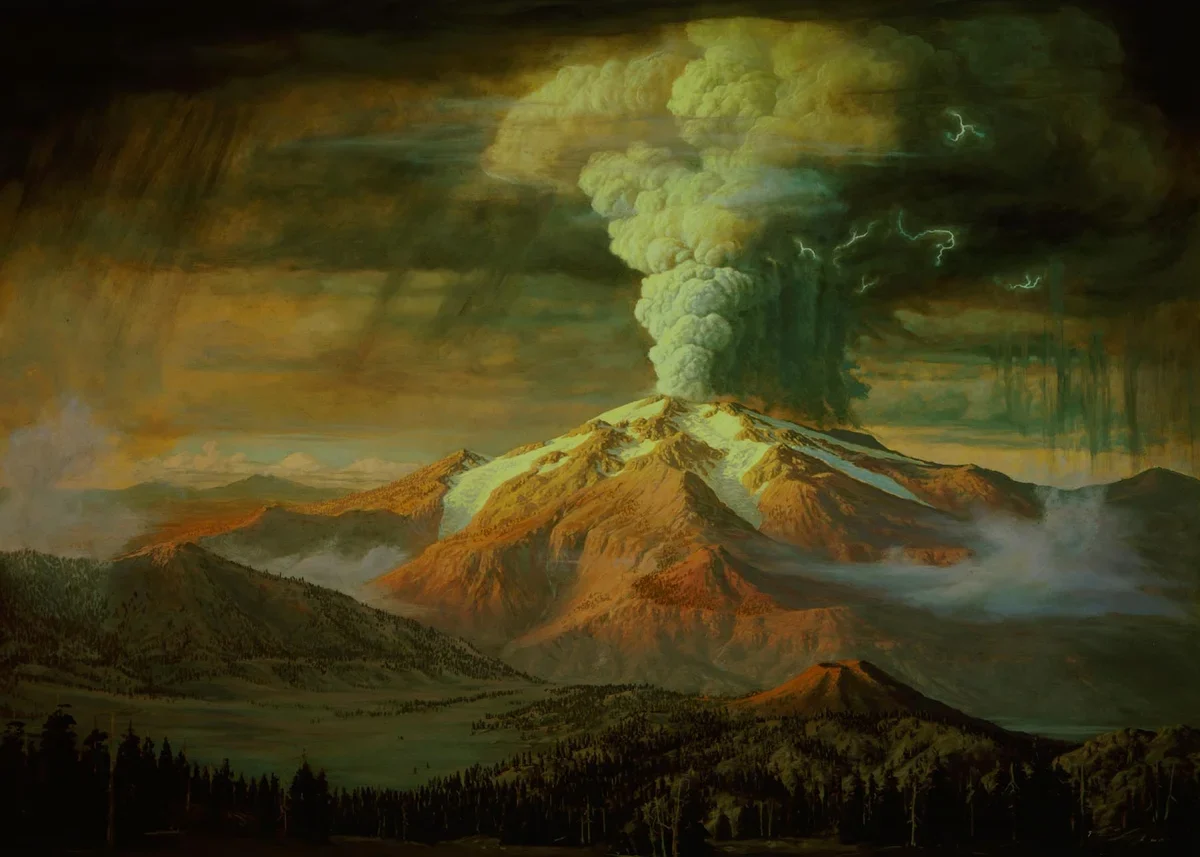
The question is less idle than it sounds, because part of it has been measured. In 2016 Patrick Nunn and Nicholas Reid gathered Aboriginal stories from 21 places on the Australian coast that describe land now under the sea, and worked out what depth of water each one required. The answers ran from 7,250 to 13,070 years ago. In Oregon, the Klamath tell of Llao of the Below World and Skell of the Above World fighting over a mountain, and a young soldier at Fort Klamath heard a version in 1865 from an old man named Lalek. Mount Mazama blew itself apart about 7,700 years ago and left Crater Lake. One reference work on volcanoes counts that as a relay through "approximately 250 generations".
If those are memories, it would mean a story can carry a fact further than any stone inscription has. It would mean our species had a recording instrument before it had writing, and that the instrument was people talking to their children, night after night, with no way of checking the copy.
On Velikovsky's reading it would mean more. It would mean that the whole of early human religion, the fear of the sky, the gods who burn and drown, sits on top of something our ancestors watched, and that we have spent three thousand years reading a disaster report as poetry.
And it would leave one thing in front of us. A species whose records run that deep would have to ask what else is in them, and what ours will say to someone 7,000 years from now.
What the standard account holds
The standard account begins with the physics. Shapley told Putnam that stopping the Earth "would have wrecked all life on the surface of the planet". In 1974, at a session of the American Association for the Advancement of Science in San Francisco, Carl Sagan offered a solution of sulphuric acid for the clouds of Venus, where the book had expected hydrocarbons. In 1985 Leroy Ellenberger, once a Velikovsky supporter, wrote in Nature that Greenland's Dye 3 ice core can be counted year by year back at least 7,200 years, and that the heavy dust layers the scenario requires are absent.
Then the texts. The Seven Suns teaches impermanence: "So impermanent are conditions." Sanhedrin's sun in the west is one of four readings offered for a single verse. In Waters the Blue Star passage concerns a third world war and atomic bombs, and Jason Colavito, who looked, could not trace the phrase "Blue Star Kachina" before 1963. A collection from 1905, taken down in Hopi by the missionary H. R. Voth, has stars falling as an agreed signal between travelling peoples, and a search of its scanned text finds no Blue Star. Its prophecy is about something else: "our forefathers have been prophesying that. We are now in trouble. Our children are taken away from us". One collector did not hear everything, but that was a star no one needed yet. For the Kolbrin, this search found no manuscript and no scholarly study; what Glastonbury's history records for 1184 is a fire.
And a catalogue can agree because it was copied: the Ipuwer on that ZetaTalk page is Velikovsky's.
The sharpest point, made by the critic Bob Forrest in 1983, is Herodotus himself, book 2, chapter 142. Velikovsky's quotation stops at "where he now rises". The sentence goes on. In Godley's words: "yet Egypt at these times underwent no change, either in the produce of the river and the land, or in the matter of sickness and death." Four reversals of the sun, the priests said, and no catastrophe.
What the physics did not reach
In 2014 NASA's WISE survey reported no object the size of Saturn or larger out to 10,000 astronomical units, in the all-sky search that also looked for Nemesis. That tested Lieder's kind of planet, not Velikovsky's Venus, and it leaves smaller bodies open. They did not find it.
Three things stand outside that ruling. Velikovsky wrote that Venus would be hot and that Jupiter would give off radio noise, and in Science in 1962 Valentine Bargmann of Princeton and Lloyd Motz of Columbia, who rejected his theories, asked that his priority be recorded. Reviewing the record in Skeptic in 2001, David Morrison allowed that Venus is hot and held that he had reached it by the wrong road; that summary is Robert Carroll's.
The second is the way he was fought. The accounts do not agree on what Macmillan faced. Scott McLemee, reviewing Michael Gordin's history, describes the letters as "disorganized, uncoordinated" and says a deliberate boycott has little evidence behind it, though a few science departments did cancel meetings with Macmillan's salesmen. Shapley's own letters name no textbooks. He called himself "sad, but not savage." A book was answered with letters marked not for publication, and the letters became part of its fame.
The third is the idea under the method: that a story can hold geology. Nunn and Reid's work and the Klamath story do not depend on Venus, and no ice core speaks to them. The National Park Service ties Hopi and Zuni traditions to the eruption of Sunset Crater in about 1085, where corn was pressed into the cooling rock. The Klamath account reached print through outsiders thousands of years after the ash fell, and nobody can show an unbroken chain. What this work supports is local memory of local events. None of it shows one body seen by everyone.
Four times
Einstein wrote to Velikovsky in 1951, in German, that he had what it took to refute even the multiplication table by historical-philological methods, and by Velikovsky's account the two went on arguing physics in Princeton until Einstein's death in 1955. The search for what lies behind the old stories has moved to other hands: to geographers with sea-level curves, whose dates are inferred from the depth each story requires, to the winged shapes in the SOHO frames, and to the readers of Zecharia Sitchin, though no link from Sitchin to Velikovsky turned up in this search.
Velikovsky explained the past with a planet anyone can see at dusk. Lieder's is one no survey has found. The method asks less of the sky with every generation.
That leaves the sentence. Macaulay's note reads the reversals as Herodotus's understanding of something he was told about astronomical cycles. What the priests of Egypt meant by it, and why they said it to a visiting Greek, remains a question about people more than about planets.
They told him the sun had changed its course four times. They told him that nothing in Egypt changed. Only one half of that sentence made the bestseller list.
Questions This Leaves You With
Is there anything a person actually does with this?
Nothing for your own life. No one has a date, and anyone selling a date is selling something. The story offers a habit instead. When a claim arrives with a quotation, you can go and read the sentence after it. That costs an afternoon and a library card. The larger question belongs to everyone, and it has no deadline on it: how much of what people remember should a society write down, and who decides which stories are records?
Does this sit against a religious account of the world?
It cuts both ways, and thoughtful people have argued each. Velikovsky took scripture as a true record and offered it a physical cause, which can be read as a defence of the text or as a theft of its meaning. A person of faith can hear the Seven Suns as a teaching about impermanence and want nothing from a comet. Another can see no conflict at all between a text that means something and an event that happened. Which way it falls is yours to decide. This site will not tell you.
Does this change what a human life is?
A life is about eighty years. Lalek's story, if it is a memory, crossed some 250 generations, each one handing it on before it stopped. Nobody in that line knew how far it would go. On one reading that makes a single life very small, a short link in a long chain. On another it makes it enormous, because the chain only holds if each link does the work, and any one of them could have let it drop. Which did you feel?
What would change your mind, in either direction?
Name it now, because it is harder later. Toward a shared memory of one event: a physical marker of the same date on several continents, matched to stories that could not have travelled, or an ice core showing the layer Ellenberger looked for. Toward separate local memories: more dated cases like Nunn's and the Klamath, each tied to its own coast or volcano, and stories traced to a printed source. Toward a planet: an object, in the sky, with an orbit. Each can be looked for.
What did the priests actually mean?
This is the open one. Herodotus reports the claim and does not explain it. Macaulay's astronomical cycles are one guess. As Velikovsky's own chapter records, Scaliger raised the long Sothic cycle of the Egyptian calendar and set it aside himself, and Humboldt tried the slow drift of the equinoxes. Each fits some of the words and none has closed the matter in anything opened for this article. You have one sentence, in Greek, and it has outlasted everything built on it. What would you need to see to say you knew what it meant?
Sources
- Herodotus 2.142, tr. A. D. Godley (Perseids) Perseids Primary record
- Herodotus 2.142, tr. G. C. Macaulay, 1890, with note Lexundria Primary record
- Immanuel Velikovsky, Worlds in Collision (1950), 2009 reprint Internet Archive Primary record
- Bob Forrest, Worlds in Collision: A Critique (1983) Skeptica Study
- Immanuel Velikovsky, Scientist of the Day Linda Hall Library Study
- Velikovsky, Days and Years: America Velikovsky Archive Primary record
- Immanuel Velikovsky (encyclopedia citing his autobiography) Velikovsky Encyclopedia General reference
- Einstein to Velikovsky, 8 July 1946 Velikovsky Archive Primary record
- Einstein to Velikovsky, 5 January 1951 Velikovsky Archive Primary record
- Velikovsky to Pfeiffer (letter on the round of publishers) Velikovsky Archive Primary record
- Putnam to Shapley, 24 January 1950 Velikovsky Archive Primary record
- Shapley to Macmillan, 18 January 1950 Velikovsky Archive Primary record
- Shapley to Putnam, 25 January 1950 Velikovsky Archive Primary record
- Shapley to Thackrey, 6 June 1950 Velikovsky Archive Primary record
- Paula Findlen, The Nation, 2014 The Nation Study
- Catalog of Copyright Entries renewals, 1977, R663754 New York Public Library Primary record
- Worlds in Collision as bestseller (quoting Ellenberger, Kronos 1984) Velikovsky Encyclopedia Study
- Scott McLemee, Catastrophe Theory, Inside Higher Ed, 2013 (review of Michael Gordin) Inside Higher Ed Study
- The Admonitions of Ipuwer World History Encyclopedia General reference
- Anguttara Nikaya 7.66, The Seven Suns, tr. Bhikkhu Sujato (CC0) SuttaCentral Primary record
- Revelation 8:10-11, King James Version Bible Gateway Primary record
- Babylonian Talmud, Sanhedrin 108b, Soncino translation Halakhah.com Primary record
- The Kolbrin Bible: Egyptian Texts of the Bronzebook Knowledge Mountain Media Primary record
- The Kolbrin Bible: publisher's site Knowledge Mountain Media Primary record
- The Kolbrin, 1994 edition record WorldCat Study
- Glastonbury Abbey Wikipedia General reference
- Frank Waters, Book of the Hopi (Viking, 1963), Library of Congress record; quoted from a paperback printing, p. 408 Internet Archive Primary record
- Jason Colavito, Did the Hopi Predict the End of the World?, 2013 JasonColavito.com Study
- Same Message Many Voices, ZetaTalk Newsletter, Issue 559, 18 June 2017 ZetaTalk Primary record
- Troubled Times: Pole Shift (reprinting excerpts of Worlds in Collision) ZetaTalk Primary record
- Nunn and Reid, Aboriginal Memories of Inundation of the Australian Coast, Australian Geographer 47(1), 2016 University of New England Primary record
- USGS Fact Sheet 092-02, Mount Mazama and Crater Lake US Geological Survey Primary record
- Encyclopedia of Volcanoes, chapter summary Elsevier Study
- Geomythology: Crater Lake, 2025 European Geosciences Union Study
- Velikovsky's Challenge to Science, AAAS session transcripts, 25 February 1974 Velikovsky Archive Primary record
- Leroy Ellenberger, Falsifying Velikovsky, Nature 316:386, 1985 (reproduced) Velikovsky Encyclopedia Study
- Kelly Beatty, Velikovsky's Venus, Sky and Telescope, 2018 Sky and Telescope Study
- Carroll, quoting David Morrison, Velikovsky at Fifty, Skeptic 9:1, 2001 Skeptic's Dictionary Study
- NASA's WISE Survey Finds Thousands of New Stars, But No Planet X, 7 March 2014 NASA Primary record
- H. R. Voth, The Traditions of the Hopi, Field Columbian Museum Publication 96, March 1905, pp. 15 and 26 Internet Archive Primary record
- Henry Voth Wikipedia General reference
- Traditional Knowledge of Prehistoric Eruptions US National Park Service Study
- Ignatius Donnelly, Ragnarok: The Age of Fire and Gravel, 1883 Project Gutenberg Primary record
- Sahih Muslim 2937a Sunnah.com Primary record
- Velikovsky, Worlds in Collision, East and West Heritage History Primary record