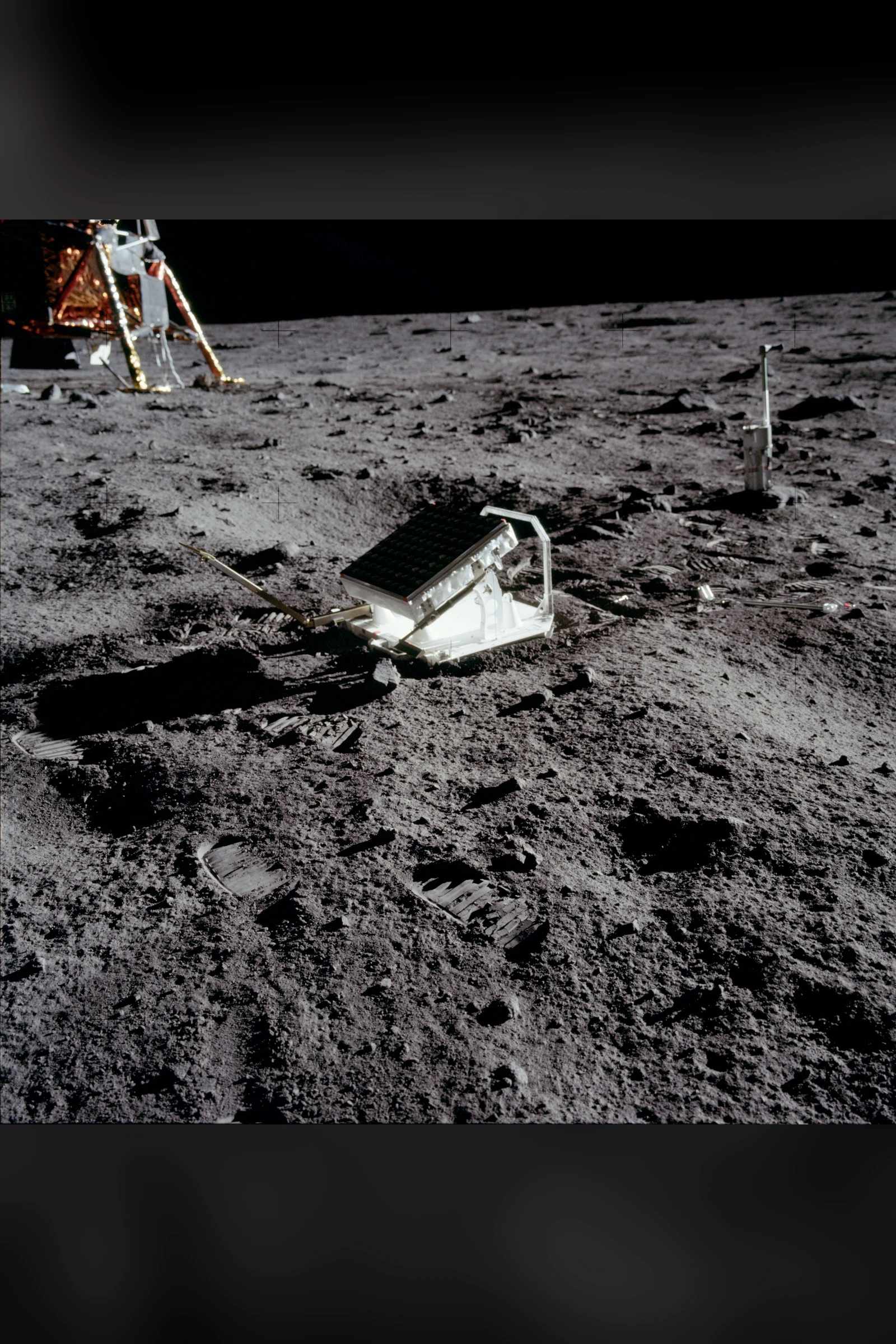
The Apollo 11 laser reflector sits on the Sea of Tranquility, about 20 metres south of where the lunar module stood: an aluminium panel about 46 centimetres across, holding 100 corner cubes of fused silica in ten rows of ten. It has no power supply, no wires and no moving part. The mission record says Apollo 11's crew set it there in July 1969. Since 1976 a line of writers has said that no crew set anything there at all.
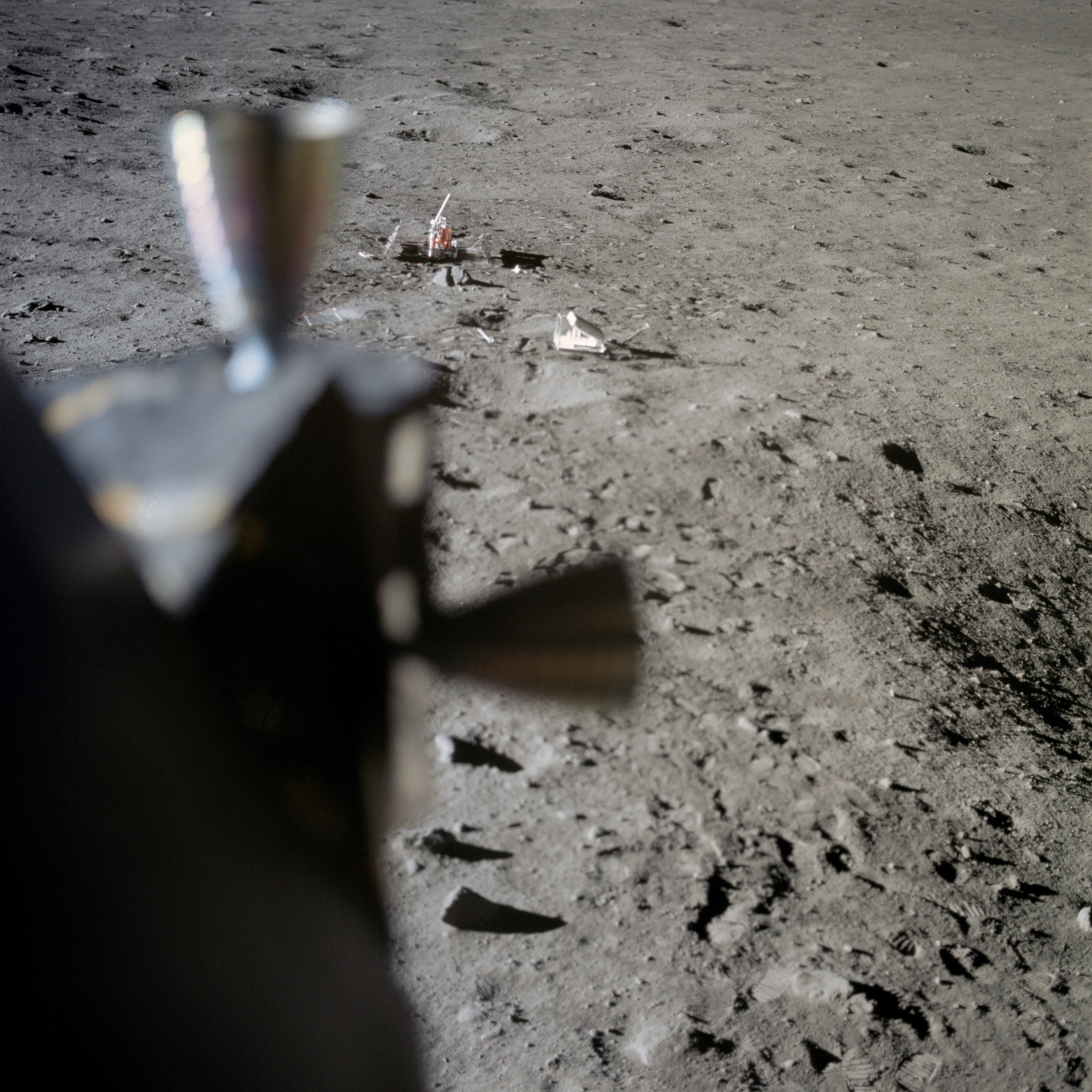
NASA frame AS11-40-5952 shows it propped on its bracket, tipped up off the grey ground, with boot treads pressed into the dust around its foot. Far behind it, small in the corner, the lunar module stands on foil-wrapped legs under a black sky.
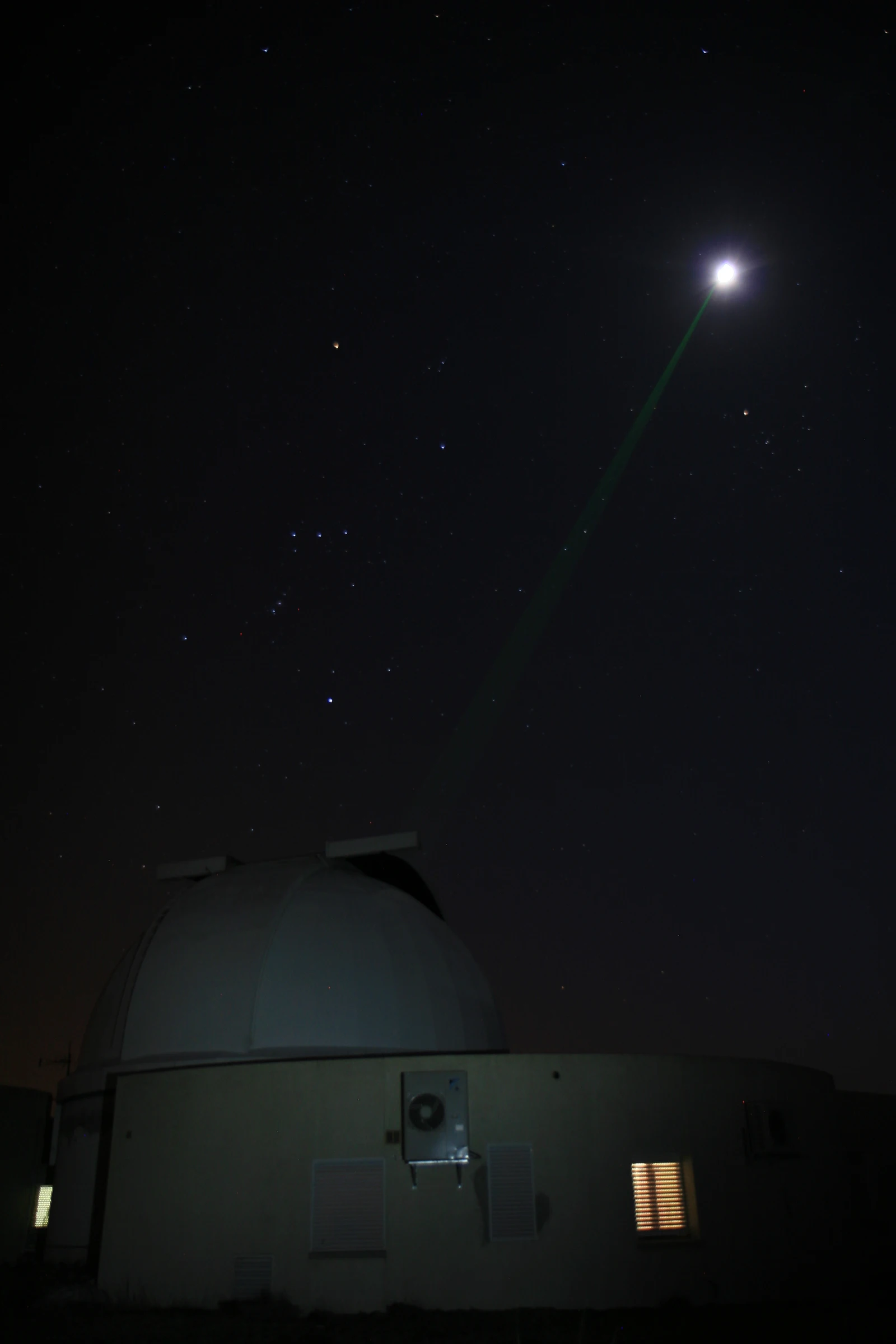
Each cube is three faces of glass meeting at a corner, with no silver on them. Light that goes in comes back the way it came. A pulse of laser light climbs out of an observatory and spreads across a patch of Moon more than a kilometre wide. Of about 300 quadrillion photons fired by a modern station in one pulse, a handful come home.
It is still answering.
Echoes at Lick Observatory
The panel began as a rubber ball. On 25 March 1962 Jim Faller, who had come up through Robert Dicke's gravity group at Princeton, wrote a note proposing a corner cube set in a 25-cent ball from Woolworths, to be rolled off a Surveyor lander onto the Moon. Dicke's reply survives: "Perhaps we could discuss this. Bob Dicke."
By May 1965 it was a paper in the Journal of Geophysical Research with seven names on it, and Carroll Alley of the University of Maryland became its principal investigator. NASA approved it in June 1967. Then, on 6 September 1968, the team learned that the first crew might be too short of time outside for the planned instrument package. A passive panel takes minutes to set down. Faller: "The experiment was quite literally saved by the clock!"
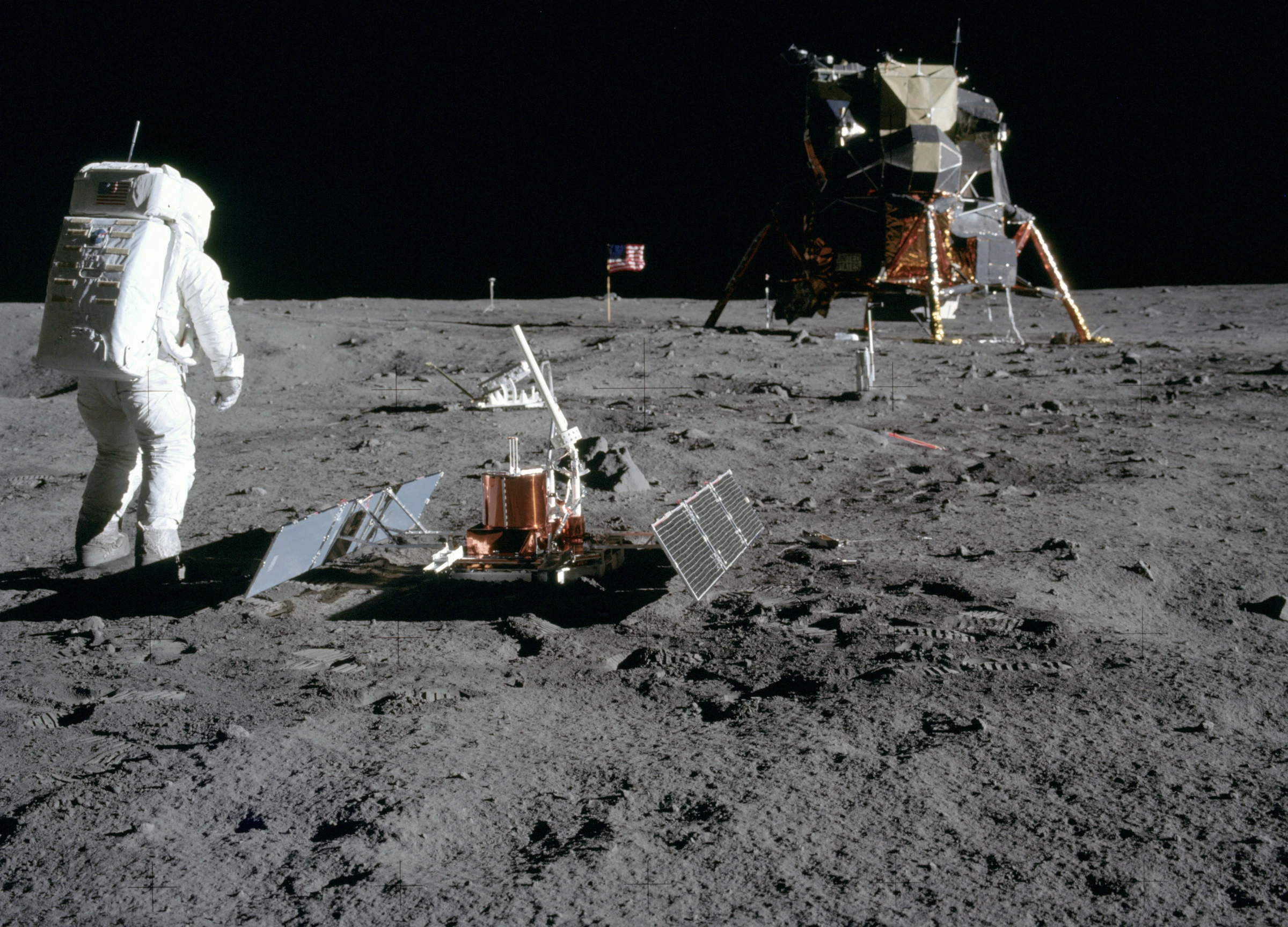
On the surface it came down to a search for flat ground. Aldrin: "Well, it's going to be a little difficult to find a good level spot here." Then, 110 hours and 59 minutes into the mission: "Okay; how about I put the LR-cubed right about here?" Five minutes later Armstrong told Houston: "The laser reflector is (pause) installed and the bubble is level and the alignment appears to be good."
The telescopes started that same night and got nothing. At Lick Observatory in California the team searched for four days on the 120-inch telescope, then stopped to rework the equipment. On 1 August 1969, by Faller's later count, the laser fired 162 times across nine runs before anyone recognised a return (NASA's 1969 report gives 169 shots for the night). A last series of 120 shots followed.
About one hundred came back above the background.
The crew were already home. The timing fixed the distance to the Moon with a single-shot accuracy of about 8 metres. Faller and his colleagues reported it in Science that October.
The Book That Said Nobody Went
Bill Kaysing put the doubt between covers. We Never Went to the Moon, with America's Thirty Billion Dollar Swindle on the cover, came from Eden Press of Fountain Valley, California, in 1976, by Kaysing and Randy Reid. A Rocketdyne letter in the book says he worked for the engine maker, first as a senior technical writer, from 1956 to May 1963. He put the chance of success at ".0017 percent" and wrote, "In other words, it was hopeless." The pictures, he said, came from a set in Nevada. The empty black sky was part of his evidence.
He was not the first: an informal Knight Newspapers poll in 1970 found more than 30 percent of its 1,721 respondents suspicious of NASA's claims. But Kaysing's was the book NASA answered. Its fact sheet of June 1977 cited him and opened: "Yes. Astronauts did land on the Moon."
Then the idea found a screen, as other official stories had. Capricorn One staged a Mars mission in cinemas before the decade was out, and in February 2001 Fox's Conspiracy Theory: Did We Land on the Moon? put Kaysing, Bart Sibrel and David Percy before a network audience. In July 1999 Gallup had found 6 percent saying the landing was staged or faked.
Mary Bennett and David Percy, in Dark Moon (1999), and their publisher Aulis hold that the surface pictures were staged, that the astronauts "conceivably never left low-Earth orbit", and that this was an authorised operation rather than "a conspiracy engineered by a cabal". In 2002 Marcus Allen, UK publisher of Nexus magazine, told the Sunday Telegraph: "Getting to the Moon really isn't much of a problem - the Russians did that in 1959," he said. "The big problem is getting people there." His account: NASA sent robots and faked the crews, because radiation was lethal.
On that reading the panel answers nothing. L. D. Smullin and G. Fiocco of MIT got laser echoes off the bare Moon in May 1962, and a Soviet team in Crimea did it in September 1963. Robots carried reflectors too: Lunokhod 1 in November 1970 and Lunokhod 2 in January 1973, both with French-built arrays. An echo needs no mirror, the reply runs, and a mirror needs no crew.
An online handbook written to answer these claims grants half of it: "Strictly speaking, however, these devices cannot be used as indisputable evidence of crewed Moon landings."
If No One Walked There
Set aside for a moment whether it is true. Ask the better question. What follows if it is?
On Allen's reading the panel is a prop. A machine would have reached Tranquility Base before 1 August 1969, unannounced, and put down a working array on the exact spot where the flight plan, the transcript and the photographs place two men. Every boot print in frame 5952 would have been made on a set, and matched by hand to a place nobody had stood.
If the crews stayed in low orbit, six landings would be six productions, carried for three and a half years, and 382 kilograms of labelled rock and soil would have to come from somewhere else. A rival superpower with its own telescopes would have missed it, or stayed quiet.
It would change what we think our species has done. We would have spent more than half a century remembering a place we never went. If the crews did stay in low orbit, as Aulis says they conceivably did, the record for human distance from Earth would not have been set in 1970 by the crew of Apollo 13. It would belong to the four people aboard Artemis II, who swung past the Moon in April 2026 and reached 406,771 kilometres from home. That flight would not have been a return. It would have been the first time anyone left.
And one consequence is still in front of us. Crews are meant to land on the Moon again. If a record of that size could be manufactured once, we would have to ask what could ever count as a record: which photograph, which rock, which echo a later generation should accept, and from whom.
What the Standard Account Rests On
The standard account rests on physics and on dates. NASA's Apollo 11 Preliminary Science Report gives the physics: the curve of the Moon stretches a short pulse into microseconds off bare ground, and an array, being small, does not. The Crimea team measured what bare ground costs: 150 to 300 kilometres of accuracy in 1963, about 200 metres in 1965. Lick's first shots at the reflector reached about 8 metres. Stations now work to about a millimetre.
The Apollo 11 array answered in August 1969, 15 months before the first robot reflector reached the Moon. Faller records the only American robot route closing first: "The possibility of retro-reflectors being carried on an unmanned NASA mission had disappeared with the close of the Surveyor program." The last Surveyor flew in January 1968. The handbook that grants the crew point adds that the arrays show the United States could put instruments "exactly where they claim to have landed astronauts on the Moon".
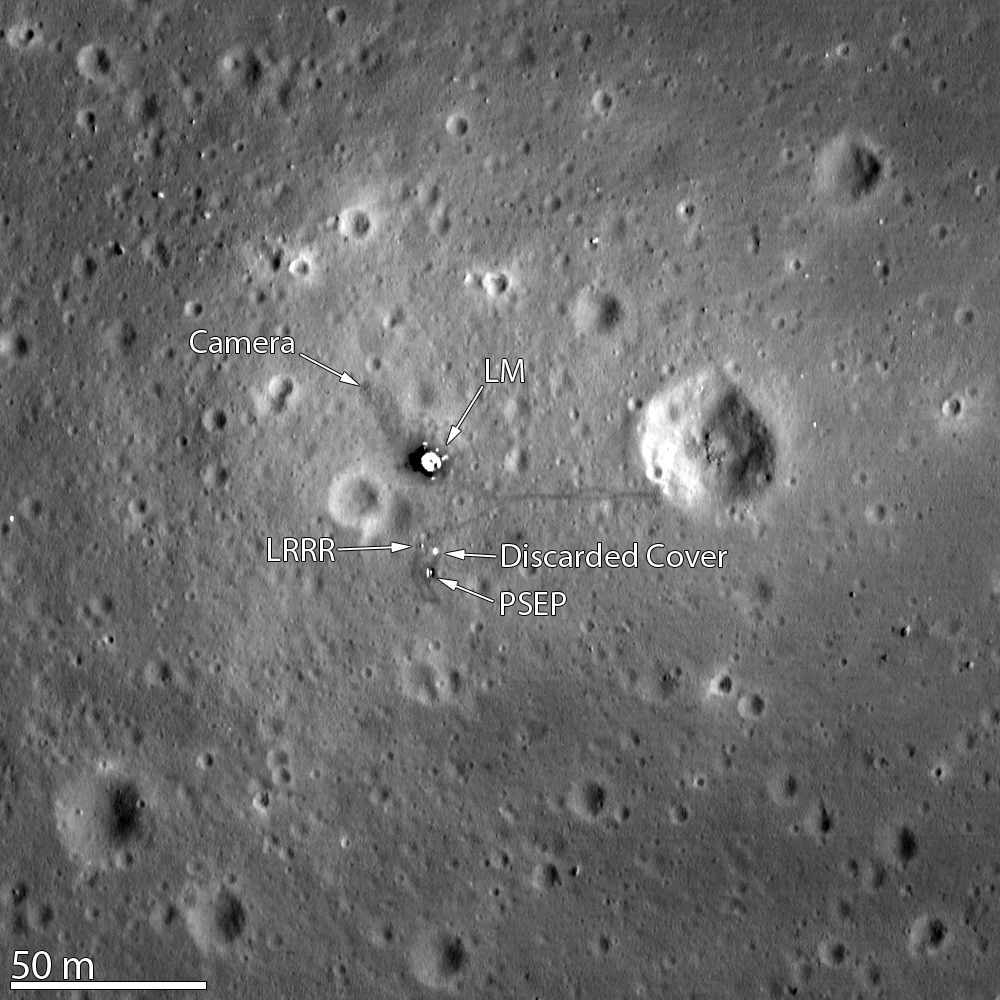
Apollo returned 382 kilograms from six sites; three Soviet robots returned 300 grams. NASA's Lunar Reconnaissance Orbiter has photographed the array and its discarded cover from about 24 kilometres up. The Lebedev Institute ranged "all lunar retroreflectors" from 1973 on equipment made "in the Soviet Union", some of the work in collaboration with the American team, and by 2013 the French station at Grasse had supplied about half of all ranges. Kaysing left Rocketdyne six years before Apollo 11 and gave the ground of his disbelief as "a hunch, an intuition". On this record the weight lies with the landings.
What That Does Not Reach
The panel carries no signature. It shows that an object was at Tranquility Base by 1 August 1969. It does not show whose hands set it there, and the record's own defenders say so. Past that point the argument rests on dates and on the absence of a machine.
Official X searched for any record of an American robot carrying a reflector to the Moon before August 1969, and found none. The nearest thing is Surveyor 5, which came down in the same sea in 1967, about 25 kilometres from Tranquility Base. Moscow is less clear. A Soviet rover was destroyed at launch on 19 February 1969, five months before Apollo 11, so it never reached the Moon. Faller asked the Russians he met whether it carried a reflector, and reports the one reply he got: "only the (Russian) military knows."
Then there are the tapes. The sharpest recording of the first moonwalk was the raw slow-scan video kept at the tracking stations, by one engineer's estimate 15 reels at each of three stations, 45 in all. A search begun by a Parkes scientist in the 1990s drew in NASA engineers. They did not find them. NASA's 2009 report concludes that they were reused during a tape shortage in the early 1980s, or thrown out. Converted broadcast copies survive. The originals do not. A former Goddard chief said tapes would not have been wiped without approval from Johnson Space Center: "Neither he nor anyone else, however, could recall the name of the person who would have made that call."
The rocket's paper has holes as well. Dwayne Day, writing in The Space Review in 2006 after visiting the archives, found hundreds of thousands of pages on microfilm and "nothing close to a complete set" of Saturn drawings. His explanation is that much of it was never meant to be saved, and that contractors held their own records.
The Hundred Faces
The panel has since changed its own subject. In 2010 Tom Murphy's group at UC San Diego, firing from Apache Point in New Mexico, reported that the three Apollo arrays had faded: down by a factor of ten at every phase of the Moon, and by another ten near full Moon. Neither loss existed in the earliest years.
During the total lunar eclipse of 21 December 2010, the signal climbed far past anything seen at full Moon. The group's reading is dust over about half of each front face, soaking up sunlight and warping the cubes.
That is an inference from light. Nobody has been back to look.
New glass is there now. On 2 March 2025 Firefly's Blue Ghost lander set the University of Maryland's NGLR-1 reflector down in Mare Crisium, and the next morning Grasse logged more than 1,000 ranges to it. Its first strength estimates were made against one yardstick: the Apollo 11 array.
That leaves one object. It shows that something stood at Tranquility Base by August 1969, in the place and in the week the mission record says, and the record around it leans hard toward the landings. The staged reading would still need its machine. How much lies on those hundred faces, what it is, how it got there: the lasers cannot say. A visit could read the glass, and the treads at the foot of the bracket. It might not satisfy everyone. Allen said in 2002 that he would take a sighting of the lander as "powerful evidence that something was placed on the Moon by man", and not as proof that men went.
The panel takes no side. It sends back what it is sent.
Questions This Leaves You With
Is there anything a person actually does with this?
Nothing in your own life turns on it, and anyone selling you a secret or a date is selling something. What you can do is read. The Apollo Lunar Surface Journal sets the transcript beside the photographs, and the five minutes it took to place this panel take about five minutes to read. The Preliminary Science Report is free to download. The larger question is one no society has settled: how to keep the record of what it did so that it can still be checked fifty years on. The lost reels show how easily that fails.
Does this sit against a religious account of the world?
It cuts both ways, and the record shows both. On Christmas Eve 1968 the Apollo 8 crew read the opening verses of Genesis from lunar orbit to a worldwide broadcast. You may hear that as reverence at the edge of creation, or as a state borrowing scripture for a Cold War broadcast. Whether the flights enlarge a created world or trespass on it is not a question a laser can answer, and the panel of glass touches neither reading. This site will not tell you which way it falls.
Does this change what a human life is?
Set a working day beside that panel. Two people spent minutes hunting for level ground, and what they put down has outlasted most of the careers that built it, with no power and no care. One reaction is that a life looks small beside a thing that keeps answering after its makers have gone. Another is that those five minutes make a single day look enormous. And if the crews never went, the same panel asks something colder: how much a people will believe about itself. You may already know which of these you felt first.
What would change your mind, in either direction?
Name it now, before you are committed, because it gets harder later. Toward the staged reading: a dated American record of a machine able to land a reflector before August 1969, or a launch that fits no published flight. Toward the mission record: pictures of the Tranquility hardware taken and released by an agency with no tie to NASA, or the treads seen by someone standing there. Japan's Kaguya orbiter reported the pale halo left by Apollo 15's engine in 2008, which shows disturbed ground rather than hardware. Decide how much that counts for you, and why.
Who signed off on the tapes?
This is the empty space. The 2009 report follows the reels to a federal records centre and to a shortage of one-inch tape, and there the paper stops. A former Goddard chief remembered having labels stripped and tapes wiped, and said it could not have been done without approval from Johnson Space Center. Nobody could name who gave it. The report's own verdict is that "At no time did anyone recognize the unique content". There may be a routine form in a box somewhere with a signature on it. There may be none. Nobody has produced it, and that is all that can be said.
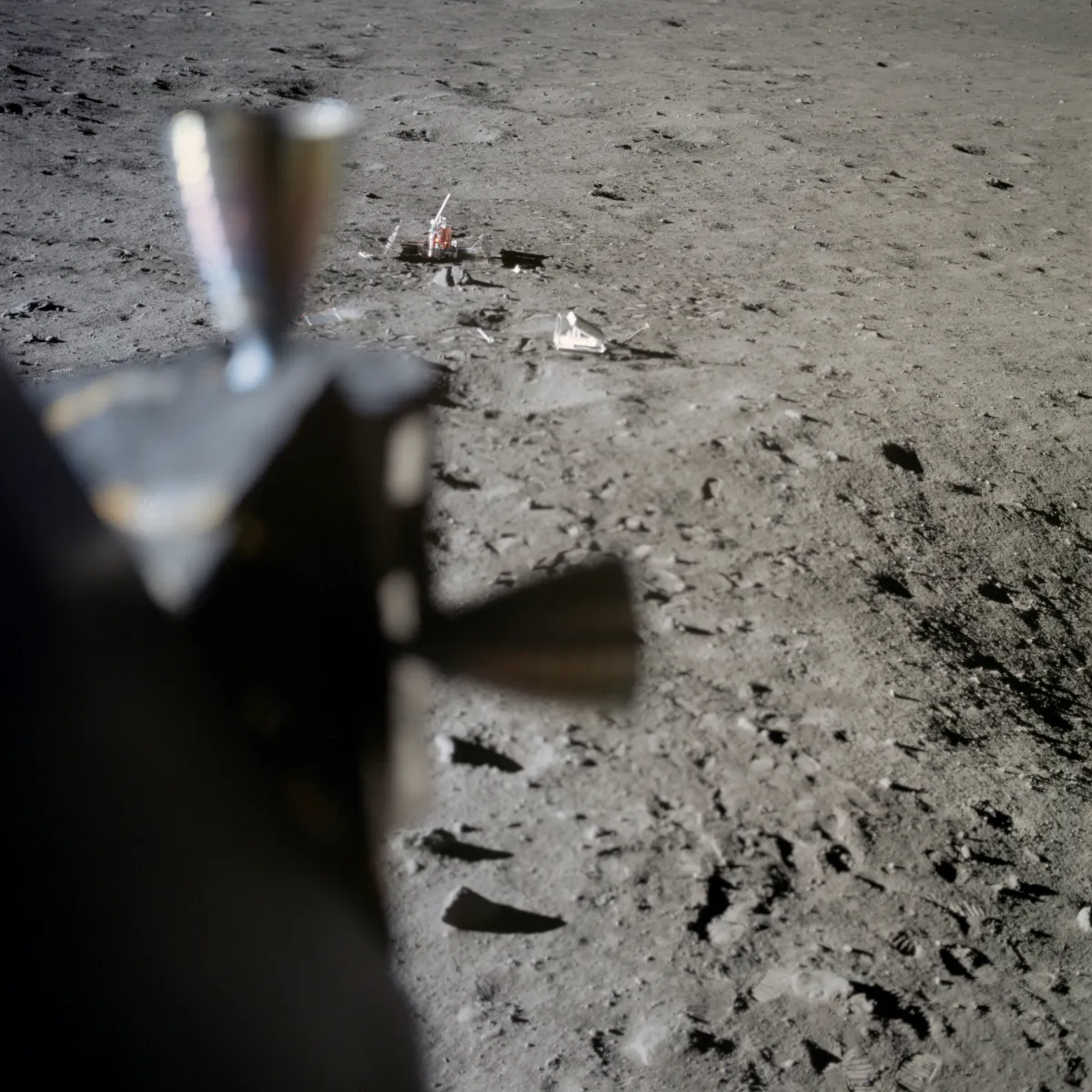
Two Apollo 11 experiments seen from inside the lunar module, NASA frame AS11-37-5551. NASA, Apollo 11 frame AS11-37-5551, public domain. Resized. 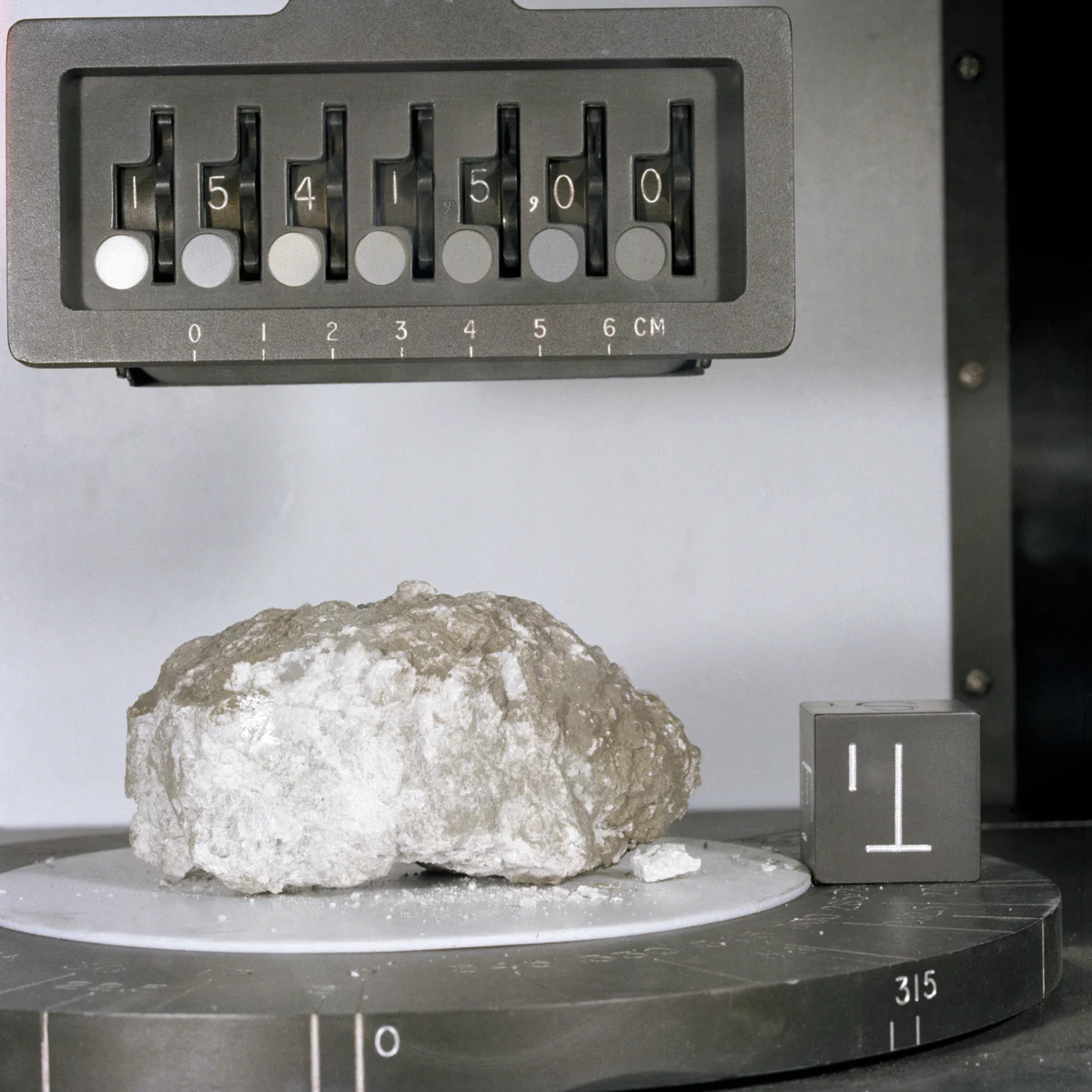
Sample 15415, returned by Apollo 15, photographed at Johnson Space Center in August 1971. It is one of about 2,200 samples from six sites. NASA Johnson Space Center, photograph S71-42955, public domain. Resized.
Sources
- Apollo 11 Lunar Surface Journal: EASEP deployment and closeout Eric M. Jones and Ken Glover, eds. Primary record
- Laser Ranging Retroreflector, Apollo 11 Preliminary Science Report (NASA SP-214), 1969 NASA; Alley et al. Primary record
- Lunar Laser Ranging: a Science and a Story, 19th International Workshop on Laser Ranging, 2014 James E. Faller Primary record
- Laser Ranging Retro-Reflector: Final Report, 1971 C. O. Alley et al., University of Maryland Primary record
- Apollo 11 Lunar Laser Reflector, mission page International Laser Ranging Service Study
- Apollo Lunar Retroreflectors Tom Murphy, UC San Diego Study
- APOLLO: the basics of lunar laser ranging Tom Murphy, UC San Diego Study
- Apollo 11 Mission Report, 1969 NASA Primary record
- Apollo 11 Image Library Apollo Lunar Surface Journal Study
- Lunar Laser Ranging in the USSR, 19th International Workshop on Laser Ranging, 2014 Yu. L. Kokurin et al. Primary record
- Lunar laser ranging: the millimeter challenge, Reports on Progress in Physics, 2013 T. W. Murphy Jr. Study
- Long-term degradation of optical devices on the Moon, Icarus 208, 2010 T. W. Murphy Jr. et al. Primary record
- Lunar Eclipse Observations Reveal Anomalous Thermal Performance of Apollo Reflectors, Icarus, 2014 T. W. Murphy Jr. et al. Primary record
- NGLR-1 status report, 17 October 2025 University of Maryland NGLR team Primary record
- We Never Went to the Moon, catalogue record (Eden Press, 1976) Open Library Primary record
- Moon Hoax: Debunked!, 4.7 Bill Kaysing, 2017 Paolo Attivissimo et al. Study
- Who Started the Moon Landing Hoax Conspiracy Theory?, 2019 Today I Found Out Study
- Moon Hoax: Debunked!, 4.6 Origins and history, 2017 Paolo Attivissimo et al. Study
- Apollo 11 moon landing: why conspiracy theories have endured, 2019 Meghan Keneally, ABC News Study
- Why Are There No Stars in Space Photos?, 2026 Official X Study
- Capricorn One Wikipedia General reference
- The Fox special, February 2001 Jim Scotti, University of Arizona Study
- Did Men Really Land on the Moon?, 1999 Gallup Primary record
- Aulis: the Apollo investigation Aulis Online Primary record
- Dark Moon: Apollo and the Whistle-Blowers Mary Bennett and David S. Percy; Aulis Primary record
- Sunday Telegraph, 24 November 2002, Robert Matthews (repost) Free Republic repost of The Sunday Telegraph Study
- Optical Echoes from the Moon, Nature 194, 1962 L. D. Smullin and G. Fiocco Primary record
- Moon Hoax: Debunked!, Mirrors on the Moon, 2017 Paolo Attivissimo et al. Study
- Artemis II's record-breaking journey around the moon ends with dramatic splashdown, April 2026 Associated Press via WTOP Study
- Lunar Rocks and Soils from Apollo Missions NASA Astromaterials Curation Primary record
- Surveyor 7 NASA NSSDCA Primary record
- Surveyor 5 NASA NSSDCA Primary record
- Apollo 11: A Stark Beauty All Its Own, 2012 NASA Goddard Space Flight Center Primary record
- The Apollo 11 Telemetry Data Recordings: A Final Report, 2009 NASA Goddard Space Flight Center Primary record
- The Saturn V blueprints, 27 March 2006 Dwayne A. Day, The Space Review Study
- Apollo 8: Christmas at the Moon NASA Primary record
- The halo area around Apollo 15 landing site, 20 May 2008 JAXA Primary record