
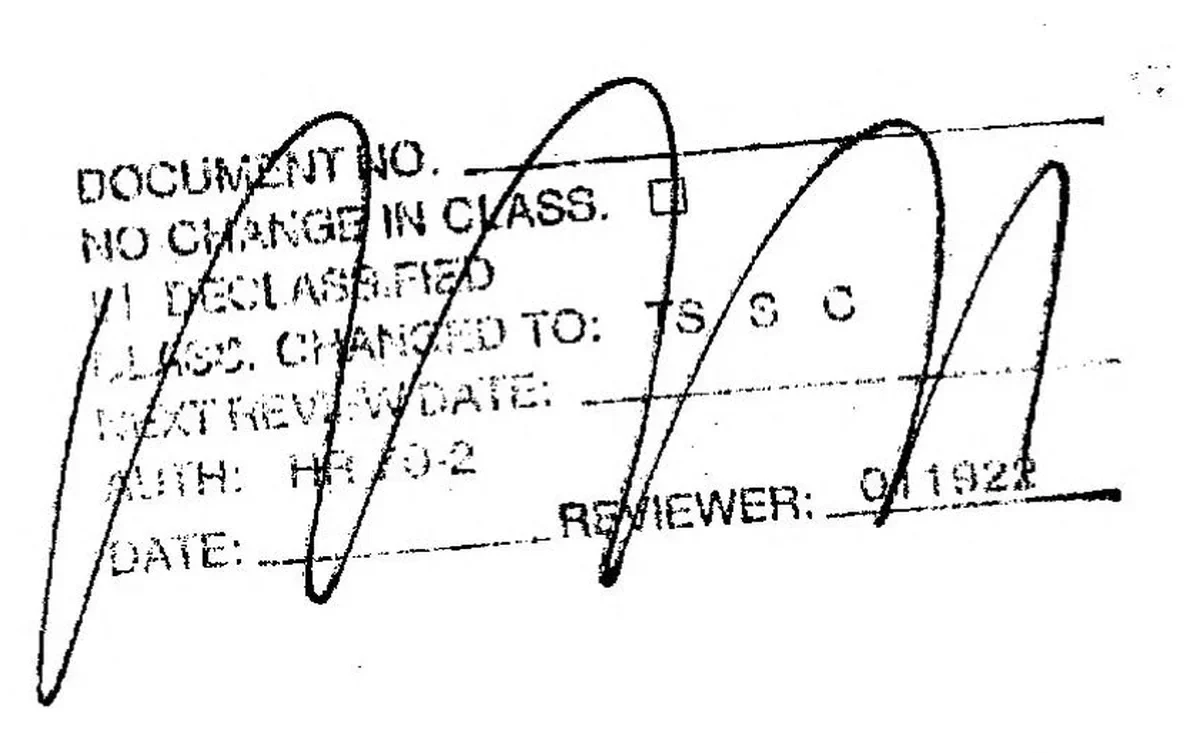
The document behind the claim that the CIA acknowledged Tartaria is a typed paper of 14 pages called National Cultural Development Under Communism. The cover gives a month, June 1957, and a review stamp with pen loops running through it. No author. No office. No letterhead, anywhere in it.
Nearly all of it is about Muslims under Soviet rule. How many mosques stood in European Russia in 1917, how many in the whole Union by 1942. What became of the religious schools, the holy law, the fast, the road to Mecca. A refrain comes round like a bell: "Such is the manner in which the Communists respect Muslim beliefs and customs, Muslim national and cultural institutions!"
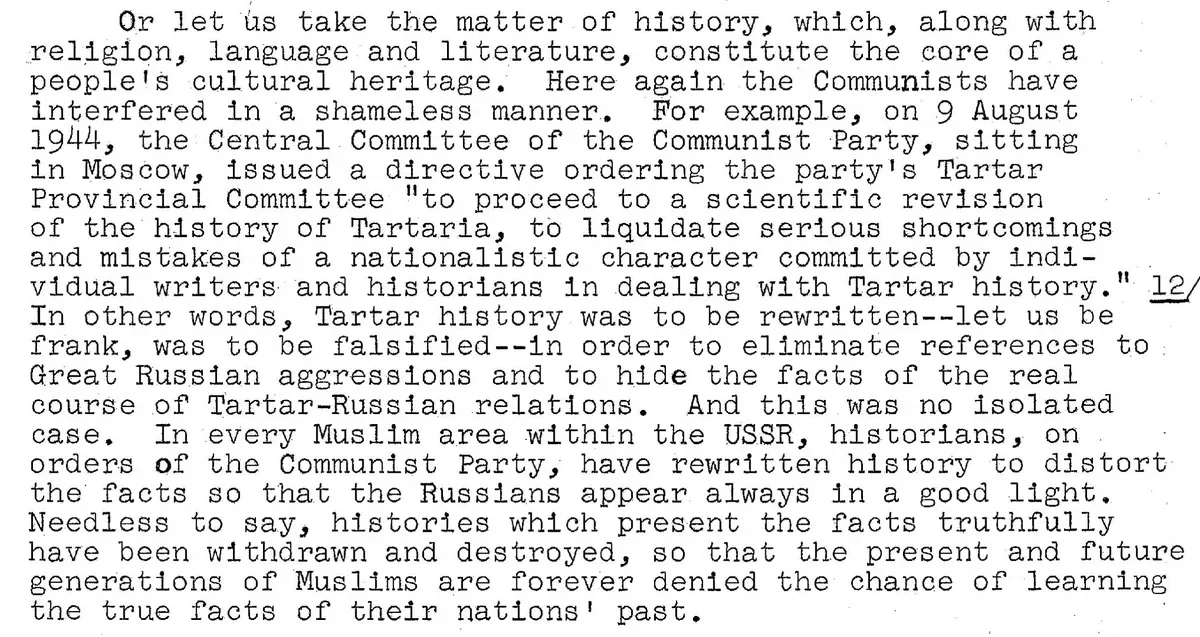
Then page 9, and a paragraph on history. A directive of 9 August 1944, from the Central Committee of the Communist Party, sitting in Moscow. An order "to proceed to a scientific revision of the history of Tartaria". A gloss straight after it: "let us be frank, was to be falsified". And a few sentences on, histories that "have been withdrawn and destroyed".
The word appears once. It carries an empire now.
The Paper and the Thread
The paper sits in the CIA's online reading room as CIA-RDP78-02771R000200090002-6. Two dates mark its release and they disagree: the catalogue record says 22 July 1998, and the stamp across every page says 1999/08/24. On the cover the No Change box looks empty, and a pen stroke runs through the box beside Declassified. Thirteen pages after the cover, the last of them a list of 15 sources, every one an open publication.
The earliest reading of it for Tartaria found so far came on 17 April 2018. KorbenDallas, an administrator of the forum stolenhistory.org, opened a thread called Tartary - an Empire hidden in history, built on the 1771 Britannica and the name on the old maps of Asia. Near the top he set an excerpt from the paper, "to add some credibility (or to take away some)", and dated it: declassified in 1998, created in 1957. He added a doubt of his own, that Tartary had been solely Muslim. Then came a heading, The Coverup, and the line the rest of the story would run on.
"The official history is hiding a major world power which existed as late as the 19th century."
The excerpt travelled. On 17 April 2024, six years later to the day, a Facebook group called Tartaria presented it as a fresh find from digging in the CIA files.
An Admission on a Government Page
For the writers who followed KorbenDallas, the source is the point. Not a forum, not a video channel: a paper released by the Central Intelligence Agency, under its stamp, using the word. Sage O'Quay, on Substack in March 2026, called it the work of a CIA analyst, explaining "the mechanism of historical erasure in plain, bureaucratic language". One stamped sheet can carry a story for decades, as the one-page Hottel memo of 1950 has.
The page gives them a great deal. It names the hand: the Central Committee, in Moscow. It names the date. It says what was wanted, and what for: rewritten, falsified, "to eliminate references to Great Russian aggressions and to hide the facts of the real course of Tartar-Russian relations". And it refuses to call this one case. "In every Muslim area within the USSR", it says, historians on party orders rewrote the past, and truthful histories went, so that generations "are forever denied the chance of learning the true facts".
O'Quay's reading is the hardest form: "a government ordered the falsification of an entire territory's history". On the Substack Tartarian Tantra, Ryan turned it around in 2023: "CIA tried to cover up the history about Tartaria". Allan Cornford, in a book of 2022, gives the page count and the 1999 release and quotes the passage, then goes somewhere else again: he calls Tartaria itself "a cleverly managed PSYOP".
The claim takes its full shape when this page is set beside the old maps. A word covers Asia for centuries. The word goes. And here, on a government page, is an order about it. Which would make the disappearance a decision, with a date, a committee and a city attached.
If the Order Was About an Empire
Set aside for a moment whether it is true. Ask the larger question. What kind of history are we living in if it is?
It would mean, first, that the largest country on the old maps did not fade but was struck out, by a committee, in a single summer, while the war was still being fought.
It would mean that the Tatars of Kazan, and every people named on those old sheets, were what remained of a power their own schoolbooks could not mention. A nation's grandchildren would have sat in classrooms, learning somebody else's past.
It would mean that our record of the past is thinner than it looks. If one state could reach into every library from the Baltic to the Pacific and take out a whole nation, then every atlas we own would be a survivor of something, and the shelves we trust would be the shelves that were allowed.
It would reach further than Asia. If our sense of who we are rests on what the dead wrote down and what the living kept, and one paragraph could end a people's memory of itself, then memory would be the most fragile thing we have made, and our kind might be losing it, on that reading, faster than it has been making it. Every history we have would stand on the same footing as that vanished one, waiting for its committee.
And one consequence would still stay in front of us all. On that reading the proof came out of an archive by accident, in a paper about something else, released and overlooked. Which would leave the question of what else is sitting in a released file, in plain type, waiting for someone who knows what the word means.
Note 12
Lead Stories ruled in April 2024 that the file does not validate the empire, with Sarah Thompson tracing the excerpt back to the 2018 thread and taking the name for the old label on Central Asia and Siberia. The small mark after the quotation points somewhere closer. Note 12, on the paper's last page, cites Walter Kolarz, Russia and her Colonies, 1952, quoting the Soviet journal Propagandist of 1944. Kolarz, a journalist, uses Tartaria as his name for the Tatar republic on the Volga, capital Kazan: "the government of Tartaria". He glosses the party paper Kzyl Tatarstan as "Red Tartaria". Of the Crimean republic he writes that "Crimean Tartaria finally vanished from the scene" after the war, a sentence that could be lifted whole into the story. H. N. Brailsford, in a book of 1927 that describes a visit to Kazan, called the same republic Tartary for short.

The resolution survives in the party's published collections. Point 7 tells the Tatar regional committee to organise the scholarly working-out of "istorii Tatarii". Revision is the English in Kolarz. Tatariya was the republic's everyday name: the word comes eight times, for its party bodies, its people, its newspaper Krasnaya Tatariya and the past of that land. The Russian for Tartary does not occur, nor the word for empire. A parenthesis the CIA paper leaves out names the errors: embellishing the Golden Horde, popularising the epic of Idegei.
On this account the order concerned how the Tatars of one Soviet republic told their past. It came more than 40 years after Tartary, in Svetlana Gorshenina's history, had left scholarly use. No order naming Tartary or a Tartarian state turned up in the search for this article.
What the Order Did
However far that reaches on the word, it does not make the order small.
It was a real order, and Kazan acted on it. The Golden Horde was a real steppe state, and the way Tatars remembered it was the target. Early in the war front newspapers had used the Idegei epic to raise the spirits of Tatar soldiers. By the autumn of 1944 it had been declared harmful. Iskander Izmailov, in Rodina in 1997, follows the Tatar committee's session of 6 October into the Institute and the curricula. I. M. Mirgaleev and his colleagues, in Golden Horde Review in 2023, have the whole genre falling out of research plans, and Idegei unstudied until 1988. How far the freeze went is argued over in Kazan: the History of the Tatars, as Alfiya Gallyamova quotes it, says about three decades, and Gallyamova argues in 2019 that this overstates it, since Tatar scholars kept working.
Other republics show the same pattern, short of the word destroyed. Kolarz, in the same book, says the History of the Kazakh S.S.R. of 1943 was "withdrawn from circulation". The Turkmen editors of the 1951 Dede Korkut, an epic the paper names, got 25 years, and Muradgeldi Soegov records that the edition never reached its readers.
And in Crimea the Soviet state took Tatar names, and others, off the map in the literal sense. Order 5859ss of 11 May 1944 sent close to 200,000 Crimean Tatars east within days. An NKVD count has 22,355 dead in Uzbekistan in the first year. By May 1948, on the historian Sergei Gromenko's account, more than a thousand place names had been replaced.
"Destroyed" has names attached as well. Damir Iskhakov wrote in 2019 that the manuscript of the Ocherki istorii TASSR, ready for press, was destroyed in 1944, and that the whole print run of a published history of the republic was liquidated in 1951. He gives no footnote there. Izmailov, on the same years, has the Ocherki needing serious reworking and a first volume of the History of the Tatar ASSR published in 1951.
No second source for the destruction turned up.
Who Was It Written For
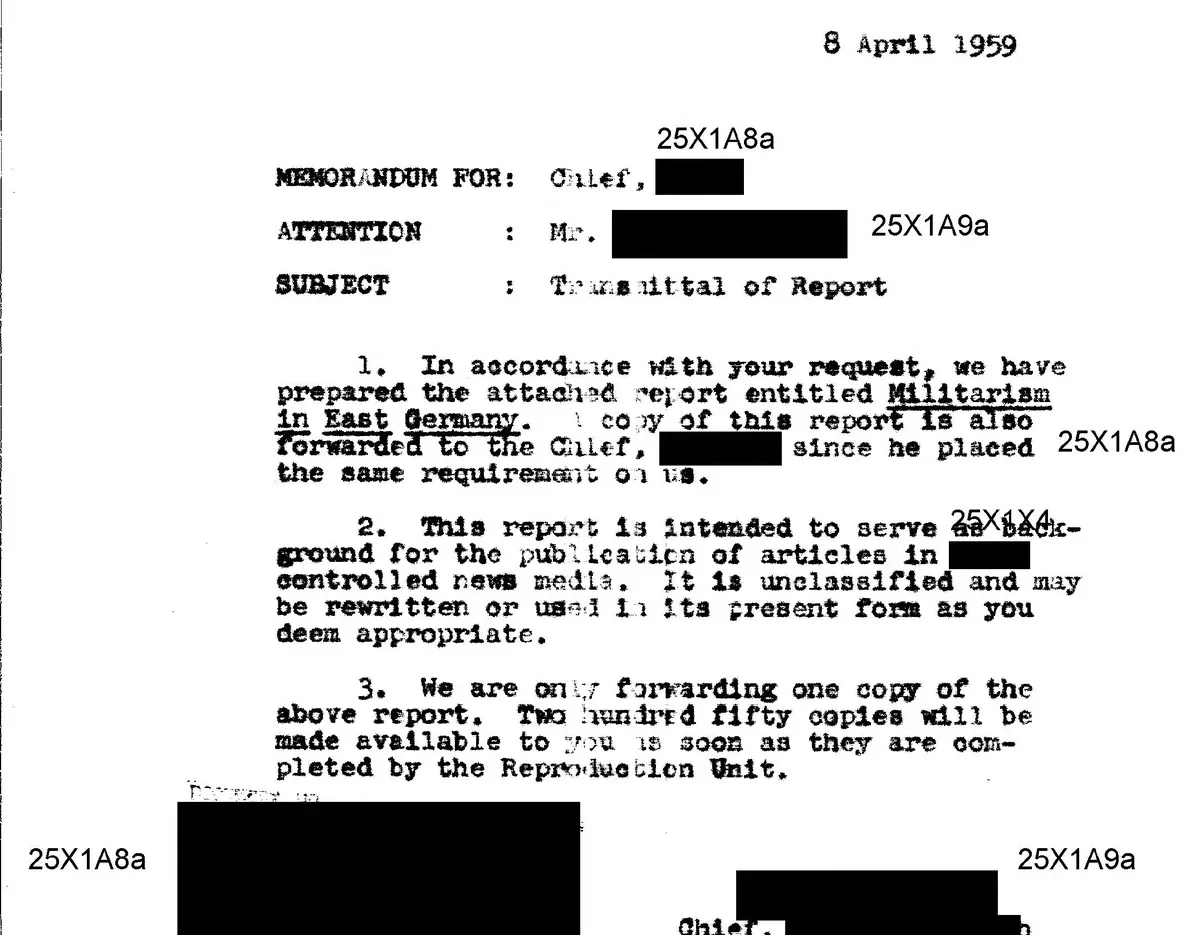
Who wrote the paper is not on the record. Its CIA series suggests what kind of thing it was. Requested studies, some for the Plans directorate. Egypt's Role in the Muslim World, passed on in 1956 as built wholly on overt sources. A record catalogued as Article for publication in (Classified). And a memo of 8 April 1959, about a report on East Germany: background for articles in controlled news media, with what stands before controlled blacked out. "It is unclassified and may be rewritten or used in its present form".
Nasir's Democracy, in the same series, is an unsigned essay telling every Egyptian to "hearken to the words of Allah". Across the 413 series texts searched, it is the only other paper with the phrase "Such is the manner". The Tartaria paper blesses the Prophet each time it names him and ends by telling other Muslim peoples they "would do well to reflect". It reads as text prepared for Muslim readers abroad, with no American name on it. That is an inference. Nothing found shows it was printed, or that one such reader saw it.
A cover note might settle it. The record lists the paper as sequence number 2. Official X tried the document numbers on either side of it on the CIA's site on 30 October 2026, and both came back not found.
What would lift the word from a republic to an empire is a text that does it: a Soviet order naming Tartary, or Tatariya used for a state on the old maps. The record so far has neither. The word has a footnote. A few lines on, the sentence at the centre of the story has none: "histories which present the facts truthfully have been withdrawn and destroyed". Which histories. Whose shelves.
Perhaps it was written to be rewritten. Since 2018, it has been.
Questions This Leaves You With
Is there anything a person actually does with this?
Yes, and it takes about ten minutes. The paper is free on the CIA's site, and page 9 is the one to read, with note 12 on page 13 beside it. Reading it changes nothing in your daily life, and no one needs it to. The larger question is civilizational: how a modern state managed what its peoples could know of themselves, and what that cost. Anyone selling you a hidden date or a secret timeline drawn from this page is selling something. The page itself asks for nothing.
Does this sit against a religious account of the world?
The paper speaks in the voice of a believer, and it may have come from an office writing in that voice. You could take that as an insult to faith, devotion used as a tool. You could also take it as a record that real mosques were closed and, on its account, pious Muslims dismissed from their work, whoever chose to tell it. It cuts both ways. This site will not tell you which way it falls.
Does this change how you think about what you were taught?
Hold your own schooling up against a people told in 1944 that an epic of their own was a mistake. It may make what you know feel smaller and more conditional, a set of lessons somebody approved. Or it may make it rarer: the fact that Idegei came back into print in the late 1980s, after more than 40 years, says something about what people keep when no one is checking. Notice which of those you felt first.
What would change your mind, in either direction?
Name it now, before you are committed. For the claim: a Soviet text that uses Tatariya, or this resolution's wording, for a past empire, or an order about Tartary that does not run through 1944. The sheet of Propagandist itself matters too: Kolarz quotes it on Idegei's raids on Russian towns, words the republished resolution does not have, so it held something the collections do not. Against the claim: a paper from Kazan in 1944 applying the order with no empire anywhere in it. If none of those would move you, ask what would.
Which histories were withdrawn and destroyed?
This is the gap, and it is a real one. The paper names no book. Kolarz names one, in Kazakhstan. Iskhakov names a manuscript and a print run, gives the 1951 title only loosely and cites nothing at that point. A second source, or a discard record from a Kazan library, would turn one writer's line into a record, and say whether his 1951 run is the volume Izmailov describes or another. Whether "every Muslim area" holds is wider still: it would take the same search, republic by republic. Until someone runs it, the line that matters most to the story rests on the least.
Sources
- National Cultural Development Under Communism, June 1957, CIA-RDP78-02771R000200090002-6 Central Intelligence Agency, CIA FOIA Electronic Reading Room Primary record
- CIA catalogue record for CIA-RDP78-02771R000200090002-6, Wayback capture of 19 April 2025 Central Intelligence Agency Primary record
- Resolution of the Central Committee of the VKP(b), 9 August 1944, on mass-political and ideological work in the Tatar party organisation, from KPSS v rezolyutsiyakh, 9th ed., vol. 7, 1985, pp. 513-520 Russian Wikisource, republishing the Central Committee record Primary record
- Russia and her Colonies, 1952, by Walter Kolarz: review record, Journal of Asian Studies 12(4), 1953 Cambridge University Press (a record of the book; the book is in copyright, its pages were read in a scan to check quotations and are not linked) Study
- Kolarz, Walter Kulturstiftung der deutschen Vertriebenen Study
- How the Soviets Work, 1927, chapter 7 H. N. Brailsford, Marxists Internet Archive Primary record
- Idegeevo poboishche, Rodina, 1997, No. 3/4 Iskander Izmailov Study
- Reprisal for the Golden Horde in the mid-twentieth century, Golden Horde Review 7(4), 2019 Alfiya Gallyamova Study
- On the study of Tatar variants of the epic of Idegei, Golden Horde Review 11(4), 2023 I. M. Mirgaleev, I. I. Fazlutdinov, I. G. Zakirova Study
- Idegei, Tatarica encyclopedia F. Urmancheev General reference
- Izobretenie koncepta Srednej/Central'noj Azii, 2019 Svetlana Gorshenina, Central Asia Program, George Washington University Study
- Obraz Zolotoi Ordy i zarvavshiesya tatary, BUSINESS Online, 16 November 2019 Damir Iskhakov Study
- On the Turkmen editions and editors of the Book of Dede Korkut, Vestnik Udmurtskogo universiteta 27(3), 2017 Muradgeldi Soegov Study
- Decree No. 5859ss, 11 May 1944, English translation Seventeen Moments in Soviet History, from Revelations from the Russian Archives Primary record
- The 1944 Soviet Deportation of Crimean Tatars to Uzbekistan and the Urals as Special Settlers, Wschodnioznawstwo, 2024 J. Otto Pohl Study
- On the renaming of Crimean places, Krym.Realii, 22 August 2016 Sergei Gromenko Study
- Transmittal of Report, 8 April 1959, CIA-RDP78-02771R000100300027-6 Central Intelligence Agency, via Internet Archive Primary record
- Nasir's Democracy, CIA-RDP78-02771R000500080004-2 Central Intelligence Agency, via Internet Archive Primary record
- Cover note to Egypt's Role in the Muslim World, 9 March 1956, CIA-RDP78-02771R000500030001-0 Central Intelligence Agency, via Internet Archive Primary record
- Article for publication in (Classified): Communists Exploit Youth, April 1959, CIA-RDP78-02771R000500340005-2 Central Intelligence Agency, via Internet Archive Primary record
- Memorandum for the Deputy Director, Plans, 28 August 1957, CIA-RDP78-02771R000400150001-8 Central Intelligence Agency, via Internet Archive Primary record
- Tartary - an Empire hidden in history, stolenhistory.org, April 2018, Wayback capture KorbenDallas, forum thread Primary record
- Fact Check: Declassified 1957 CIA File Mentioning Tartar History Does NOT Vindicate Tartarian Empire Conspiracy Theory, 19 April 2024 Sarah Thompson, Lead Stories Study
- Declassified CIA Document: The History of Tartaria was Deliberately Falsified, 1 March 2026 Sage O'Quay, Substack Study
- Tartarian Rule? Or Millennial Kingdom?, book excerpt, 2022, as reposted on Basecamp Allan Cornford (a third party's repost) Study
- Whats up with Tartarian hype, 8 October 2023 Ryan, Tartarian Tantra, Substack Study