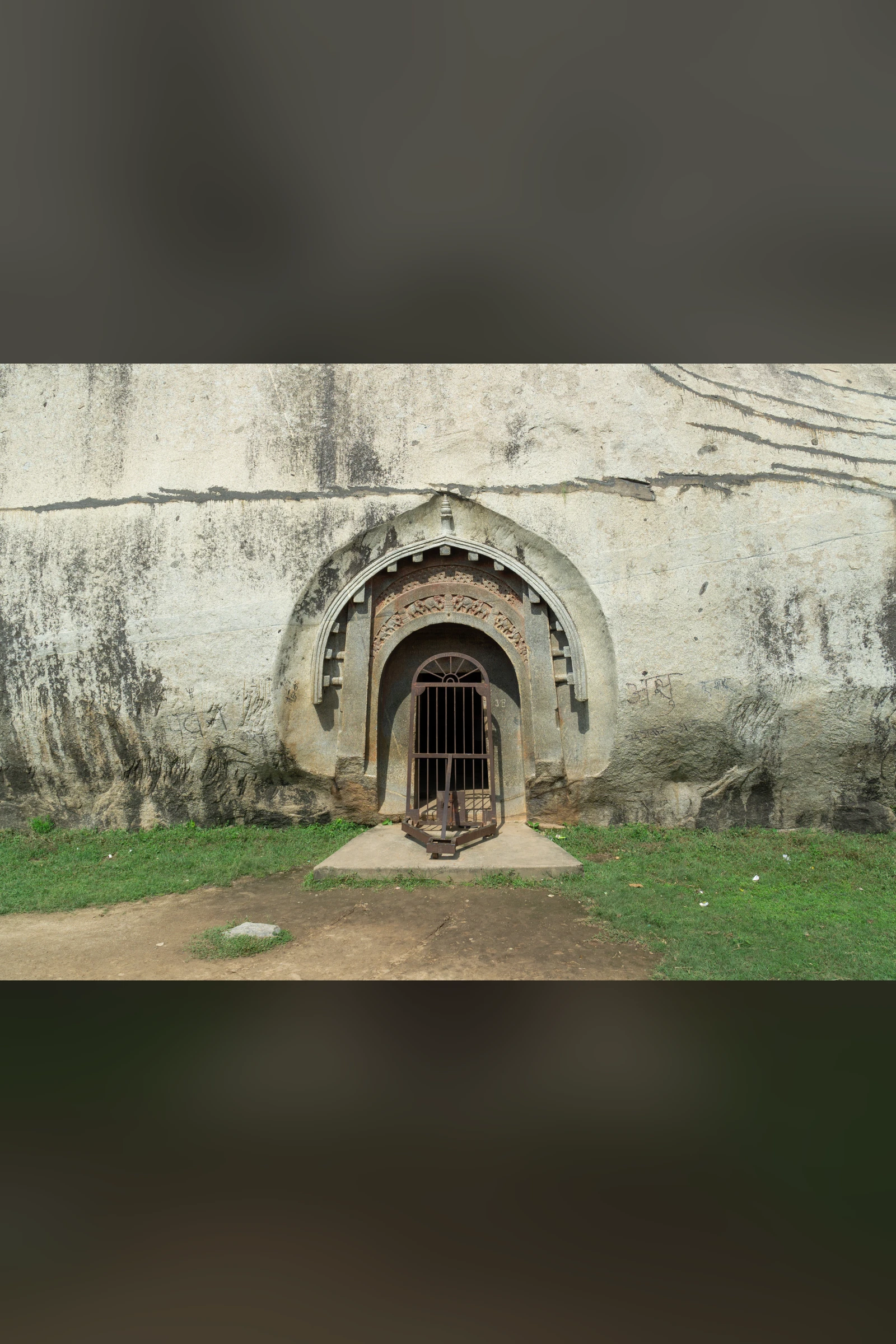
The Barabar Caves are rooms cut into solid granite in the hills of Jehanabad district, Bihar, India, about 25 km north of Gaya. There are four in the Barabar ridge and three on the Nagarjuni hill beside it. Inscriptions at their doors give most of them to a sect of ascetics in the 3rd century BCE.
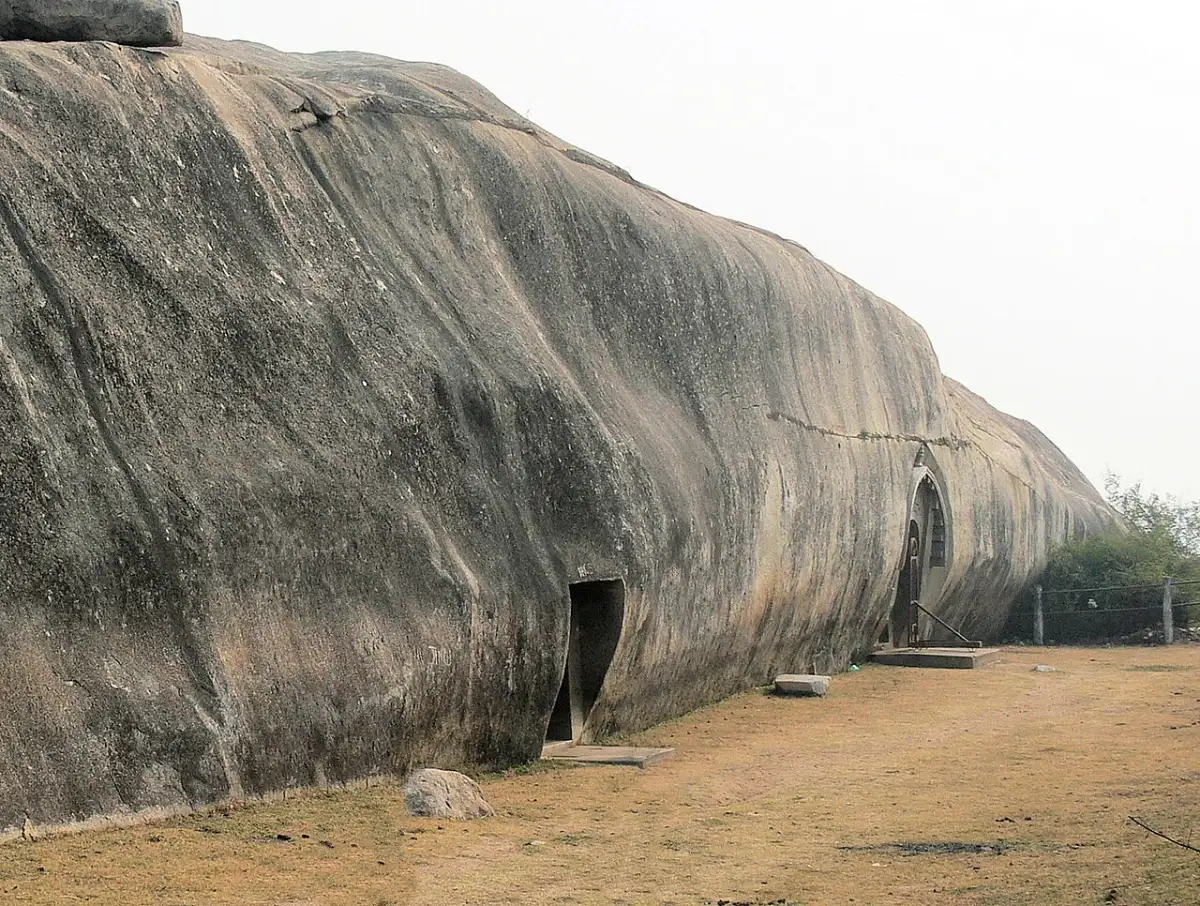
The ridge comes up out of the ground like the back of something asleep, bare grey rock with a dirt path along its foot. In that flank is a doorway about six feet high, narrowing toward the top. The old surveyors called the shape Egyptian.
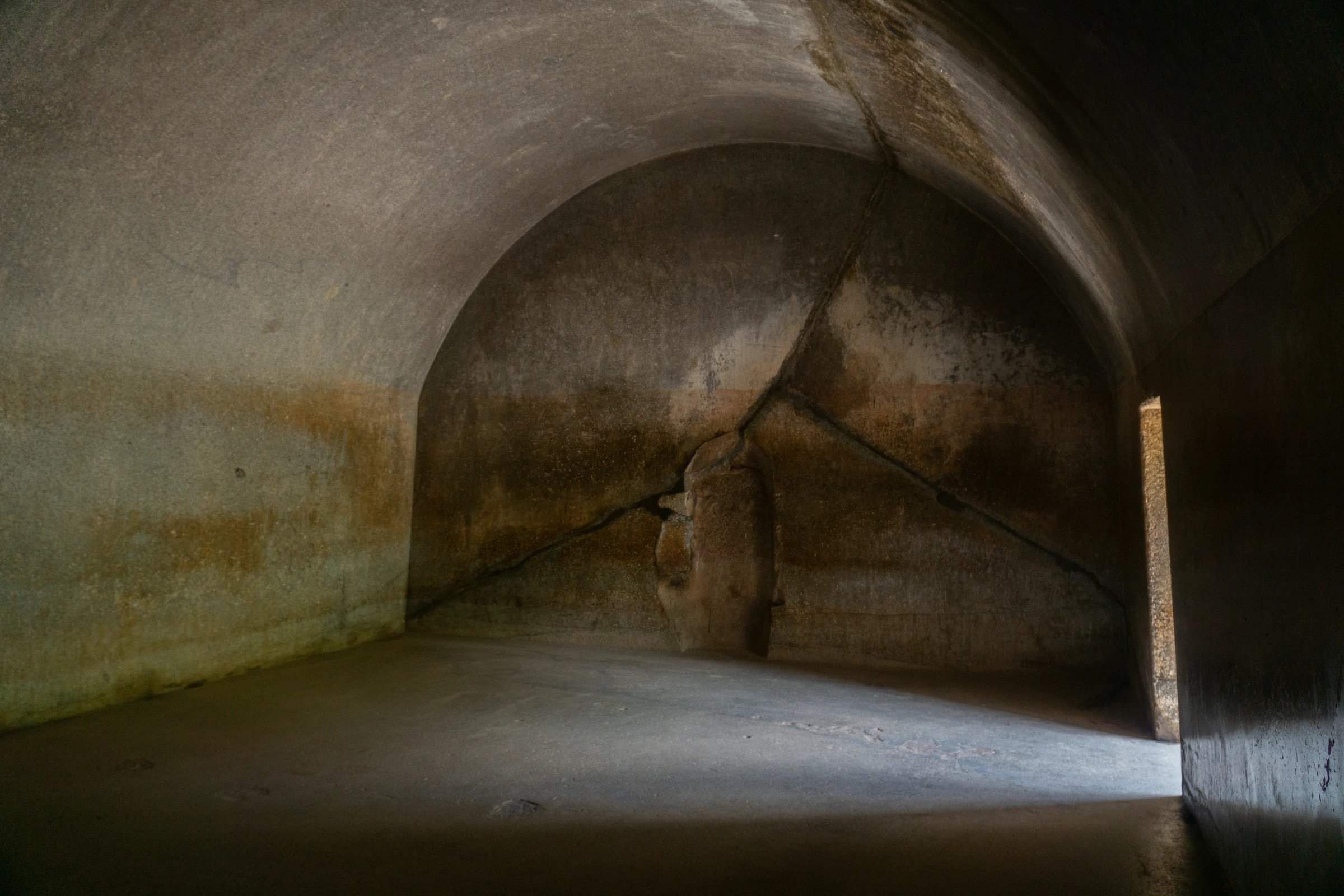
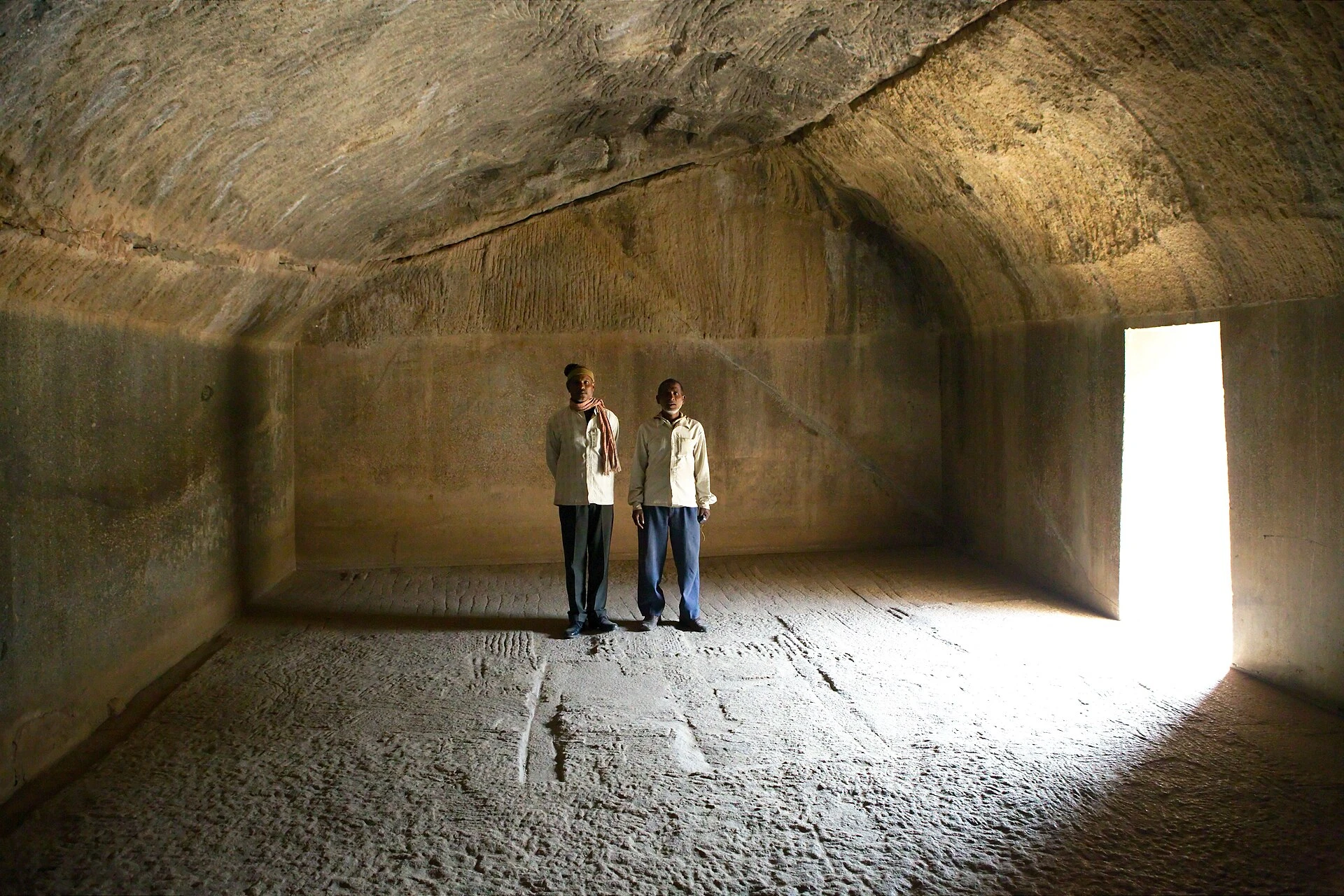
Behind the door of the cave called Karan Chaupar is one vaulted room, 33 feet 6 inches long and 14 feet wide, 10 feet 9 inches at the crown. No block, no joint, no beam. One stone, hollowed out. A flame carried in meets another flame rising out of the rock. A word spoken in the room goes on after the speaker has stopped.
Every surface but the floor shines.
Somebody polished the inside of a hill.
A Night on the Rice Straw
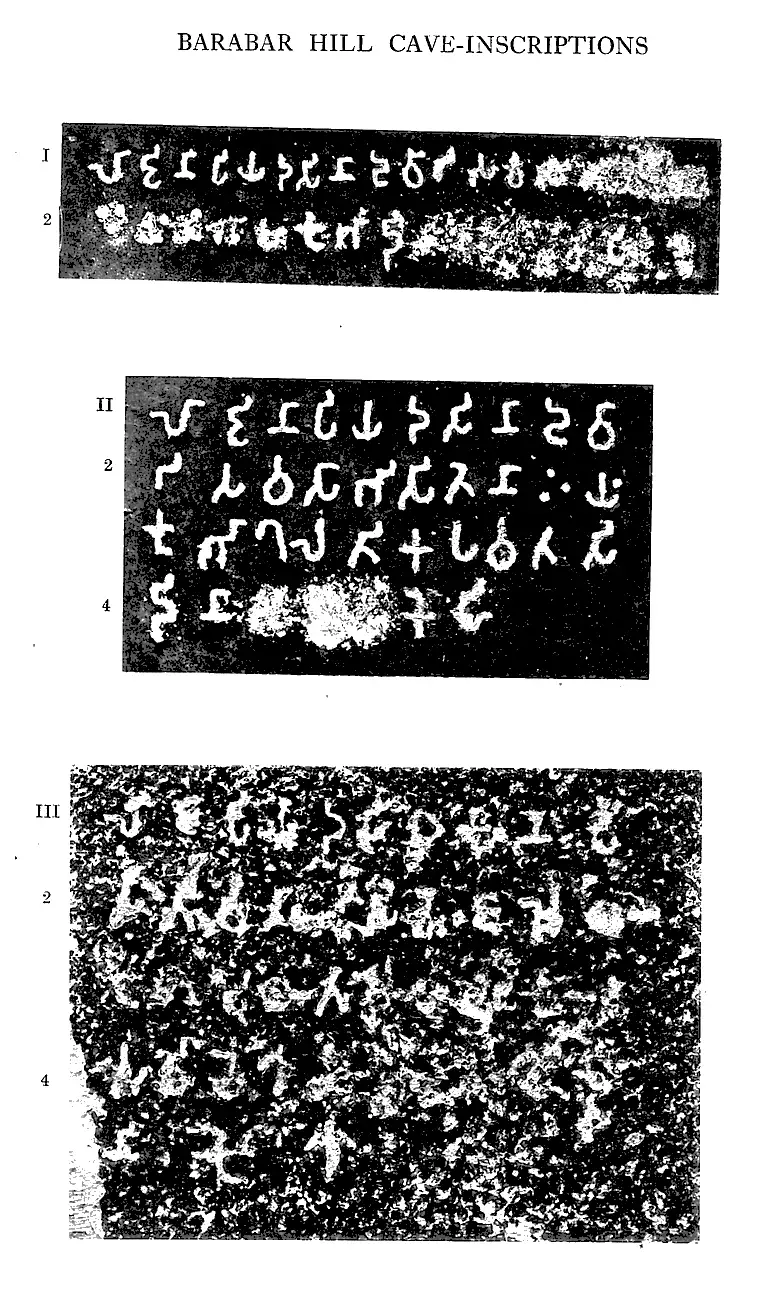
Europeans came first for the letters: J. H. Harington found an inscription above a door here about 1785. Captain M. Kittoe of the 6th Native Infantry published his notes in the Journal of the Asiatic Society of Bengal in May 1847. His servants were late on the road, so he spent a night in Karan Chaupar on a bundle of rice straw, with a candle he happened to have, and the bears stayed away. Before lying down he traced the faint letters at the door in red ochre.
He called the labour of polishing such a surface "almost incredible". He called the echo "very beautiful". And he wrote one sentence that has hardly been chased since: "from the quantity of chips of haematite strewed about, I am inclined to think this mineral was used in polishing."
Eugen Hultzsch's edition of 1925 gives the door of the cave now called Sudama in plain words: "By king Priyadarsin, (when he had been) anointed twelve years, this Banyan-cave was given to the Ajivikas." A second gift of the same year stands in "the Khalatika mountain", and Georg Buhler glossed that word as bald, bare. The Bald Hill. A third, in the nineteenth year, is for shelter in the rains, in a phrase Hultzsch rendered literally as the approach of "the roar of waters".
The stone says Priyadarsin, never Ashoka. Hultzsch would not call the identity certain; A. L. Basham argued no other king is as likely. No inscription gives a year BCE. Alexander Cunningham, surveying in 1861-62, made them 252 and 245 BCE, and later chronologies run a few years earlier. Three more rooms on Nagarjuni were given to the same sect by Dasharatha, a later king of the line, for as long as the moon and sun endure.
The Ajivikas left no scripture. Their teaching survives only through their Buddhist and Jain rivals.
A Finish Measured in Microns
The strongest modern case comes from Jayan Films, a Paris company whose Builders of the Ancient Mysteries project took instruments into these rooms and made the film Barabar, the Archaeological Site of the Future. In July 2024 Ben van Kerkwyk carried it to a large audience on his channel UnchartedX, with the word that 3D scans had shown remarkable precision.
The project holds scans and reports, and it has a number. A Mitutoyo roughness tester, set against the rock in April 2023, reads Rz 0.466 microns on the screen labelled Granite Barabar. In the same picture stand marble at 2.253, industrial granite at 9.492 and glass at 0.101. A human hair is about 70 microns across. For scale, the wall's ridge-to-hollow figure is about a hundred and fifty times smaller.
Julien Sivan of the ALBA Project took the argument further in a preprint of March 2026, The Song of the Stone. He cites sub-centimetre symmetry over 10 metres, "an optical mirror finish", and the 2020 measurements of the project's acoustician, Frederic Chevalier, which on his account give four caves on two hills one note: 34.4 Hz, within 0.1. On Sivan's reading, the rooms were never cut. Quartz in granite is piezoelectric; in his simulation a rotating magnetic field shakes the stone apart at its stress points until the cavity rings its note, and the builder hears it and stops. "They need ears," he writes.
The rooms had a life in the imagination first. E. M. Forster saw them in 1913, renamed them the Marabar Caves in A Passage to India in 1924, and put the match in the visitor's hand: "another flame rises in the depths of the rock". The walls gave him one syllable back. "Boum", he wrote, "as far as the human alphabet can express it".
If the Stone Was Worked by Something Else
Set aside for a moment whether any of it is true. Ask the better question. What kind of past are we living after, if it is?
It would mean, first, that the king's gift was a label. The clerk who cut twelve years anointed would have been writing on a room whose making he could not explain, and the inscriptions would date the handover, not the hollowing. Every date on the hill would be a floor, not a beginning.
It would mean a craft with no apprentices. On that reading somebody on the Ganges plain held a method for stone that left no workshop, no treatise, no failed first attempt and no heir. It would sit beside the lost formula of Greek fire and the long silences around Roman concrete and Damascus steel, and it would dwarf them. Those are recipes. This would be a whole relation to rock, gone.
It would mean that our picture of what a body can do with a tool is drawn too small. About ninety human generations stand between this century and those rooms. If Sivan's physics held, some of the earliest of them shaped a hill by listening to it, and all of ours since would have gone back to hitting it.
And it would mean the record is still there. A method that leaves a surface leaves a signature. If that were so, how many other walls would we have to go back and read?
The Standard Account
The standard account holds that people of the Mauryan period cut and polished these rooms by hand, and it starts with the dedications: a donor, a year and a use. The word on the Nagarjuni doors, vasha-nishidiya, means a dwelling for the rainy season.
Its second ground is the unfinished work. In Lomas Rishi, left incomplete, the straight walls are polished, the outer wall of the round chamber is "only smoothed and not polished", and on the half-hewn roof "the cuts of the chisels, both broad and narrow, are still sharp and distinct". Chisel, smoothing, polish: every stage survives in one room.
Its third ground is that the finish is not alone. Vincent Smith's History of Fine Art, in its 1930 revision, calls it "the fine polish which is so typical of Mauryan work", and the same gloss sits on the sandstone pillars of the period. Percy Brown held that an agate burnisher finished the Piprahwa crystal reliquary and that the pillars had "somewhat the same process".
The figures are narrower than they sound. A stylus trace runs 4.8 mm, and it says how smooth, not how. The project's industrial granite appears, in its own pictures, to be the matte slab of a laboratory bench. A lab sheet of May 2023 gives Ra 0.0425 and Rz 0.4092 and names no sample. Sivan writes that hand abrasives are "possible" and that his mechanism "has never been observed in a laboratory". His papers put Karan Chopar at 34.4 Hz in one place and near 57 Hz in another.
What the Chisel Marks Do Not Reach
The chisel marks say how the rock came out. They do not say what made it shine.
The search for this article turned up no published microscope, thin-section or chemical study of a Barabar wall, and no gloss reading. Kittoe, Cunningham, Smith and Basham describe the surface. None of them tests it. Whether the polish is the granite itself, abraded flat, or carries anything added, no published study of these walls settles.
No report consulted here names a polishing tool from the site, and no excavation report of the cave floors came to light. A tool would show one stage of the work. It would not settle the rest.
No timed trial of anyone polishing a granite vault by hand came to light. How long it took, and how many people, is unknown.
The order of work is stranger than either side says. Kittoe saw Lomas Rishi with "the sides only being polished and the vault left in the rough". Cunningham reports the same polished walls under a roof left unfinished, and puts the stop down to a deep fissure in the rock. On their accounts the walls were finished while the roof above them was not.
The people are missing too. Someone went round these doors with a chisel and attacked one word, Ajivikas. By Basham's count most of the inscriptions show it, and at Sudama the letters were cut so deep that Cunningham could still trace them through the holes. Hultzsch blamed the time of the Maukhari king Anantavarman, who installed Hindu images here. Basham answered that the one door where the word stands untouched, Gopika, is a cave Anantavarman took over, and reasoned that the defacer could still read the script.
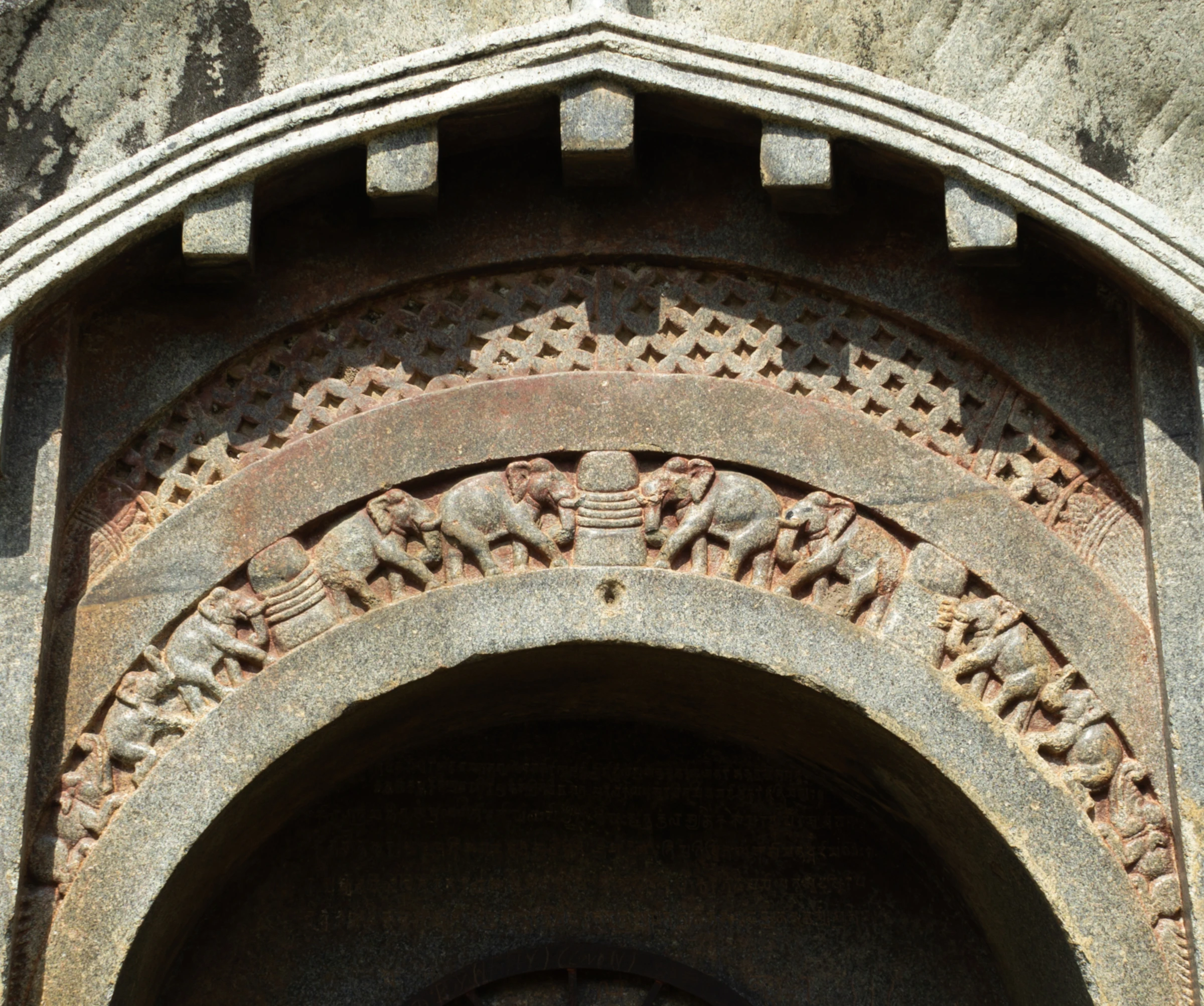
And the finest entrance has no dedication at all. The Lomas Rishi porch, carved to copy a timber gable with elephants walking its curve, carries no Mauryan inscription. Cunningham dated it to the 3rd or 4th century CE, Basham to the Mauryan period or just after.
A Chip of Red Stone
The caves stand under the protection of the Archaeological Survey of India, in its Patna Circle. The project's reports are in French. Official X read the roughness figures from images on the project's pages and has not read the reports or seen the film, so what they say of their own method is not described here. Sivan's next step is a physical test: magnets on a flywheel and a block of granite.
For the walls themselves the useful instruments are small. A microscope under raking light could show whether quartz and feldspar grains stand level and whether the polish has a direction. That could say something about the last stage of the work. It could not say who did it, or why a king gave a mirror to men who owned nothing. The inscriptions are silent on that, as they are on the sound.
A floor in Bihar. A scatter of red chips, if they are still there. A captain with a candle, who wrote down what he saw and thought it mattered. Nobody has reported testing them, and the one man who looked went to sleep on the rice straw.
Questions This Leaves You With
Is there anything a person actually does with this?
Nothing in your own life follows from it, and anyone selling you a date or a device built on Barabar is selling something. What you can do is smaller. You can read Kittoe's few pages, free online, and Cunningham's, and see how much more is on record. Then you can stop treating "how did they do it" as one question. Cutting a room and polishing a room are two different jobs, and the evidence for each is different. The larger question stays with you: how a people could lose the memory of how a thing was done while the thing itself stayed in front of them.
Does this sit against a religious account of the world?
It can be read both ways, and serious people have. These rooms were gifts to men who, as their rivals report it, held that fate rules everything, and the gift came from a king whose own inscriptions speak of moral duty. Someone later cut those men's name out of the rock. Some will hear in that a warning about what faiths do to each other. Others will hear devotion: a room finished far beyond need, for its own sake. Hindu images went into some of these caves centuries on, and Muslim faqirs lived on the hill after that. This site will not tell you which way that falls.
Does this change what a human life is?
Think about the person who held the polishing stone. Nobody knows their name. They may have spent years of a short life on a wall that only ascetics would see, in a dark room, for the rains. That can make a life feel smaller: years of labour, and not one letter of credit in the whole hill. It can also make one larger: a stretch of a stranger's days that still throws back a candle after twenty-two centuries. You may already know which of those you felt.
What would change your mind, in either direction?
Name it now, before you are committed. If a published microscope study found polishing grooves running the way a hand strokes, with abrasive grit in the pores, that would count hard for the standard account. So would a timed trial on a granite vault reaching those figures with period tools. In the other direction, an independent team repeating the acoustic readings and getting one note across all the caves would count, or a block of granite in a laboratory that actually eroded under Sivan's field. A striking video would count for nothing either way, and neither would a resemblance.
What is the real unanswered question here?
Why this finish, here, and then so rarely again? Later rock-cut halls in India grew larger and far more elaborate, and the gloss on hard granite did not become their habit. Nobody has an account, tested against the stone, of who these masons were, where they learned it and where they went. The usual answer is royal money. It may be right. But the inscriptions do not say it, and no workshop has been reported. The space where the masons should be is still empty, and it is the same size as the rooms they left.
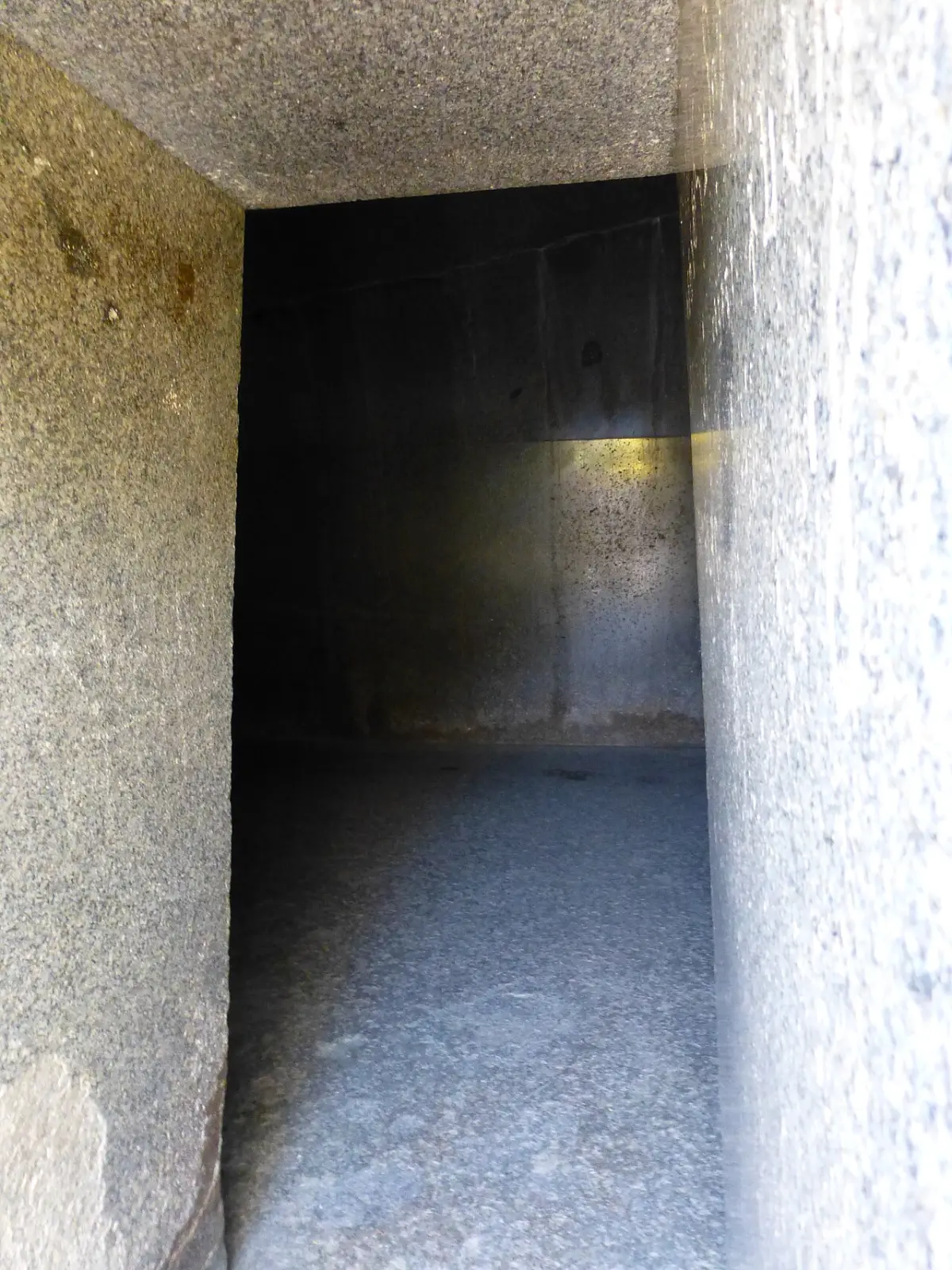
The plain tapering doorway of the Sudama cave, in the shape the old surveyors called Egyptian. Photo: Photo Dharma from Penang, Malaysia, CC BY 2.0 (creativecommons.org/licenses/by/2.0), via Wikimedia Commons. Resized. 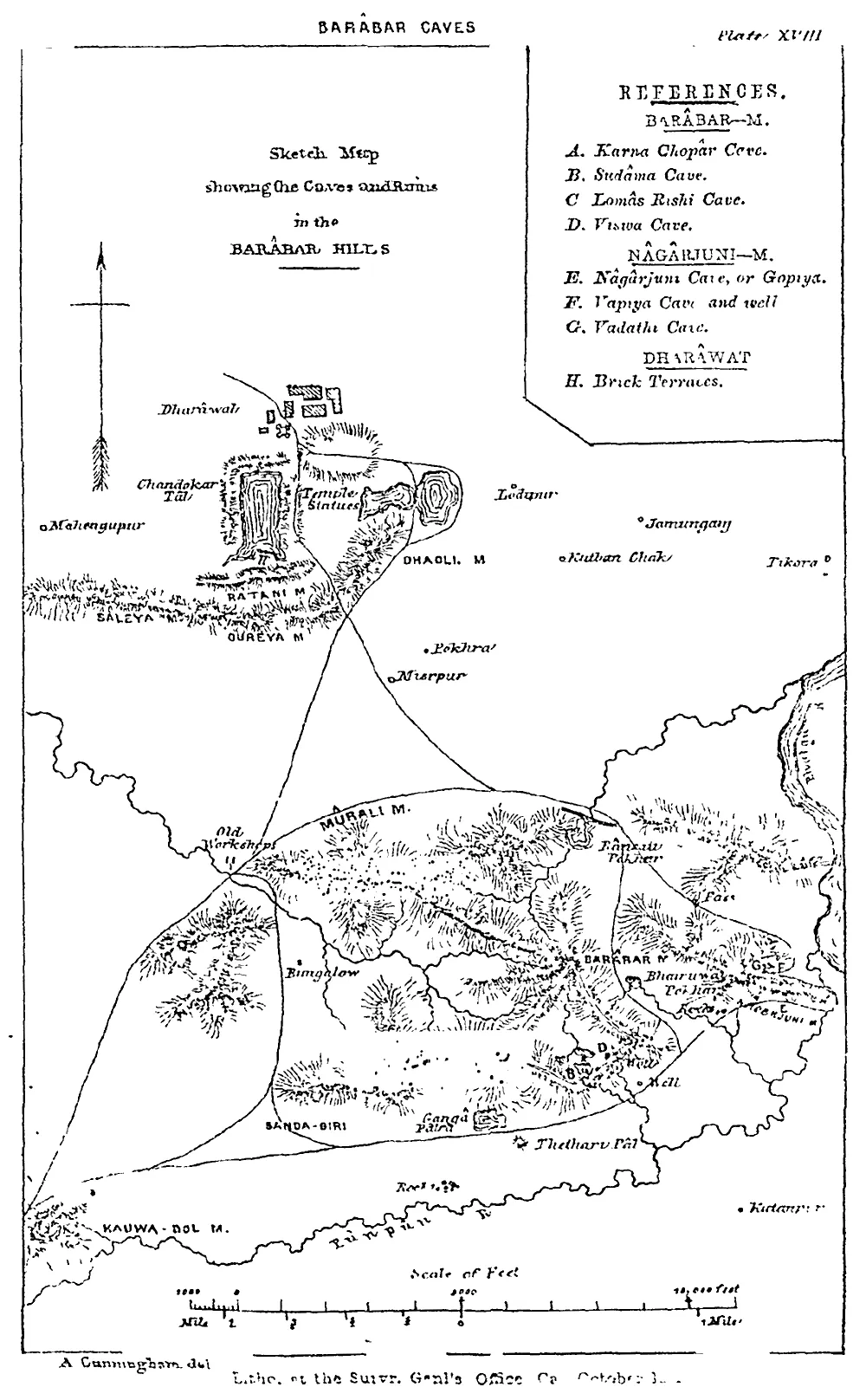
Cunningham's survey map of the Barabar and Nagarjuni hills, published in 1871, with the caves lettered. Map from A. Cunningham, Four Reports Made During the Years 1862-63-64-65, 1871. Public domain, via Wikimedia Commons. Resized. 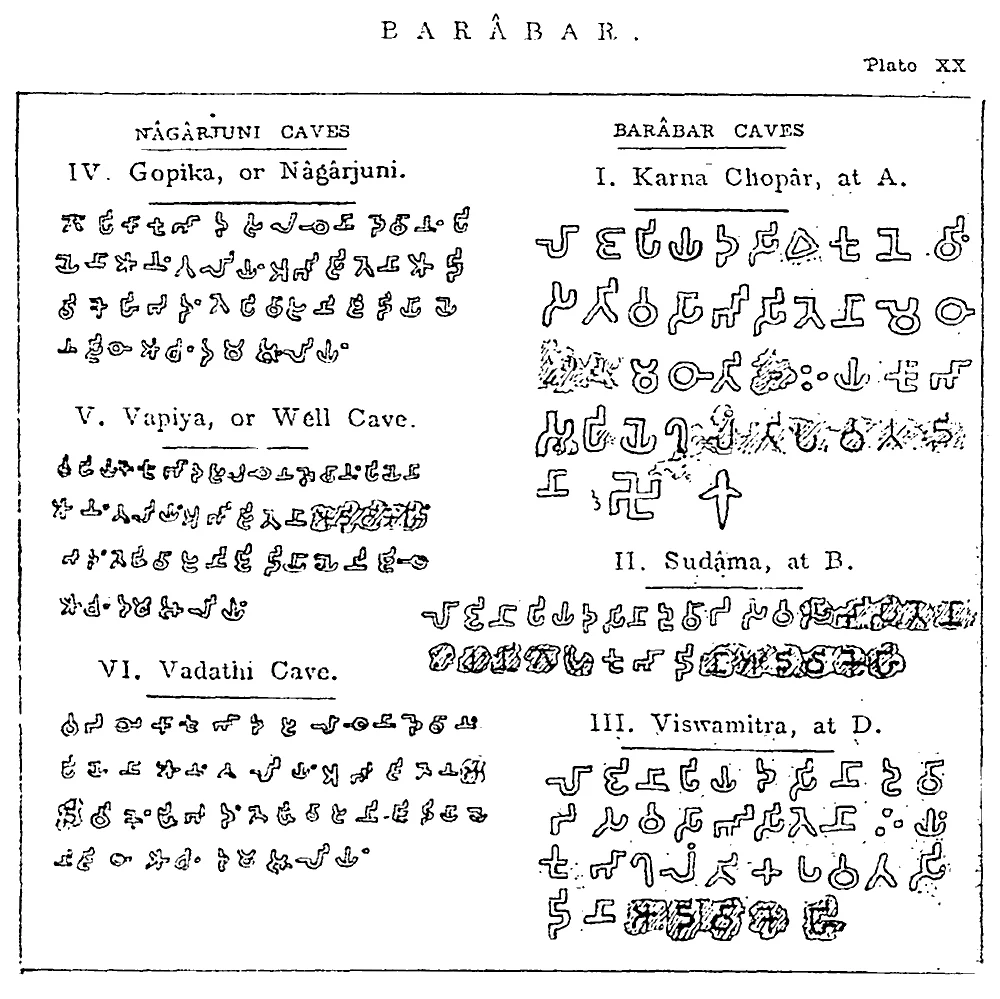
Cunningham's hand-drawn copies of the inscriptions from both hills, Plate XX of his 1871 report. Plate XX from A. Cunningham, Four Reports Made During the Years 1862-63-64-65, 1871. Public domain, via Wikimedia Commons. Resized.
Sources
- Notes on the Caves of Burabur, Journal of the Asiatic Society of Bengal 16, May 1847 Captain M. Kittoe Primary record
- Four Reports Made During the Years 1862-63-64-65, vol. 1, 1871 Alexander Cunningham, Archaeological Survey of India Primary record
- Inscriptions of Asoka, Corpus Inscriptionum Indicarum vol. 1, new edition, 1925 Eugen Hultzsch Primary record
- The Barabar and Nagarjuni Hill Cave Inscriptions of Asoka and Dasaratha, Indian Antiquary 20, 1891 Georg Buhler Primary record
- Inscriptions of the Early Gupta Kings and Their Successors, Corpus Inscriptionum Indicarum vol. 3, 1888 J. F. Fleet Primary record
- History and Doctrines of the Ajivikas, 1951 (catalogue record; the text was read on a scan) A. L. Basham; Luzac Study
- A History of Fine Art in India and Ceylon, revised by K. de B. Codrington, 1930 Vincent A. Smith Study
- Indian Architecture (Buddhist and Hindu Periods) (catalogue record; the text was read on a scan) Percy Brown Study
- Review of Balcerowicz, Early Asceticism in India, International Journal of Jaina Studies 12(2), 2016 Willem B. Bollee Study
- A Passage to India, 1924 E. M. Forster; Project Gutenberg Primary record
- Hill Meets Plain: E. M. Forster's Narrative Tremors, Review of English Studies, 2025 Lara Choksey; Oxford University Press Study
- Monuments of the Patna Circle Archaeological Survey of India, Patna Circle Primary record
- Rugosimeter readings, 2023 Jayan Films, Builders of the Ancient Mysteries Primary record
- Reports on the Barabar and Nagarjuni chambers Jayan Films, Builders of the Ancient Mysteries Primary record
- Barabar, presented by UnchartedX, 10 July 2024 Ben van Kerkwyk, UnchartedX; Jayan Films Study
- The Song of the Stone, preprint, March 2026 Julien Sivan, ALBA Project Primary record
- Barabar Caves and Other Unexplained Ancient Constructions: We Found the Physics Behind It. But Still No Tools, March 2026 Julien Sivan, ALBA Project Primary record
- Particulate Matter (PM) Basics US Environmental Protection Agency General reference