
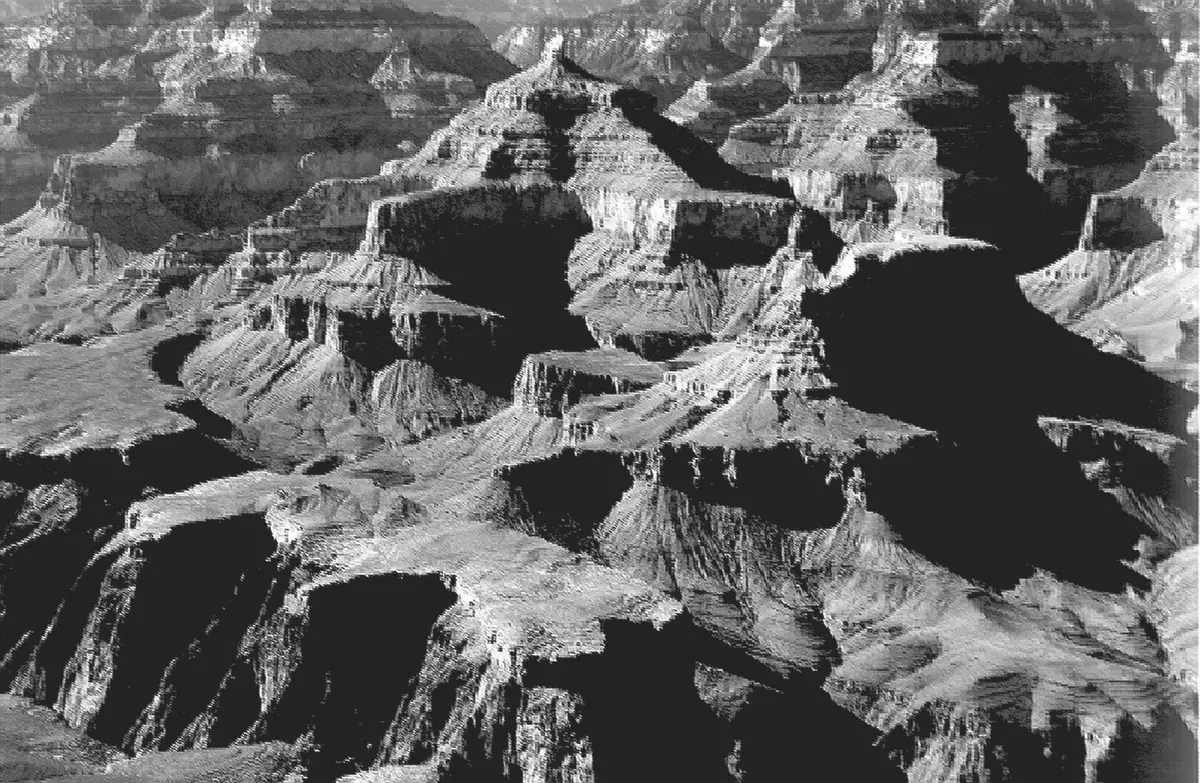
North of the Colorado River, in the heart of the Grand Canyon in Arizona, a block of buttes carries names out of Egypt: Isis Temple, Osiris Temple, Horus Temple, the Tower of Ra, the Tower of Set, Cheops Pyramid. In books and on websites this ground has another name, the forbidden zone, closed, the story goes, to hide a cave.
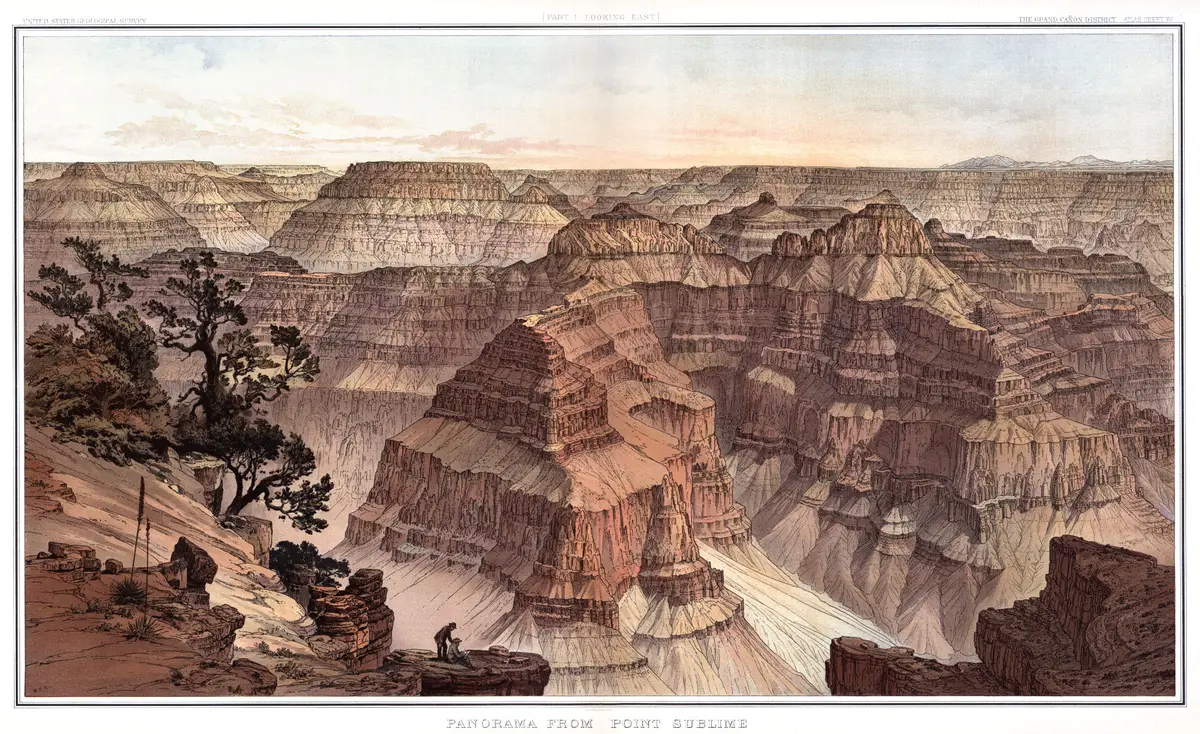
The buttes stand in ranks below the rim, each one stepped like masonry, red wall on pale ledge on red wall, the better part of a mile from the top of the rock to the river. Isis Temple is marked 7,022 feet on the survey sheet. Shadow crosses it slowly. Nothing on it moves.
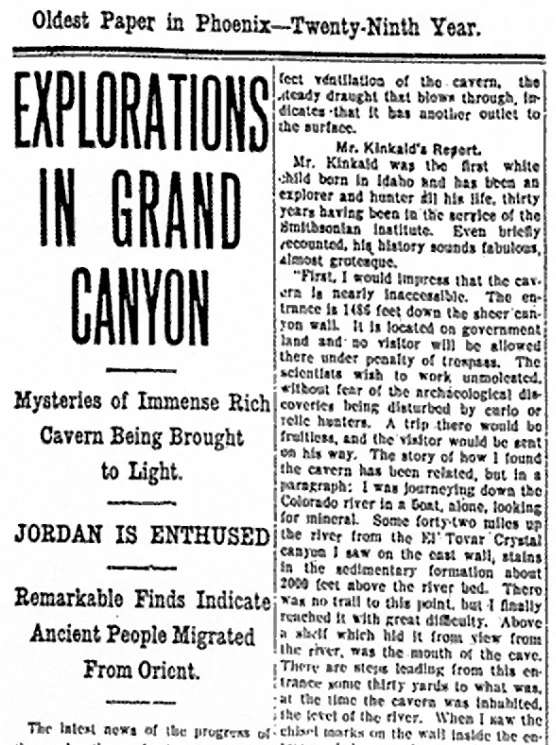
In April 1909 a Phoenix newspaper reported a door in a canyon wall, and behind it a hall cut from solid rock, tiers of mummies and an idol sitting cross-legged in the gloom. One sentence from that page has outlived everything else on it.
No visitor, it said, "will be allowed there under penalty of trespass."
Monday Evening, April 5, 1909
The paper was the Arizona Gazette, an evening daily that printed "Oldest Paper in Phoenix" at its head. Down one column of the front page ran EXPLORATIONS IN GRAND CANYON. Under that: "Mysteries of Immense Rich Cavern Being Brought to Light."
The man with the news was G. E. Kinkaid, described as the first white child born in Idaho and thirty years in the service of the "Smithsonian institute." On March 12 the same paper had given him a short item, spelled Kincaid: a lone boatman reaching Yuma from Green River, Wyoming, with over seven hundred views and "some interesting archaeological discoveries."
"Some forty-two miles up the river from the El Tovar Crystal canyon," Kinkaid said, he saw stains on the east wall, about 2,000 feet above the river bed, and climbed to a cave mouth. Inside were chisel marks, a main passage, a crypt. "One of these I stood up and photographed by flashlight," he says of the mummies.
The paper credited the work to a Prof. S. A. Jordan and the Smithsonian. It listed an idol with a lotus flower or lily in each hand, tablets of hieroglyphics and a crypt where "it smells snakey just the same." The builders were "of oriental origin, possibly from Egypt."
And near the top of Kinkaid's report, before the cave is even described, the door shuts. "The entrance is 1486 feet down the sheer canyon wall. It is located on government land and no visitor will be allowed there under penalty of trespass."
The forbidding came first.
A Hiker's Map From Chicago
The story vanished for half a century. In 1962 a book of old Arizona newspaper stories, Arizona Cavalcade, reprinted it, and David Hatcher Childress found it there. He bet the author of the book had made it up: "It sounds phony." Then he looked up the Gazette. "There it was in black and white."
His Lost Cities of North and Central America took it up in 1992, and a NEXUS article of 1993 carried his reasoning online. Carl Hart, editor of World Explorer, obtained a hiker's map of the canyon in a Chicago bookstore, and there were the Egyptian names, north of the river. They phoned "a state archaeologist at the Grand Canyon," who said early explorers had liked such names, but that the area was off limits "because of dangerous caves."
Childress wrote the sentence that named the place: "this entire area with the Egyptian and Hindu place names in the Grand Canyon is a forbidden zone - no one is allowed into this large area." This, he concluded, was where the vaults lay, "off-limits to all hikers and even, in large part, park personnel."
On that reading, a threat printed in 1909 had become a standing order.
The case has grown since, and it leans on real things. Childress allowed that the whole story might be a newspaper invention, but it ran on a front page and named the Smithsonian, which he said "lends a great deal to its credibility." The institution's own 1894 mound report records a skeleton of seven and a half feet. Every cave in the park is shut, Stanton's Cave behind bars, and federal rule 14 CFR 93.305 bars aircraft from four flight-free zones over the canyon. Don Lago reports what websites make of that: closures to hide the artifacts, and a party that said it climbed 800 feet up Isis Temple to an entrance dynamited shut.
What the Wall Would Hold
Set aside for a moment whether the cave exists. Ask the better question. What kind of continent are we living on if it does?
It would mean the Gazette undersold it. Not a curiosity. A find "one of the most valuable in the world," a hall cut by hand into the wall of the most famous canyon on Earth, sitting for more than a century behind a permit desk.
Somewhere in that rock there would be tablets nobody living has read.
It would mean the oldest story about contact is wrong. On that reading, people from the Nile crossed an ocean, found a river, and carried tablets, metal and their dead down a cliff in the interior of North America. An ocean would have been a road long before any chart we hold says so, and every account of when the two halves of the world first met would need a new first page.
It would mean something about us. A people able to cut that citadel could still vanish from memory, with no word left on either side of the Atlantic. If that can happen, our record of ourselves has holes the size of nations, and what we call discovery may be, more often than we admit, rediscovery.
And it would leave a question in front of us, because on that reading the holes are not all accidents. If a museum and a park could hold a thing that size for more than a hundred years, what else have we filed as scenery? What else have we driven to the rim to photograph, and gone home?
Eleven Days Later
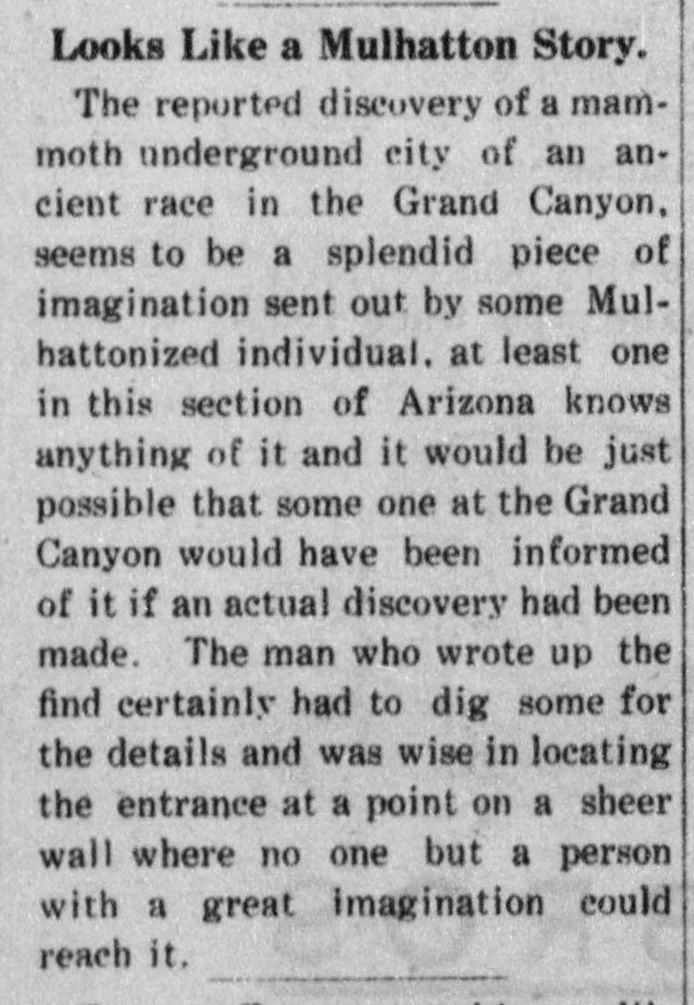
On April 16, 1909, the Coconino Sun of Flagstaff ran a short front-page item headed "Looks Like a Mulhatton Story," calling the find "a splendid piece of imagination." Joe Mulhatton, a contemporary of the Cardiff Giant, had spent thirty years planting invented stories in newspapers, caves among his favourites; his Grand Crystal Cave of 1878 held mummies with "every appearance of the Egyptian mummies." The historian Don Lago, in The Ol' Pioneer in 2009, checked over a dozen newspapers and found one reprint, in the Jerome Mining News.
In a reply quoted by Skeptoid, the Smithsonian says its Department of Anthropology "has searched its files without finding any mention of a Professor Jordan, Kincaid, or a lost Egyptian civilization in Arizona."
The names came first. Clarence Dutton named Shiva's Temple and Vishnu's Temple in 1882, for their look. George Wharton James wrote in 1900, "This we name Isis Temple." The full cluster stands on the Geological Survey's Bright Angel sheet, in a 1947 reprint of the edition of May 1906.
The park's 1988 plan, four years before the book, says "The only area currently closed to all visitation is Furnace Flats." Its compendium of June 16, 2026, names none of the Egyptian buttes, and Trinity Creek, among them, is ordinary backcountry use area AQ9. Ellen Brennan, the park's cultural resource program manager, says the story "really denigrates the Native American history of the park." The story's reprinted text calls Arizona's tribes "descendants of the serfs or slaves" of the cave's people.
Forty-Two Miles Up the River
None of that names the writer. The story has no byline. Lago argues for Mulhatton, or for "someone inspired by him," on the evidence of the text, not of a document. The Smithsonian's answer covers the files of one department, not who sat down at the Gazette that spring.
Nor is the text most people quote the text on the page. Official X read two crops of the column against the version in circulation since 1993. The crops say "underground institution" where the copies say "installation." They hold sentences the copies drop, on hieroglyphics in Yucatan and the old canals of the Salt River valley. The full page, reported to survive on microfilm, has not been published.
Then there are the directions. The story's "El Tovar Crystal canyon" has never been placed; Lago's comment is "wherever that is." Jack Andrews in 2001 read it as Crystal Creek, mile 98, and counted forty-two miles up to mile 56, at Kwagunt. On his count, the Egyptian names lie some thirty miles downstream.
The forbidden zone and the story's own directions would then lie on different stretches of river.
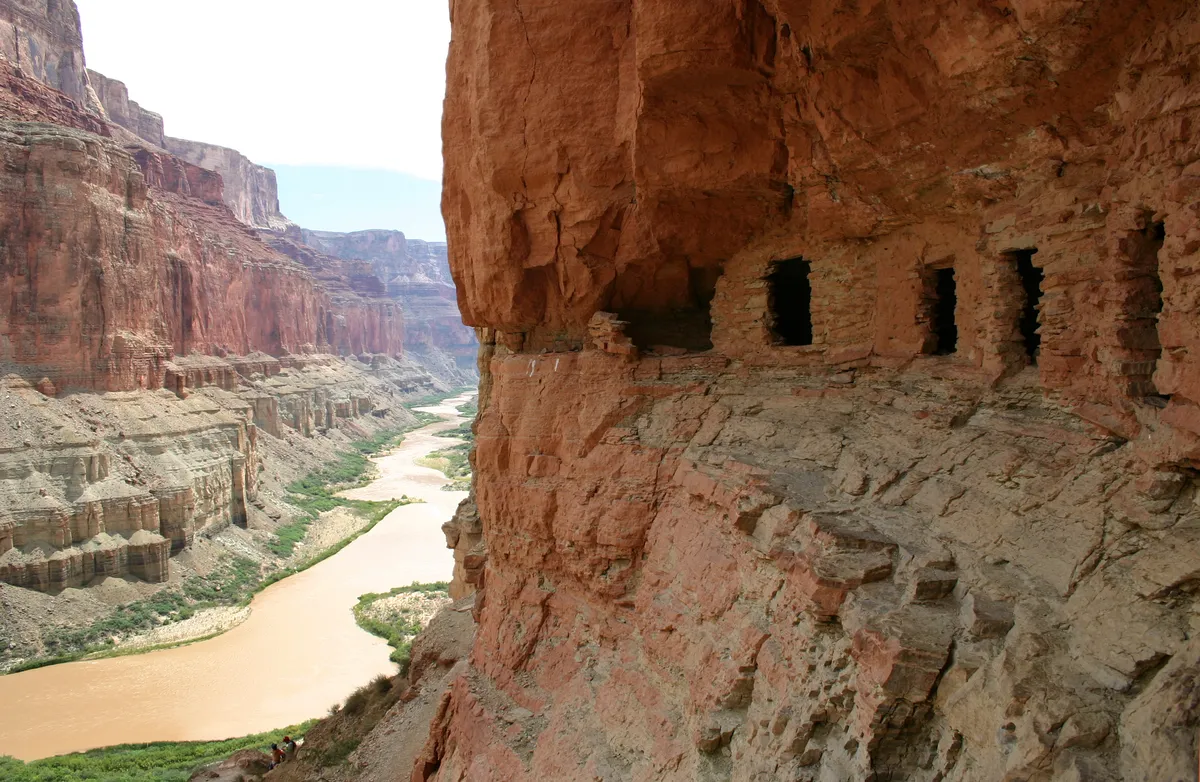
That stretch has real closures of its own. Anasazi Bridge, above mile 43, is shut without written permission. The Hopi Salt Mines, mile 63 to 64.5, are "closed to public presence, use, and access," with no exception written in. Furnace Flats, at mile 71.5, is shut too. Between them, a few miles above Kwagunt, the granaries at Nankoweap stand in a cliff face. The closures name cultural resources, and none mentions Egypt.
The voice on the phone was half right, too. All caves are shut without a permit, for "the many unrecorded features, archaeological resources, and various life" inside. All mines are shut, the uranium workings of the Orphan Mine behind a three-strand wire fence.
Several groups have hiked in to look for Kinkaid's door. No account read for this article says they found it.
Over Five Percent
This autumn part of the ground really is shut. A flash flood on August 29, 2026, closed the North Kaibab Trail and Phantom Ranch "until further notice," at the eastern edge of the Egyptian names.
What the canyon holds keeps turning up where people cannot easily go. Remote caves have given up split-twig figurines, animals folded from a single twig, 2,000 to 4,000 years old. Rampart Cave held a blanket of ground sloth dung until 1976, when someone broke its gate and a fire destroyed 70 percent of it. In 1937 the American Museum of Natural History climbed Shiva Temple, in the middle of the names, hunting a biological lost world. It found small stone rooms, cooking pits and spearpoints. People had been up there first.
The park records "over 4,300 archeological resources with an intensive survey of over 5% of the park area." One inventory estimates 2,215 Redwall caves with obvious openings in the eastern canyon alone, and says the great majority seem reachable only by "fairly heroic rappelling efforts."
The microfilm could show what the copies dropped. It could not show a cave. The rest of the park is not a secret. It is unread.
In 1909 a newspaper said no visitor would be allowed into one cave. Today no visitor goes into any cave in the park without a permit.
The cave has not turned up. The rule has.
Questions This Leaves You With
Is there anything a person actually does with this?
Nothing in your own life turns on it, and anyone selling you the location of the cave is selling something. What you can do is open the records. The park's compendium is a free PDF, the backcountry map gives each use area a code, and a permit for Trinity Creek is an ordinary application. You can stand at the rim and name the buttes off the old survey sheet. The larger question belongs to more than you: what a country owes a place it has surveyed so little of, when other people's claims on it are far older than the map.
Does this sit against a religious account of the world?
It cuts more than one way. The Gazette credited a legend of an underworld to the Hopi, through the artist W. E. Rollins, and no Hopi source for that telling has surfaced in the records read here, so it stands as the paper's. The park, for its part, closes the Hopi Salt Mines to all comers as "a significant cultural resource." And the names on the map, Ellen Brennan points out, came from mappers who "didn't really have knowledge of the ancestral people who lived here." Some readers find reverence in those names, some an erasure. This site will not tell you which way it falls.
Does this change what a human life is?
Think of the figurines, and picture, for it can only be pictured, someone splitting a twig, folding it into an animal and carrying it into a cave. The maker's name is gone. One reaction is that this makes you smaller: yours will go too. The other is that it makes a life rarer: a small piece of work can outlast the name of the hand that made it. Both are fair readings of the same twig. You may already know which one you had.
What would change your mind, in either direction?
Name it now, before you are committed. Toward the cave: the print of that flashlight photograph, a letter or payroll entry naming Kinkaid or Jordan in Smithsonian papers, or an object with a provenance from the canyon and a laboratory date. Away from it: a Gazette ledger, letter or memoir naming the writer, or the river record of Julius Stone's party, which left Green River on September 12, 1909, and ran this same reach months after the story. Watch what each can and cannot do. A search that comes back empty covers the files searched, and a closure tells you only what a park wrote down.
Who wrote it?
This is the open problem. Somebody in Phoenix in the spring of 1909 wrote a specific, confident, well-made story, and on Lago's reading laid the ground for it with the item in March. Lago's candidates for the names, David Starr Jordan of Stanford and the zoologist Trevor Kincaid, are offered as speculation about where the names came from, not as people who took part. Who carried it to the paper, and whether the editor knew, nothing answers. The forbidden zone rests on two unnamed voices, the writer of 1909 and the archaeologist on the telephone. The record names neither.
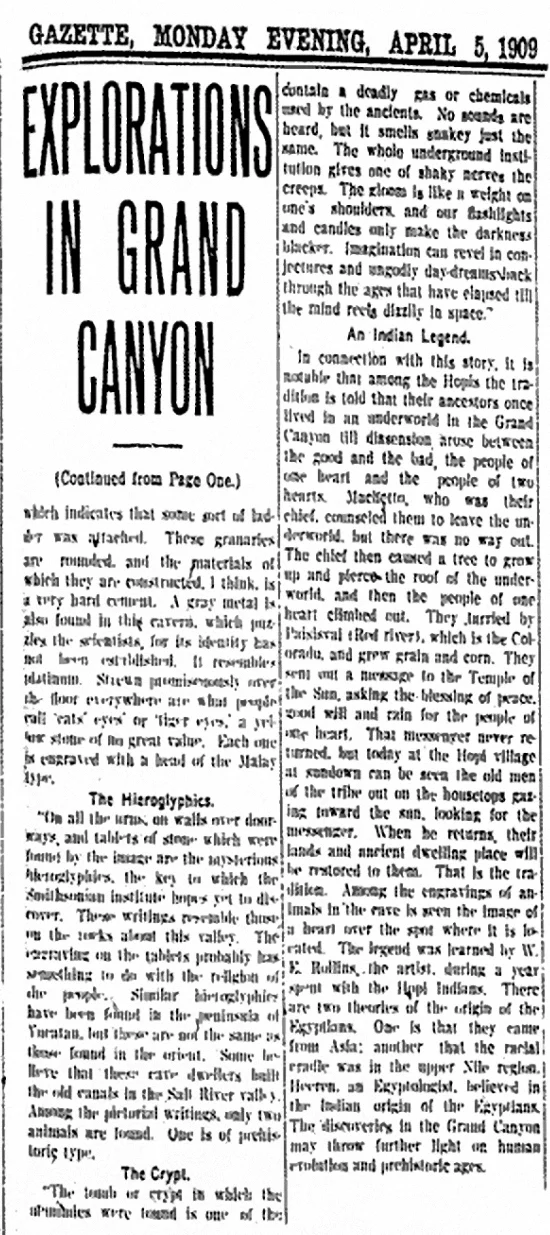
The continuation of the Gazette story, with the hieroglyphics passage and the Yucatan and Salt River sentences that later copies drop. Arizona Gazette, Phoenix, April 5, 1909, the continuation. Public domain as a 1909 US publication. Copy from the CoastConFan blog, 2016; the source of the scan is not stated. 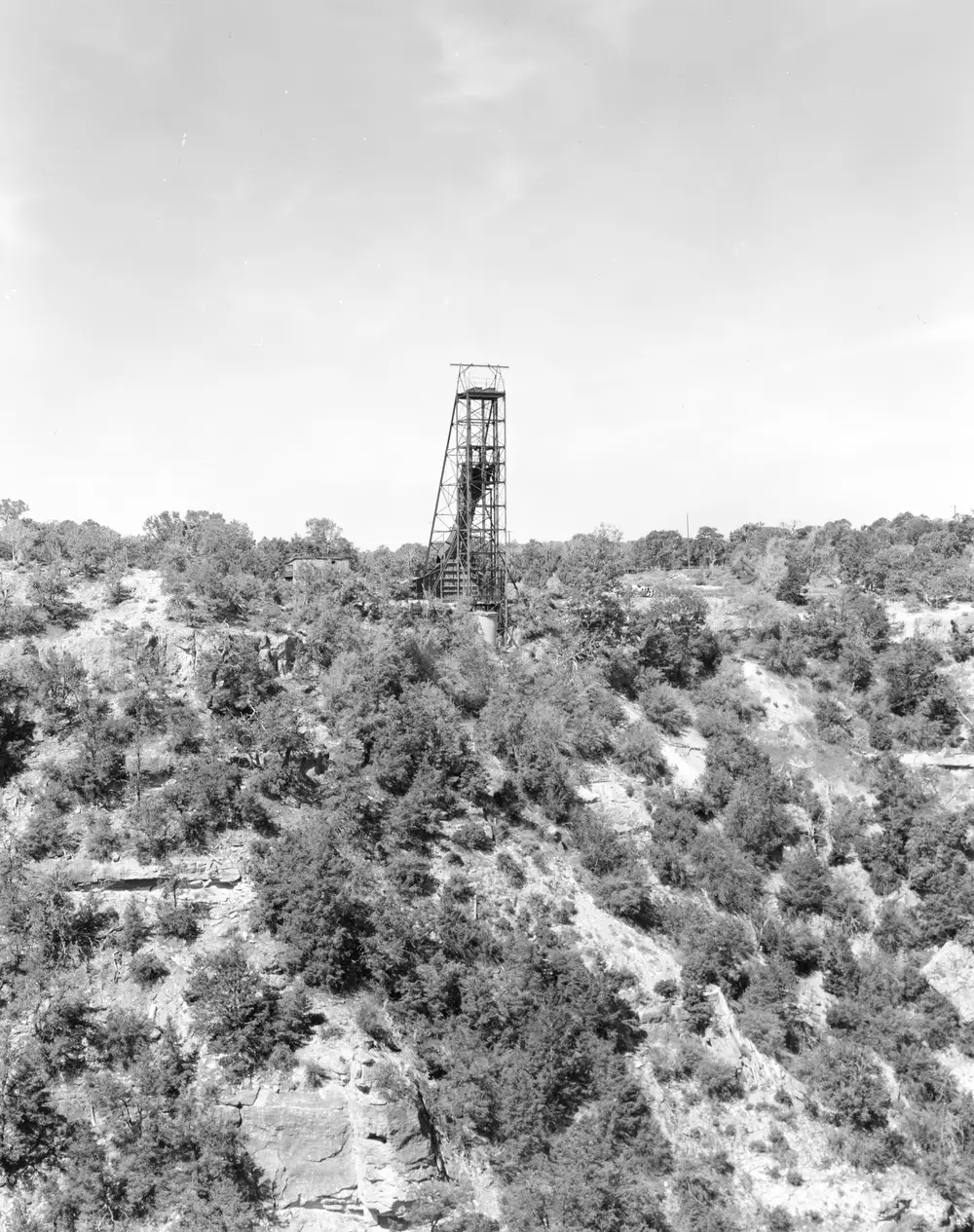
The headframe of the Orphan Mine in 2005, seen from the Powell Memorial. The uranium workings are closed to public entry. David Killam, 2005, Historic American Engineering Record, HAER AZ-67-A-6, Library of Congress. Public domain. Via Wikimedia Commons. Cropped and resized.
Sources
- Don Lago, Looks Like a Mulhatton Story: The Origins of the Grand Canyon Egyptian Cave Myth, The Ol' Pioneer vol. 20 no. 2, Summer 2009 Grand Canyon Historical Society Study
- Arizona Gazette, 5 April 1909 and 12 March 1909, column crops as posted in The Canyons of Madness, 2016 CoastConFan blog; source of the scan unstated Primary record
- Archeological Coverups?, NEXUS New Times vol. 2 no. 13, posted on KeelyNet 8 May 1993 David Hatcher Childress; KeelyNet, mirror Primary record
- Looks Like a Mulhatton Story, The Coconino Sun, Flagstaff, 16 April 1909, p. 1 Library of Congress, Chronicling America Primary record
- Superintendent's Compendium, Grand Canyon National Park, June 16, 2026 National Park Service Primary record
- Backcountry Management Plan, 1988 Grand Canyon National Park Primary record
- Backcountry use areas and campsite information National Park Service Primary record
- 14 CFR 93.305, Flight-free zones and flight corridors Legal Information Institute, Cornell Primary record
- Busting 13 of the Smithsonian's Most Persistent Myths Smithsonian Magazine Study
- Skeptoid episode 4556, 31 January 2017 Brian Dunning, Skeptoid Study
- Clarence E. Dutton, Tertiary History of the Grand Canon District, USGS Monograph 2, 1882 U.S. Geological Survey Primary record
- George Wharton James, In and Around the Grand Canyon, 1900 Internet Archive Primary record
- Bright Angel quadrangle, Arizona, edition of May 1906, reprinted 1947 U.S. Geological Survey Primary record
- Map of the Month: September 2023 Arizona State University Library Study
- The Grand Can-Spiracy, Endless Thread, 10 November 2023 WBUR Study
- Archeology Grand Canyon National Park Primary record
- Jack Andrews, The Location of Kincaid's Cave Revealed, 2001 reposted at Biblioteca Pleyades Study
- Nankoweap Granaries, photograph by Mark Lellouch, 2004 National Park Service, via Wikimedia Commons Primary record
- Kenworthy, Santucci and Cole, An Inventory of Paleontological Resources Associated with Caves in Grand Canyon National Park National Park Service, via NPS History Primary record
- Pleistocene Life and Landscapes, Grand Canyon National Park Service Primary record
- Significant Flash Flooding Closes Phantom Ranch and North Kaibab Trail, 30 August 2026 Grand Canyon National Park Primary record
- Just What Is on Top of Those Tall Buttes? Arizona Highways Study
- Harold Anthony on Shiva's Temple, Nature 140, 613, 1937 Nature Primary record
- The Galloway-Stone Expedition National Park Service Primary record
- The 1909 Grand Canyon Hoax Jason Colavito Study