
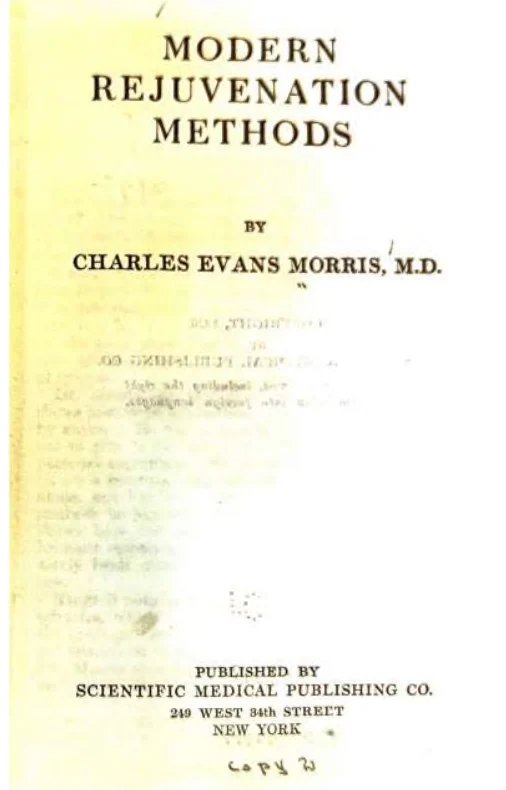
Modern Rejuvenation Methods is a book of 237 pages, copyrighted in New York in 1926 under the name of Charles Evans Morris, M.D. Its subject is radium water, and one brand of it above all: Radithor, half-ounce bottles of radium and mesothorium in distilled water, sold from East Orange, New Jersey, by William J. A. Bailey.
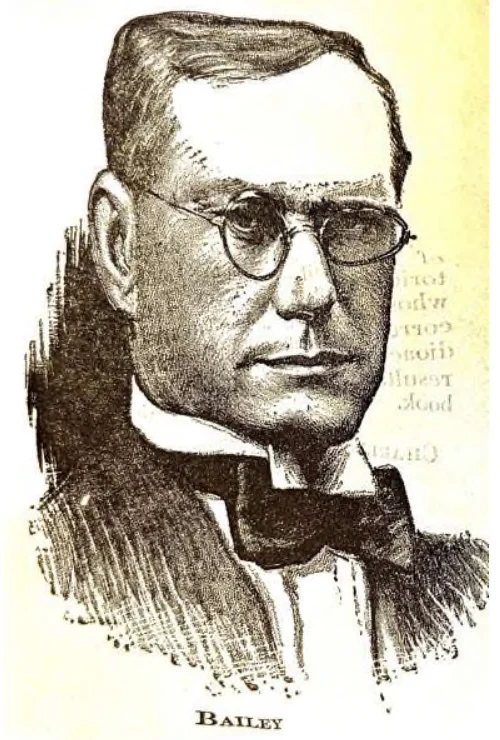
It opens on a portrait. An engraved face, round spectacles, a high collar, a black bow tie, and one word underneath. BAILEY. Not the author. The man whose water the book sells.
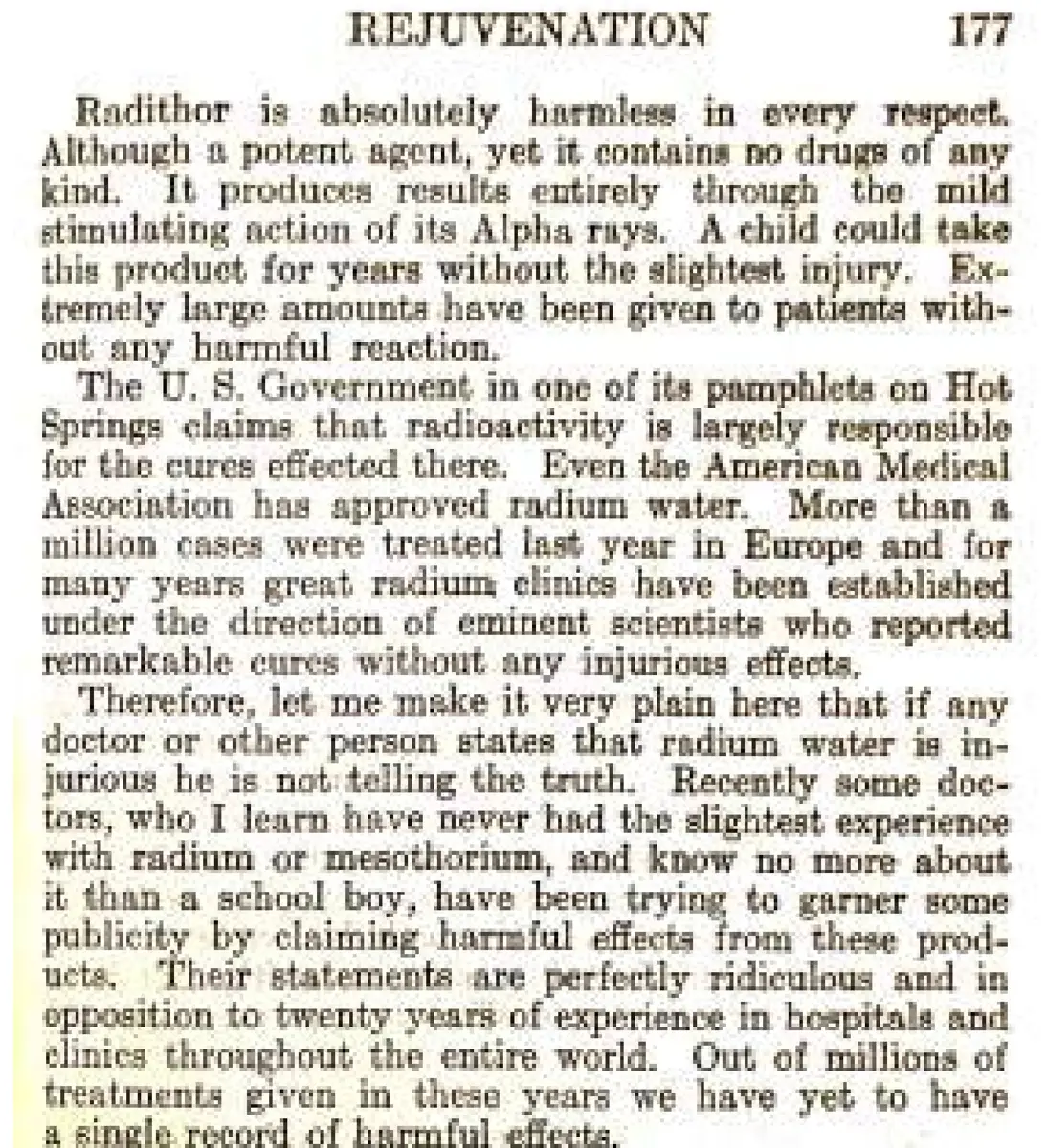
Little brown bottles, the book says, the water colorless, tasteless, odorless. Then page 177: "Radithor is absolutely harmless in every respect." And two lines down: "A child could take this product for years without the slightest injury."
The label said radioactive water, and that much was true. Federal chemists tested it and said so.
Eben Byers, a Pittsburgh industrialist and a national amateur golf champion, drank it for nearly three years. When he died of radium poisoning in 1932 he weighed 92 pounds, and most of his jaw had been cut away.
Six years after the book.
Who Is Charles Evans Morris?
In January 1927 three doctors wrote to the Journal of the American Medical Association with the same question. One asked: "Who is Charles Evans Morris, M.D., East Orange, N. J., and what is 'Radithor'?"
The Journal's answer came on 29 January. Radithor was "the latest nostrum" of William J. A. Bailey, and the book was "so obviously a piece of commercial puffery that even the most unsophisticated can hardly be deceived." Morris was real: born 1867, from Hartford, licensed in Connecticut in 1893.
Bailey, "not a physician, so far as our records show," was another matter. The Journal walked back through his companies to a device called the Radiendocrinator, "a high-priced piece of hokum that sold first for $1,000 and later for $150," and to thirty days in the Tombs in 1915, after federal authorities declared a car company he was tied to a fraud.
The book's own trail is thin. The Catalog of Copyright Entries gives its publisher, Scientific Medical Publishing Co., one title: this one. Bailey's order blank offered to send "Dr. Morris' book with your compliments" to any names a doctor supplied.
Radithor went out by the case, 30 bottles at a dollar a bottle. Some 400,000 bottles were sold between 1925 and 1930.
Floods of Sunshine
Morris begins at the springs. At Gastein, he writes, the waters cured at the source and failed in the bottle. Then came radioactivity. Radon "decays to one half in 3.85 days," so the virtue ran out on the journey. The value of the springs, he concludes, lay in their rays.
Bailey, on Morris's account, went further. Alpha rays barely penetrate, so they had to be carried inside. Hence the tiny bottle of "apparently lifeless, colorless and tasteless water" holding "the greatest force known to mankind."
One drink, and the body is "flooded with billions upon billions of Alpha rays" that spread "like floods of sunshine."
The dose follows. One bottle a day. Two or three for those past 60 with "marked evidence of senility." "There is no fear of getting an overdose of radium." The elderly should "keep their bodies slightly radioactive always." Morris, nearing 60, reports "the strength, vigor and virility of my early twenties."
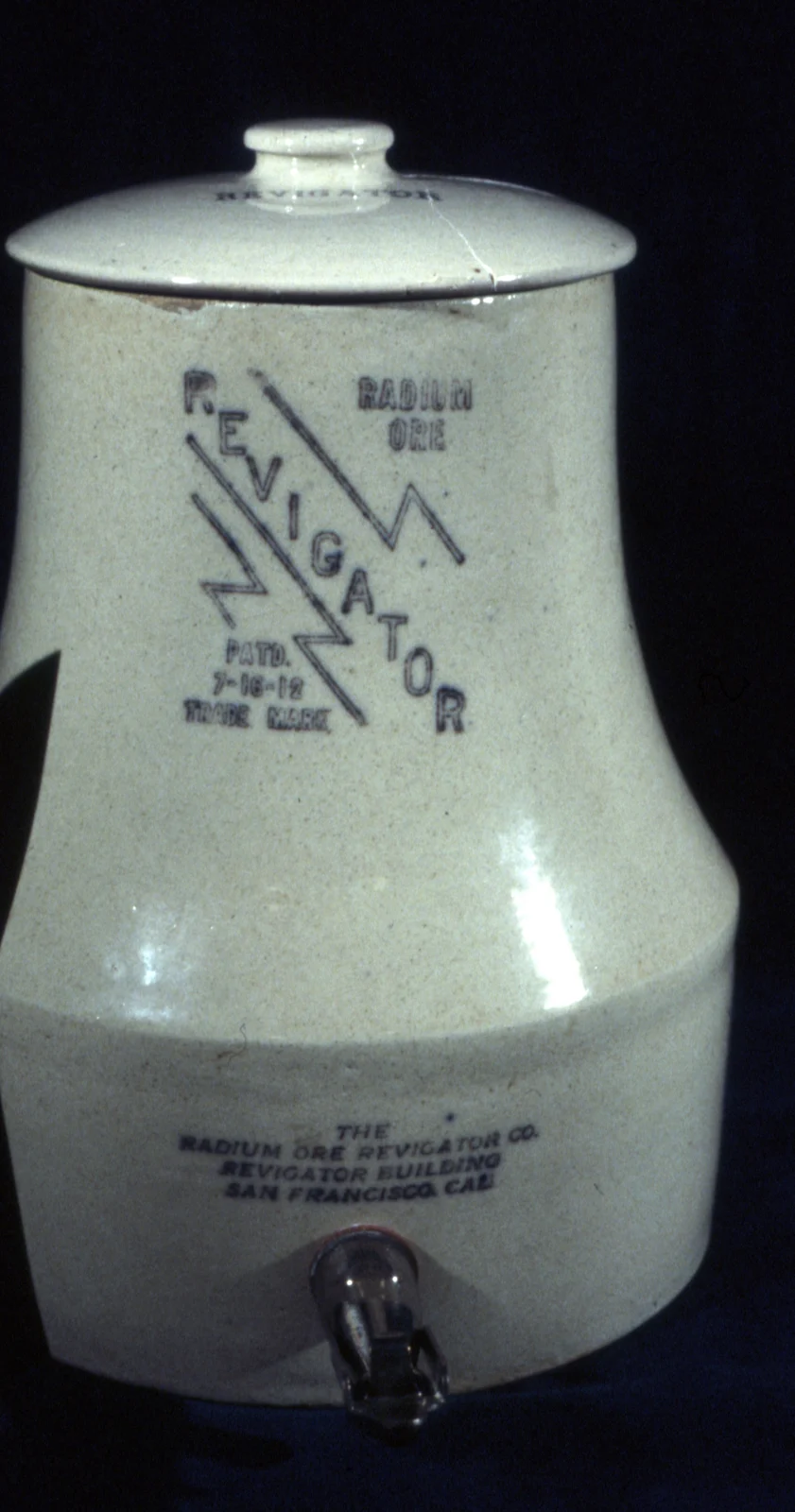
The book keeps its contempt for the jars. By the mid-1920s the Radium Ore Revigator of San Francisco was selling stoneware crocks lined with ore, and others sold ore rods and discs to drop in the water. "I beg to warn the public against the purchase of such contraptions," Morris writes. One $25 jar held "less than 10 cents worth of radium," proof that Barnum was right "that the people like to be humbugged."
The phrase radium brick is older than all of them. In 1903 the Los Angeles Times joked that a swindler "will now have to supply himself with a radium brick," a turn on the old gold brick con. No product by that name turned up in the records opened for this article, though a 2008 federal catalogue describes one ore rod as an "Ore brick to put in drinking water."
If the Rays Were Real
Set aside for a moment whether it is true. Ask the better question. What kind of body are we living in if it is?
It would mean the old springs were never superstition. Every family that carried its sick to Gastein would have been running a real experiment, at a dose nobody could measure, and the virtue of the water would be a physical thing with a half-life of 3.85 days. The physicians who waved the spas away would owe the pilgrims an apology.
It would mean radioactivity belongs to life. Morris cites a Professor Zwaardemaker, who found that a heart stopped without potassium, feebly radioactive, and started again with a trace of radium or mesothorium in the blood. He cites Albert Nodon in France, on living things as the seat of a radioactivity that follows their vitality, while dead organisms show none. On that reading a living thing is a faint and steady fire, and we are lit from inside.
It would mean old age is a shortage. Not wear. A shortage, in a supply that runs low, and what runs low can be restored. Which means our span would be a matter of dosage, and the line between 60 and 30 would be drawn by a pharmacist. The oldest thing a human being asks for would come in a brown bottle, at a dollar.
And one consequence would still be in front of us. If any amount did any good, the next question would be which amount, in which body, and who would be allowed to find out.
What the Bottles Did
The standard account starts with a sore arm. Byers hurt it falling from a Pullman berth in 1927, and a Pittsburgh physician, Charles Clinton Moyar, suggested Radithor. He took two or three bottles a day from December 1927 to October 1930; about 1,400 bottles by the autopsy paper, 1,000 to 1,500 by Roger Macklis, the radiation oncologist who reconstructed the case, and possibly more by R. E. Rowland of Argonne. Radium seeks bone. It stays.
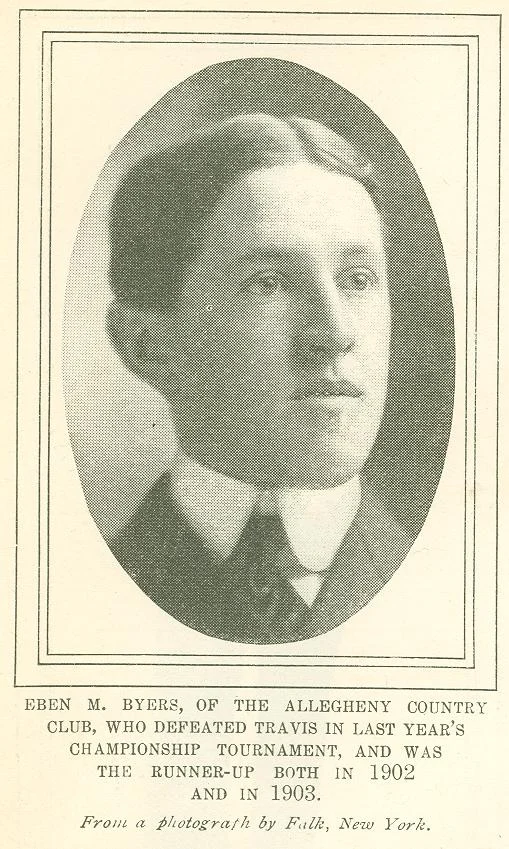
In September 1931 the Federal Trade Commission's attorney, Robert H. Winn, went to take his testimony at Southampton. "A more gruesome experience in a more gorgeous setting would be hard to imagine," Winn said afterward. Byers could hardly speak. His "whole upper jaw, excepting two front teeth, and most of his lower jaw had been removed," and holes were forming in his skull. He died on 31 March 1932, aged 51.
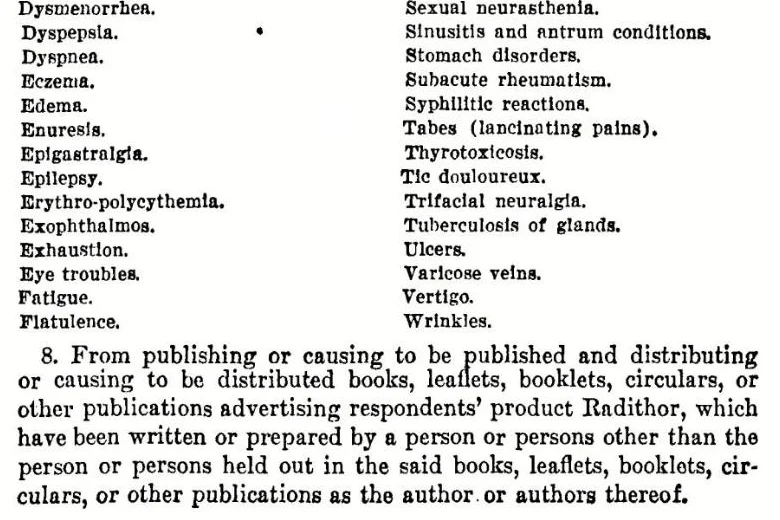
The Commission's complaint, filed in February 1930, had already said it: taken by mouth, "the alpha ray is destructive and poisonous." Its order of 19 December 1931, uncontested by Bailey, forbade him to claim that Radithor helped a list that runs for two pages and ends on wrinkles.
Harrison Martland had described radium poisoning in dial painters in JAMA in December 1925, eleven months before the book's copyright date. The book says doctors "claiming harmful effects" were after publicity. When Byers was exhumed in 1965 his body still held 6.1 microcuries. Bailey denied all of it: "I have drunk more radium water than any man alive, and I have never suffered any ill effects."
What the Order Does Not Reach
It does not reach the jars. Morris said they delivered little radon, and the FTC found one, the Radium Spa, under 3 percent of the level then thought useful. That did not make them safe. In 2009 NIST-linked chemists tested Revigators and judged the metals the greater hazard: arsenic up to 20 times the drinking-water limit, 300 times in acidic drinks.
It does not settle the author. The complaint says Bailey prepared books published as the work of others, "wholly the writings of respondent William J. A. Bailey." The order bans any publication "written or prepared by a person or persons other than the person or persons held out" as its author. Morris's book, a doctor's name on the cover and Bailey's face inside, is the obvious candidate. That is an inference. Official X read all ten pages of the decision and found neither his name nor the title. A manuscript, a contract, a payment: none has turned up.
It does not explain the bodies. Radium in Humans, Argonne's 1994 review, lists more than 80 Radithor drinkers against some 400,000 bottles. Bailey, exhumed in 1970, held 1.1 microcuries; he died at 64 of bladder cancer, and no link to radium has been established. Macklis calls the spread "extraordinary variation" and says it "remains unexplained." Most buyers were never traced, so the ones who lived say nothing about safety.
It does not close the dose. The same review found risk dropping very rapidly at lower radium doses, and says that "may suggest that a threshold exists" for radium cancers. That is a statement about harm, not a safe amount, and no safe or useful amount of swallowed radium has been shown. The National Academies' BEIR VII report of 2006 holds to the linear model and rejects benefit at low dose. Radon baths are still given at spas such as Bad Gastein; a 2026 review funded in part by the Gastein gallery says the radon cannot yet be separated from the heat and the setting. A bath of short-lived gas is not a metal lodged in bone, and EPA counts radon a cause of lung cancer. None of this speaks for drinking radium.
The Water That Is Alive
The argument that returned is older than the metal. The Revigator's makers, by the ORAU radiation museum's account, called plain water "devoid of its life element." Its founder, R. W. Thomas, was listing his Radium Cone Co. in 1931 under "Live Fresh Water." Each says the same thing: water can be dead, and something can wake it. The promise of youth traveled too, as far as a memo on George Van Tassel's Integratron and its "light energy rejuvenation."
Talk of structured water sounds the same note, though no source opened for this article joins it to radium. Its strongest version is Gerald Pollack's at the University of Washington: an ordered fourth phase of water forming beside hydrophilic surfaces. Daniel Elton and colleagues, reviewing it in 2020, found the exclusion zones real and a new phase unsupported.
The old crocks came back too. In October 2026 an influencer told followers he had been drinking from a 1920s Revigator for 250 days. "Perfectly harmless," he said. Morris had said it in print a hundred years before.
The record is not balanced on the bottle. It killed its best-known drinker, and the promise inside it was never shown.
What stays open is a single page. Bottles survive. One Macklis tested after finding it in 1989 was nearly empty and still dangerously radioactive. The book itself gives the radium about 1,700 years to fall by half. The sentence about the child is still on page 177. Charles Evans Morris's name is on the title page. Whether the sentence is his, nobody has shown.
Questions This Leaves You With
Is there anything a person actually does with this?
Nothing here is a reason to drink, bathe in, wear or breathe anything, and anyone selling you radioactive water, stones or ceramics is selling something. If you come across an old crock or a brown bottle, it is an object for a museum case, and its water is not safe to test on yourself. The larger question is not personal at all: how a society checks a cure that feels good for years and kills afterward. Your part in that is small and real. When a label is accurate, ask what it leaves out.
Does this sit against a religious account of the world?
Healing water runs through many traditions, and this story cuts both ways. One reader sees a modern salesman borrowing the old reverence for springs, with a laboratory coat over it. Another sees that the springs were only ever a place where people went to be cared for, and that no assay touches that. Morris himself reached for the word spirit when he wrote about the springs. This site will not tell you which way that falls, and you may find it falls differently on different days.
Does this change what a human life is?
Byers was 47 when he began and 51 when he died. Hold that next to Winn's account. On one reading it makes a life smaller: a body that gives no warning in time, a hope that does the damage. On the other it makes a life larger: the wish for more years is strong enough that a rich and famous man drank for nearly three years what his doctor suggested, and that wish is not foolish. It is only human. Which one you felt first may be worth noticing.
What would change your mind, in either direction?
Say it now, before you are committed. On the side of low doses, what would count is a sham-controlled radon trial with the heat and the rest held equal, or a large body of records showing fewer cancers at small exposures after every other cause was removed. Against, a clear rise in harm at those same doses would do it. On the book, a contract, a ledger or a letter naming the writer would settle authorship in one page. On live water, a measured property that survives a week on the shelf.
Why did some drinkers die and others not?
Some 400,000 bottles went out, if the sales figures are near right, and the Argonne files hold a little over 80 known drinkers. Nobody knows how many were harmed. Nobody can say why Byers went at 51 and Bailey at 64, or whether Bailey's bladder cancer had anything to do with radium. Most buyers were never traced, so nobody can count the harm or call the survivors safe. Some of the answer may still lie in cemeteries and in old patient files. That space on the chart is empty, and it may stay that way.
Sources
- Modern Rejuvenation Methods, 1926, scan of a copy stamped at copyright deposit Charles Evans Morris, M.D.; Scientific Medical Publishing Co.; Internet Archive Primary record
- Modern Rejuvenation Methods, catalogue record, 1926 HathiTrust Primary record
- In the Matter of Bailey Radium Laboratories, Inc., et al., Docket 1756, 15 F.T.C. 419-428, 1931 Federal Trade Commission Primary record
- Radithor and William J. A. Bailey, Queries and Minor Notes, JAMA 88(5), 29 January 1927, pp. 342-343 American Medical Association; Internet Archive Primary record
- The Great Radium Scandal, Scientific American 269(2), August 1993 Roger M. Macklis; Scientific American Study
- Radithor and the era of mild radium therapy, JAMA 264(5), 1 August 1990 Roger M. Macklis; PubMed Study
- Radium in Humans: A Review of U.S. Studies, ANL/ER-3, 1994 R. E. Rowland; Argonne National Laboratory Primary record
- Catalog of Copyright Entries, Part 1, Books, 1927 Library of Congress Primary record
- American Chamber of Horrors, 1936, catalogue listing Ruth deForest Lamb; Open Library Study
- United States Daily, 4 April 1932 United States Daily; Internet Archive Primary record
- Medicine: Radium Drinks, 11 April 1932 Time Study
- Los Angeles Times, 5 May 1903 Los Angeles Times; Internet Archive Primary record
- Radium Historical Items Catalog, August 2008 Buchholz and Cervera, ORISE, for the US Nuclear Regulatory Commission Study
- Radium Ore Bar ORAU Museum of Radiation and Radioactivity Study
- Revigator (ca. 1924-1926) ORAU Museum of Radiation and Radioactivity Study
- Thomas Radium Cone and C.R. jar ORAU Museum of Radiation and Radioactivity Study
- Radium Spa (ca. 1926-1930) ORAU Museum of Radiation and Radioactivity Study
- What Were They Drinking? Researchers Investigate Radioactive Crock Pots, January 2010 NIST Primary record
- BEIR VII Phase 2, public summary, 2006 National Academies Primary record
- Radon spa therapy review, Clinical Rheumatology 45(8), 2026 Rodrigues et al. Study
- Health Risk of Radon US Environmental Protection Agency Primary record
- Research Pollack Laboratory, University of Washington Primary record
- Exclusion Zone Phenomena in Water: A Critical Review, Int. J. Mol. Sci. 21(14), 2020 Elton, Spencer, Riches and Williams Study
- Water Of Life, October 2026 Futurism Study