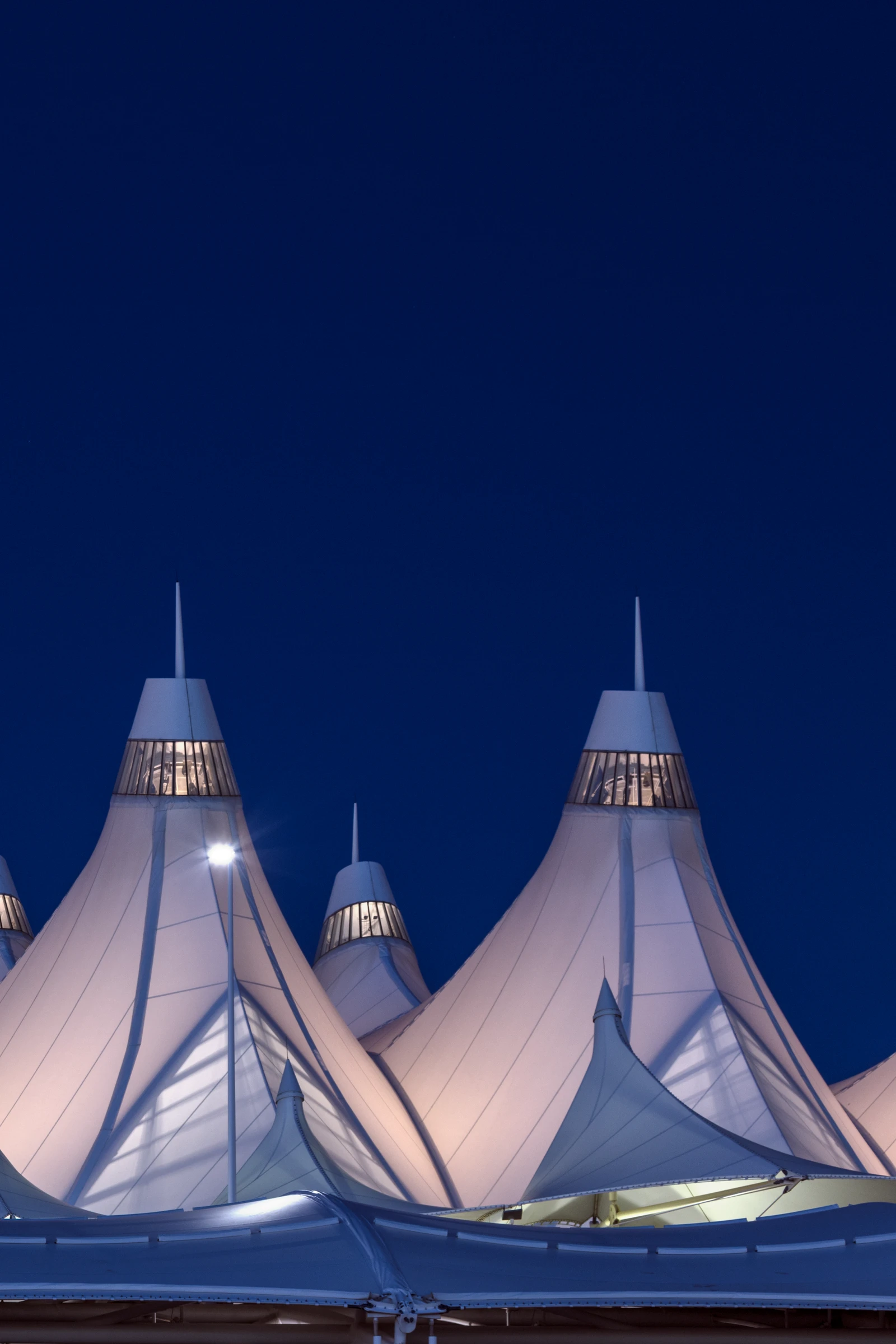
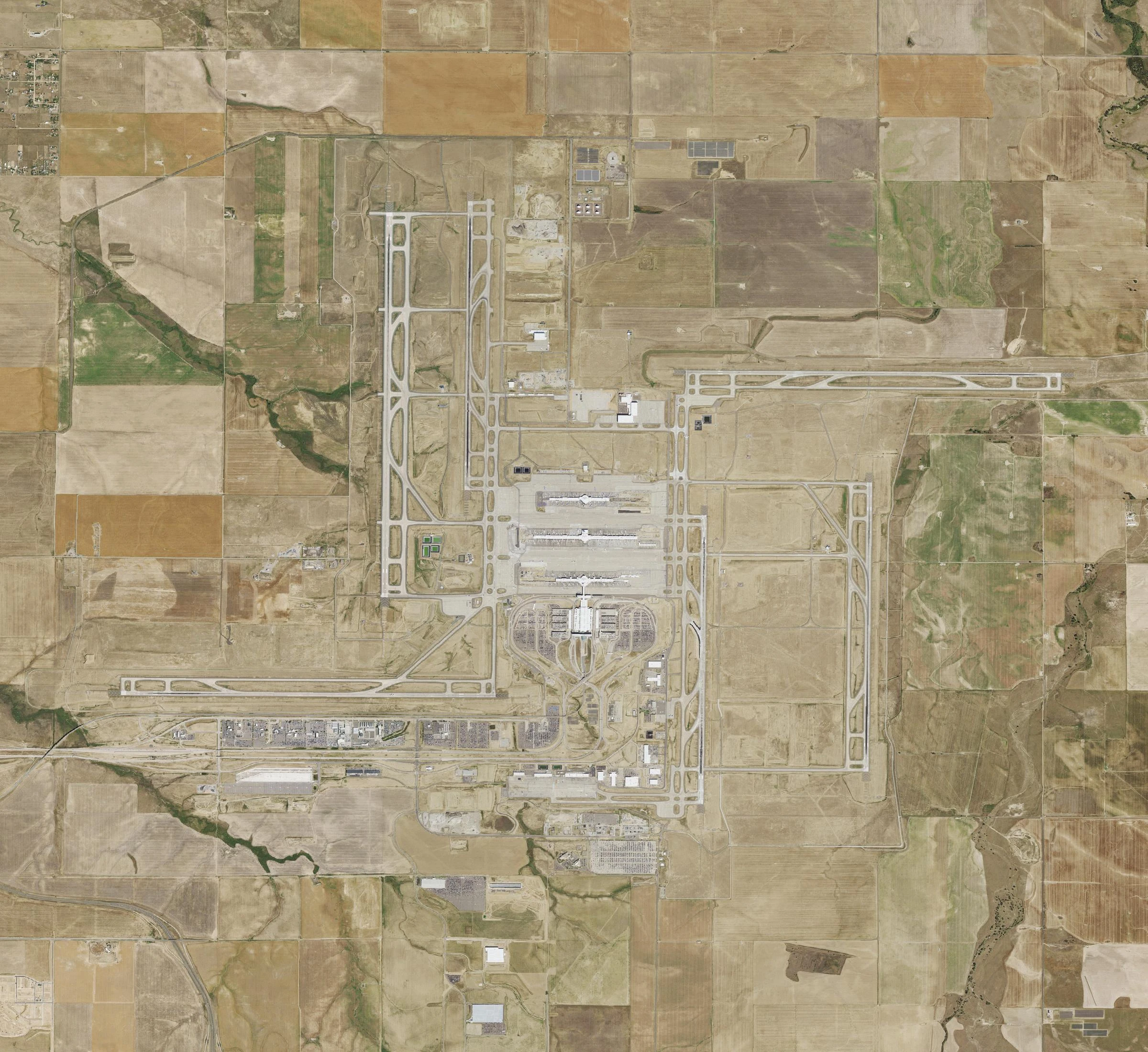
Denver International Airport sits on 53 square miles of Colorado prairie, twice the area of Manhattan by its own count, some 26 miles from downtown Denver. It opened on February 28, 1995, sixteen months late. For three decades people have been reading it like a text: the roof, the runways, the paintings, the horse, a stone in the terminal.
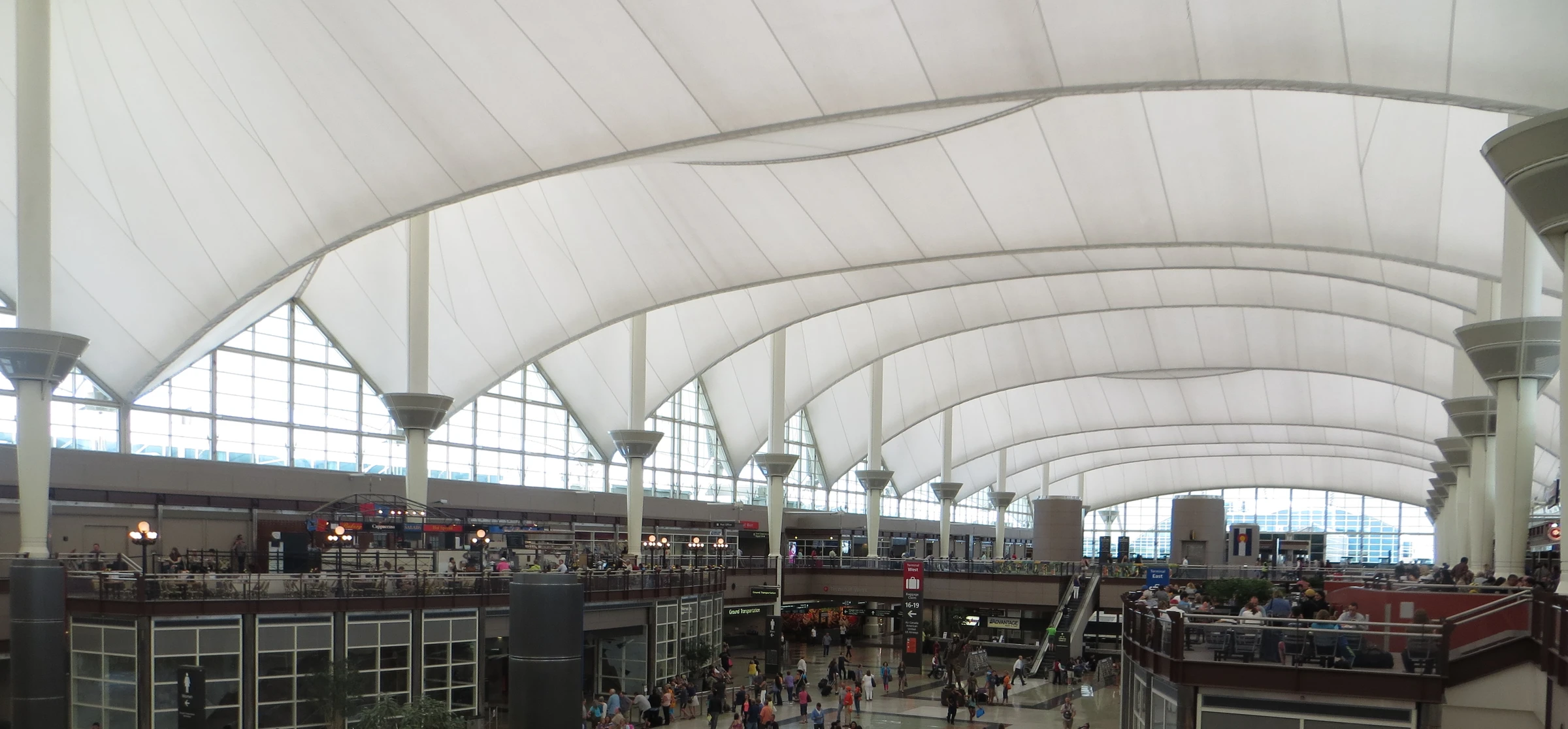
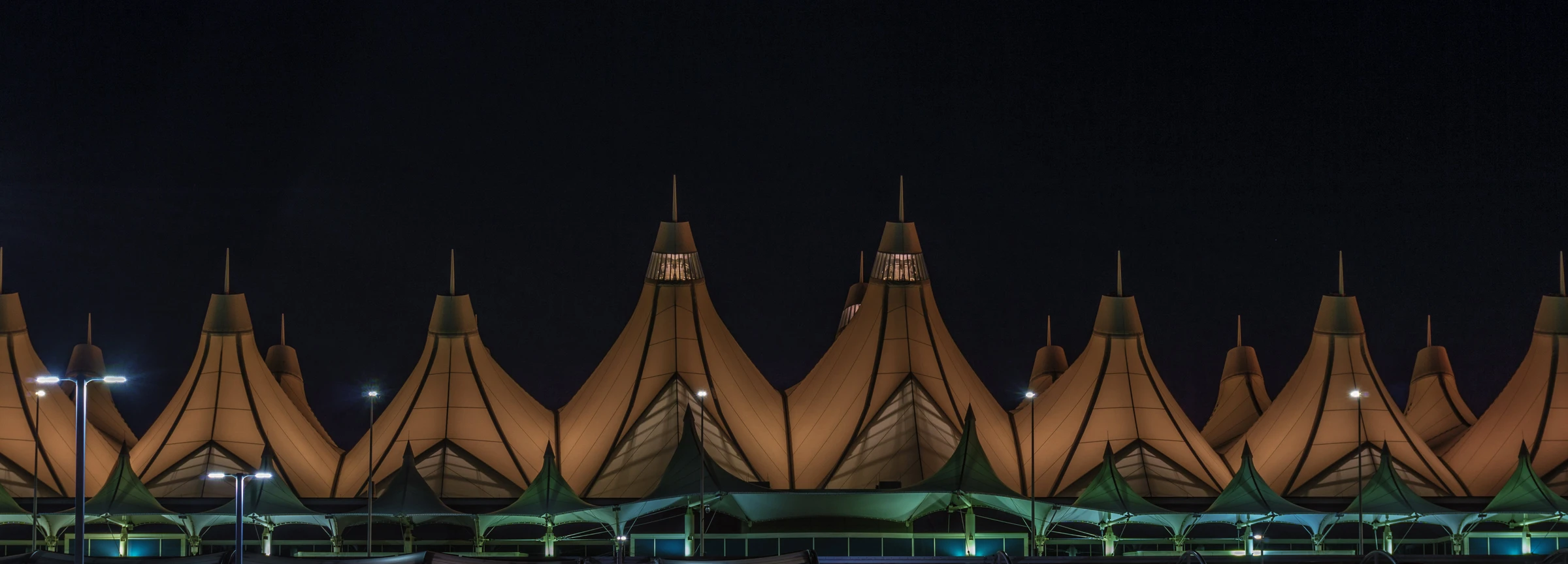
From the road the terminal is a line of white peaks, fabric stretched over 34 masts by the airport's count. A blue horse 32 feet high rears over the plain with red lights for eyes. Inside, on a polished floor, a granite stone carries a square and compasses, and low down the words New World Airport Commission.
Under all of it, in concrete, run the tunnels.
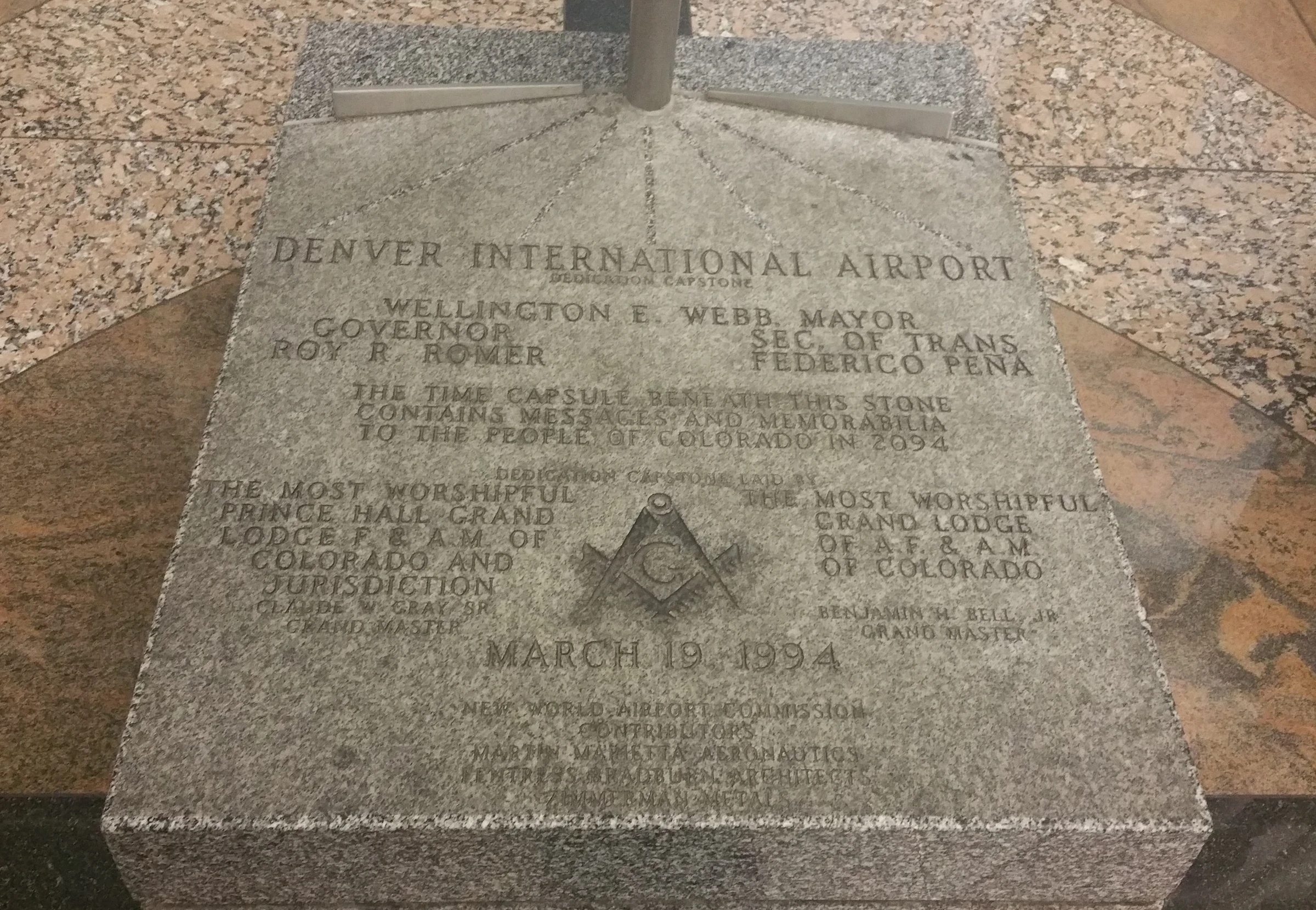
The stone says it covers messages and memorabilia "to the people of Colorado in 2094." Its date is March 19, 1994.
The airport was then eleven months from its first passenger.
A Party for an Airport That Would Not Open
On February 28, 1994, Mayor Wellington Webb came out of a room in the Stapleton parking garage, after a day of talks with the airlines, to say the airport was not ready. The opening had already slid from October 1993 to December, and from December to March 9. The baggage system was the trouble.
The New World Airport Commission kept to its calendar. Charles Ansbacher, chair of the state arts council and a conductor, had set it up as a nonprofit in 1990 to promote the airport. It had already staged an air show and a gala in a half-finished terminal. Its March 9 dedication was now off, but March 19 stayed: a capstone-laying with a time capsule, then a private reception for the artists. After that, the commission said, it would close under its articles of incorporation. Ansbacher had by then left for Austria, where his wife was the American ambassador.
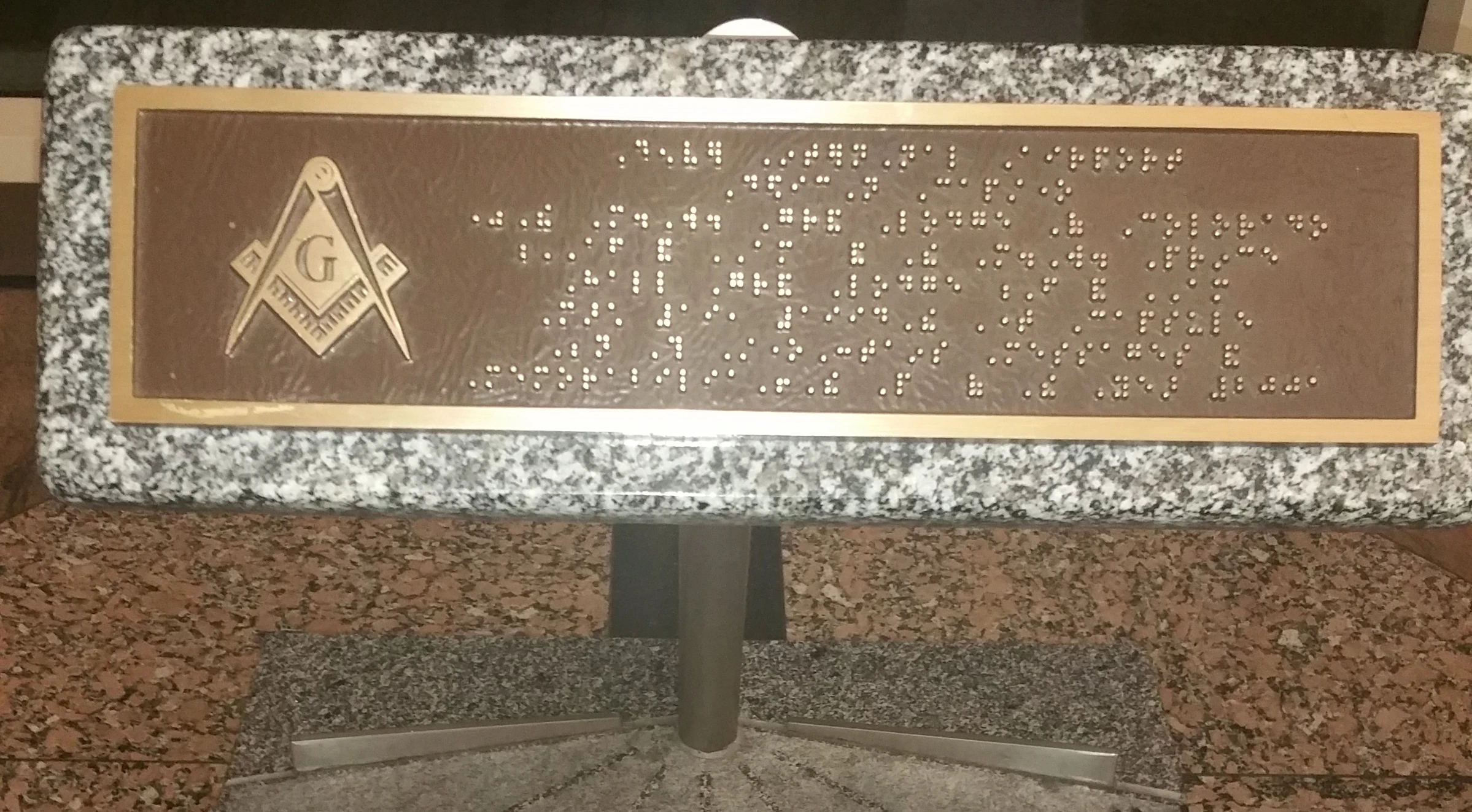
Official X read the stone from two photographs taken in 2017. Across the top: Denver International Airport, Mayor Wellington E. Webb, Governor Roy R. Romer, Transportation Secretary Federico Pena. Then the line about the capsule. Then, on either side of the square and compasses, the two bodies it says laid the stone: the Prince Hall Grand Lodge of Colorado and Jurisdiction, and the Grand Lodge of Colorado, each with its grand master. Then the date, March 19, 1994. The commission comes last, near the bottom edge, over one word, Contributors, and three names: Martin Marietta Aeronautics, Fentress Bradburn Architects, Zimmerman Metals.
The stone stayed in the hall. The body named on it wound itself up.
That same spring Leo Tanguma was painting two murals in a room at the Lakeside Mall, on a $100,000 commission. A van pulled up in 1994, he told Westword later. The visitors stayed over an hour, asked about his symbols, and one woman asked whether the airport had told him what to paint. He said it had not. They left him a thick photocopied book on a United Nations conspiracy.
The Woman Who Went Down to Look
The idea has an author, by her own account. On April 26, 1996, a researcher named Alex Christopher went on a California radio show hosted by Dave Alan to talk about her book Pandora's Box II. Westword traced nearly everything since to that transcript. She told the paper in 2007 that, as far as she knew, she was the one who started it.
She said she had been underground, twice, and had seen shafts beside the train line, each wide enough for a two-lane highway, with sprinkler pipes across the ceiling every five or six feet and a great steel door at the far end. She described five buildings, up to 150 feet tall, built and then declared to be in the wrong place and buried. She described five contractors kept apart, fences with barbed wire angled inward, and an electrician who went six levels below the fourth and would no longer talk.
The largest numbers were not hers. They came from Phil Schneider, a lecturer on underground bases: at least eight levels, a city of 4.5 square miles, a base of 88.5 square miles. Schneider was dead by the time of the broadcast, officially by suicide, a finding Christopher rejected. Which means that, in anything this search opened, his account of Denver comes through her alone.
Then she turned to the paintings. She saw three caskets holding a Jewish child, a Native American woman and a black woman. She saw a towering green figure with a sword over a ruined city, and women on a road carrying dead babies. She saw a German boy with an iron fist, hammering swords. On her reading these were no warning. They showed what was planned. Both murals and the horse are modern works in copyright, so none of them is pictured here; the sources link to where they can be seen.
The stone drew her too. She saw an arm rising from it, a keypad, and a wooden block, and Schneider, she said, called it a homing beacon for ships coming into the Great Hall.
The idea grew. David Icke's The Biggest Secret of 1999 made Denver the western headquarters of a New World Order under martial law. Leonard Horowitz put the mural's soldier on the cover of Death in the Air in 2001. On June 11, 2007, Jay Weidner spent George Noory's Coast to Coast AM reading the airport as a cathedral and the murals as a message about the year 2012, on more than 500 stations. Jesse Ventura's Conspiracy Theory took it up in 2010, by the airport's own account. Like the Integratron at Landers, the place had become a building people came to for a message.
And the case stands on real things. The six runways spread in a pinwheel that, seen from above, can look like a swastika. A section of the horse fell on the man who made it, Luis Jimenez, in his New Mexico studio in June 2006, and killed him. The General Accounting Office, Congress's auditors, recorded that the Securities and Exchange Commission was investigating the airport's disclosures about its baggage system. And the building's own architects say the heavy machinery went below ground on purpose: the Denver Art Museum quotes Curtis Fentress on turning the building upside down.
If the Paintings Are a Notice
Set aside for a moment whether any of it is true. Ask the better question. What kind of country are we living in if it is?
It would mean a public works project of nearly $5 billion was a shell. Voters were asked for an airport, and on this reading they paid for something else, with the delays and the broken machine as cover. It would mean thousands of workers went home every night and kept quiet for thirty years. It would mean that the audits we pay for could describe a building, line by line, and miss the one underneath it, and that a public record can be accurate and still be the cover.
It would mean that power in our time prefers to sign its work. Not a whisper in a locked room. A notice painted 28 feet long in a public corridor, walked past by millions of us on the way to the rental cars.
Which would mean the rest of what we build could be read the same way. Every cornerstone, every civic mural, every word in a city's own records would be a question. We have told ourselves that a public building is what it looks like. On this reading that belief would be the first thing to go.
And it would leave something in front of us. If a few people truly expect a catastrophe and have dug in, then the shape of a shelter tells us what they think is coming. On that reading, the question is who is on the list, and why we would ever be told.
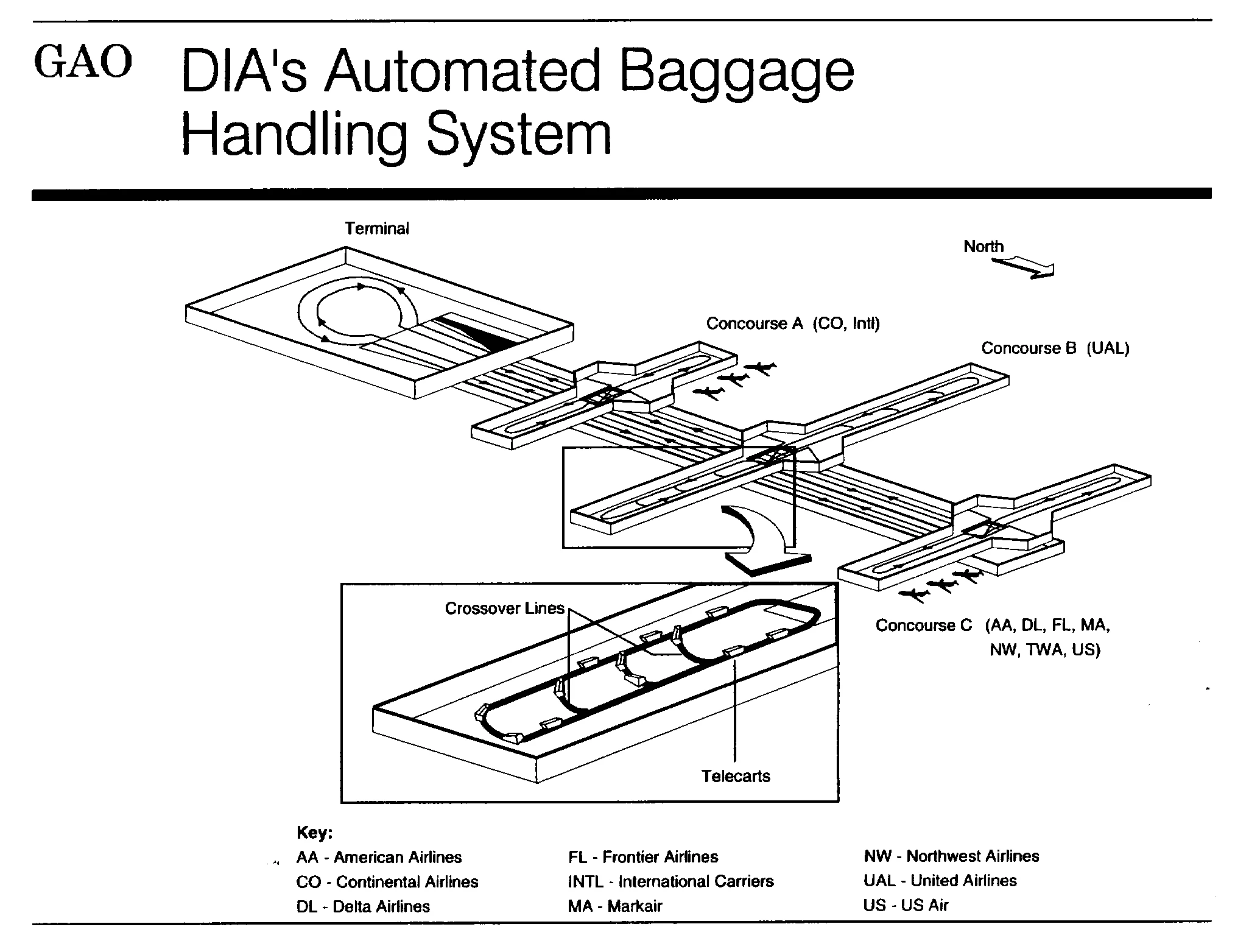
Seventeen Miles of Track
The standard account holds that the paperwork explains the strangeness, and most of the paperwork is federal. The GAO recorded a construction estimate of $2.08 billion in May 1990 and an actual $3.004 billion at opening, with the total, once interest and bond costs were counted, "over $4.8 billion." It tied most of the increase to scope, "such as the addition of an automated baggage system." That system was a $193 million contract with BAE Automated Systems: "over 17 miles of track," 4,000 telecarts, and in tests bags that "were misloaded, were misrouted, or fell out of telecarts." United dropped it in 2005. On this account, that machine explains both the tunnels and the delay.
The airport says the tunnels total about 1.63 miles, that thousands of people work in them daily, and that they stop at the perimeter. Denver7's reporters walked them. The reason the museum gives for Fentress's design is cost, efficiency and light. Jeff Price, a former assistant security director, says the runways are the FAA-approved layout for wind, and that the rumour of coffins in the tunnels may trace to radio slang for the oversized-bag carousels, called coffins.
The commission was real. The Denver Public Library holds eleven boxes of its records, collection WH858. "The idea that there is anything secretive about this is totally preposterous," Ansbacher told Westword. Masons laying stones at public buildings is an old custom: George Washington laid the Capitol's cornerstone with Masonic ceremonies in 1793. Ansbacher said a local lodge provided this one. The keypad, in the 2017 photographs, is a brass tablet of raised dots, braille by the Visit Denver account, on a block of speckled stone on a steel post.
Tanguma has said from the start that he had no instructions. The murals, in his account, move from destruction to healing, the soldier masked so that he could be any race. Some of the children's faces are real, painted at their parents' request: a boy hit by a stray bullet at the zoo, a boy lost to suicide, a girl killed helping a friend escape abuse.
Three Stories for One Name
None of that is a survey. The 1.63 miles is a spokeswoman's figure. The public is kept out, the airport says, for safety, a closure of the kind read as concealment at the Grand Canyon's forbidden zone. The answer is reasonable, and it cannot be checked from outside. This search looked for a published plan or section of the levels below the terminal. It did not find one. Reporters have seen what they were walked through. That is evidence, and it has an edge.
The commission's name is another loose thread. The library says Ansbacher named it for Dvorak's New World Symphony. Ansbacher himself told Westword in 2007 that he could not quite remember, and offered Dvorak as a guess. A spokesman had written in 2003 that it meant a new era for a world-class city. A later spokeswoman said it meant a new international airport. Three explanations for two words, none from a document.
This search found no published inventory of the capsule. Three lists circulate and they disagree: a signed Rockies ball, a Beavis and Butt-Head guide, the mayor's sneakers, casino tokens. One includes newspapers from opening day, a year after the stone was laid. When the airport placed a second capsule in 2013, it said a complete listing would be posted. The stone does not say what its three contributors gave, and nothing found here does. One of them, Martin Marietta, merged with Lockheed in March 1995, in a union of the second and third largest American defense contractors; the stone lists it beside an architect and a metal firm.
The mural outline that Christopher and Weidner each said Tanguma was given appears in nothing this search opened. The commission contract would answer that in either direction, and it was not found either. Nor did this search find how the SEC inquiry ended.
The First Claim Anyone Can Walk
The airport has stopped arguing. In 2016 it staged an exhibit of its own legends and offered a tunnel tour with an oath of secrecy as a joke. In 2018 its construction walls asked whether workers were building an Illuminati headquarters or remodeling the lizard people's lair. In 2019 a talking gargoyle went up in baggage claim, a cousin of Terry Allen's two cast in open suitcases.
The renovation behind those walls took the art with it. The Great Hall floor by Jaune Quick-to-See Smith and Ken Iwamasa could not be saved. The murals went into storage, Children of the World Dream of Peace leaving its wall in 2018. In August 2026 In Peace and Harmony with Nature went back up on Level 5, with protective barriers to follow, while the airport's page still lists Children of the World Dream of Peace as in storage, the mural with the soldier in it.
Then the tunnels themselves. On May 26, 2026, the city announced that a dormant baggage tunnel beside the train tunnel would become a public walkway, 17 feet wide, opening in 2028. Mayor Michael Johnston said travellers could decide for themselves what was fact and fiction.
If that tunnel is one of the shafts Christopher walked, then thirty years after the broadcast it is about to be opened to anyone with a boarding pass. Width of a walkway is not width of a shaft, and one corridor cannot show what lies below another. It can settle what is behind one wall.
The capsule waits. So does its list. Sixty-eight years to go.
Questions This Leaves You With
Is there anything a person actually does with this?
Nothing in your own life turns on it, and nobody needs a bunker or a plan because of it. Anyone selling you a date or a place on a list is selling something. What you can do is go and look. The airport's art pages and the GAO reports are free, and the commission's boxes sit in the Denver Public Library's Western History collection. The larger question is a civic one: how much of what a city builds should its citizens be able to see, and who decides where a safety rule ends and a secret begins?
Does this sit against a religious account of the world?
It has been read both ways. A minister called the mural satanic, Tanguma recalled, and a Christian newsletter in 2003 warned of paganism in it, while Tanguma himself is a Christian who has called his murals painted sermons, and the swords into plowshares come from the prophets. You may find a warning about evil in the same panel someone else finds a plea for peace. This site will not tell you which way that falls, because it is not a question a record can settle.
Does this change what a human life is?
Think of the children in the mural, real ones, painted because their parents asked. To some readers those faces are a code. To the parents they were a last likeness. You may feel smaller knowing that anyone's grief can be turned into someone else's evidence once it hangs in a public place. Or you may feel the opposite: that a stranger walking past with a suitcase can still stop and look at a boy who took a year to die. Either reaction is yours to keep.
What would change your mind, in either direction?
Name it now, before you are committed. A leaked engineering drawing that shows levels below the known ones would count, and so would a named construction worker with payroll records, or a contract telling Tanguma what to paint. In the other direction, a published set of as-built sections would count, or a surveyor's measurements of the walkway tunnel, or Tanguma's commission file showing no content terms. Be careful with the feeling of a pattern: a stone, a date and a word can line up in any large building. Ask what result you would accept before you see it.
Who chose what went into the capsule, and who wrote the stone?
This is the real gap. The words on the stone were drafted by somebody, and the items beneath it were chosen by somebody, before March 19, 1994, while the airport they honoured could not open. The commission's records are in a public library. No published account seen here says who wrote the wording, why that commission's name stands on it, or what the list says. It may be dull. It may be a form letter and a box of souvenirs. But the answer is on paper somewhere in Denver, and it has not been printed.
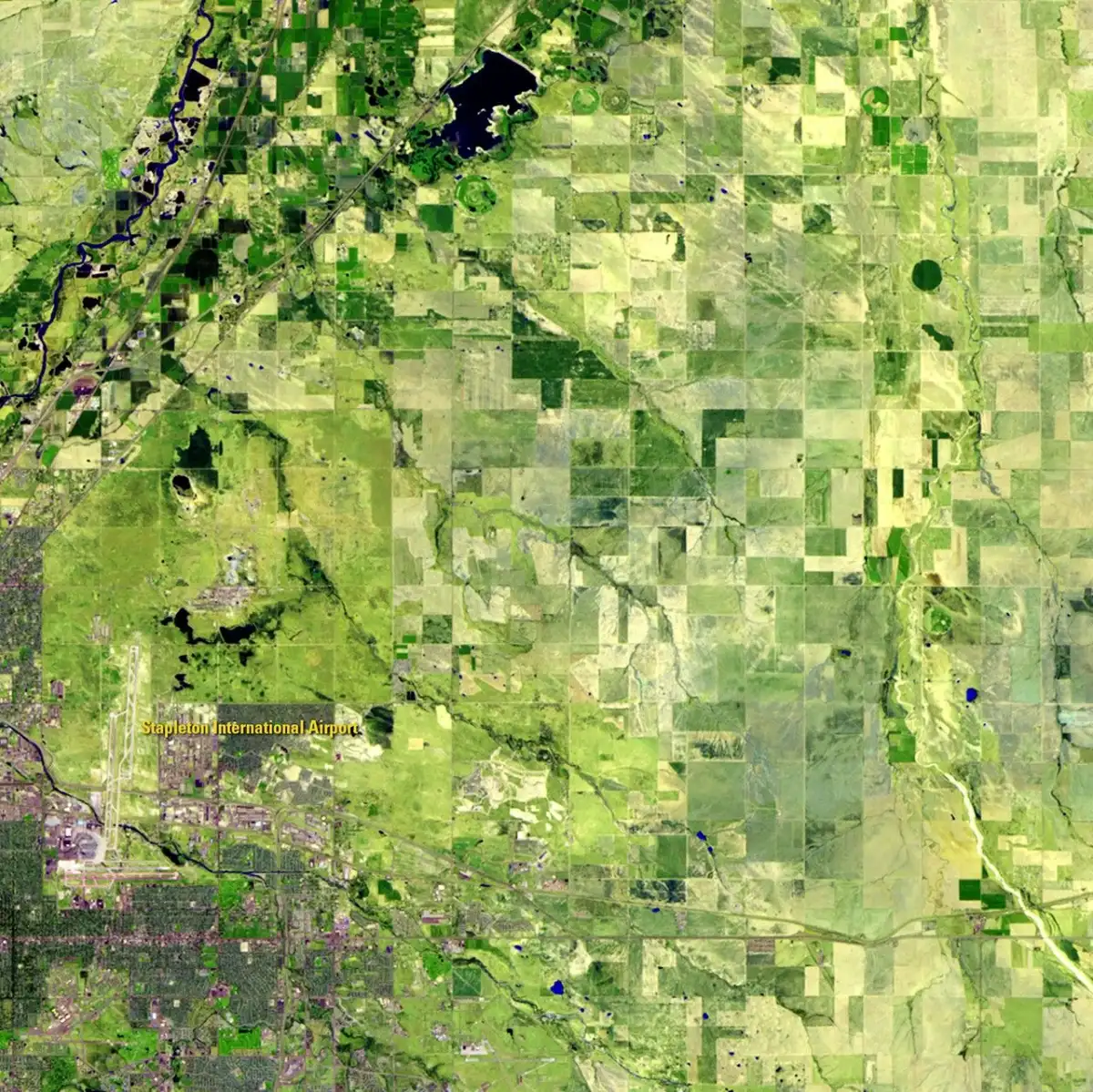
The same ground on 25 August 1984: Stapleton at lower left, with open farmland to the northeast where the airport now stands. NASA/USGS, Landsat 5, 25 August 1984, public domain, via NASA Images of Change. Resized. 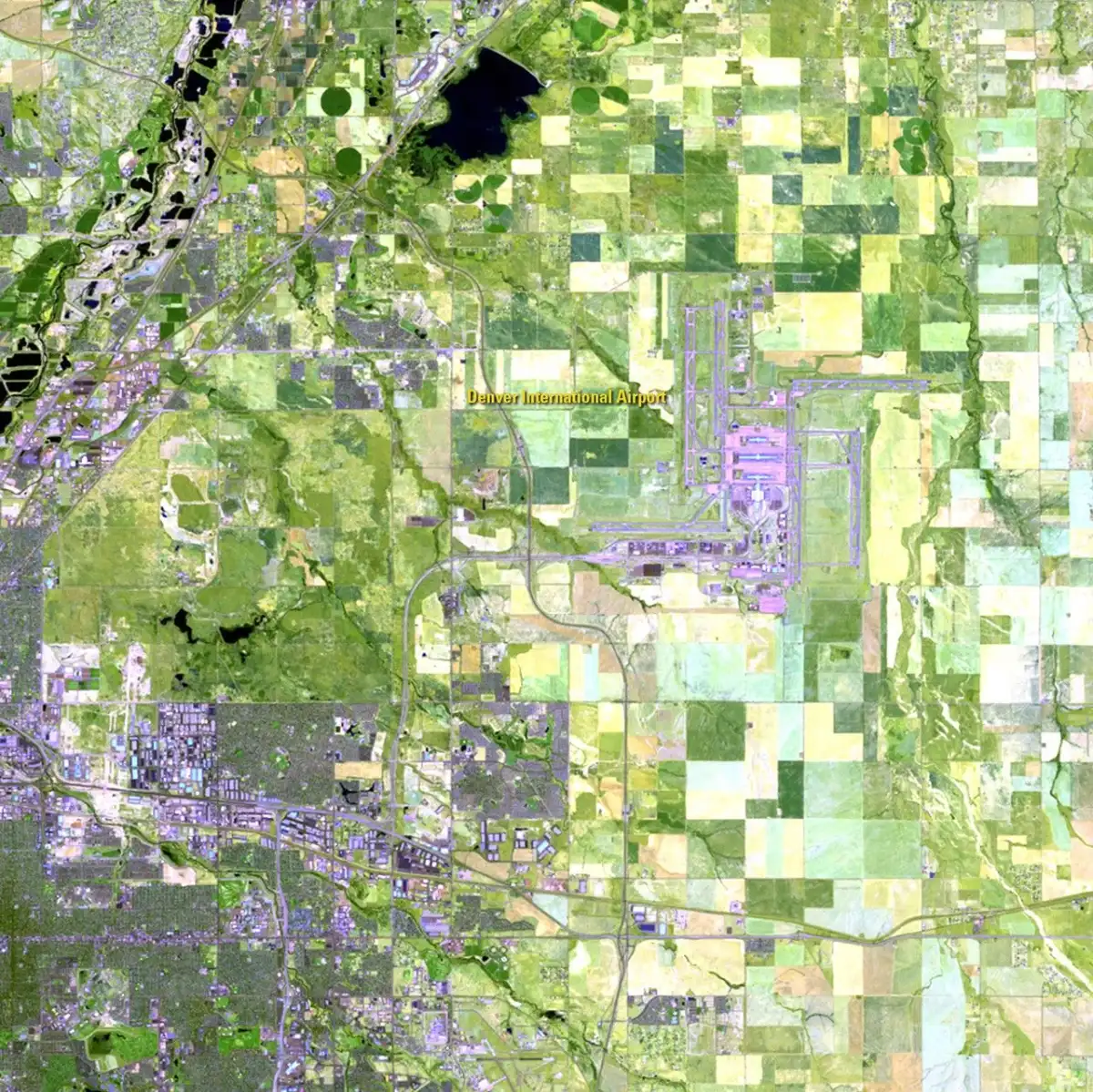
The same ground on 20 August 2011: the airport on the plain, its runways and concourses standing out among the fields. NASA/USGS, Landsat 5, 20 August 2011, public domain, via NASA Images of Change. Resized. 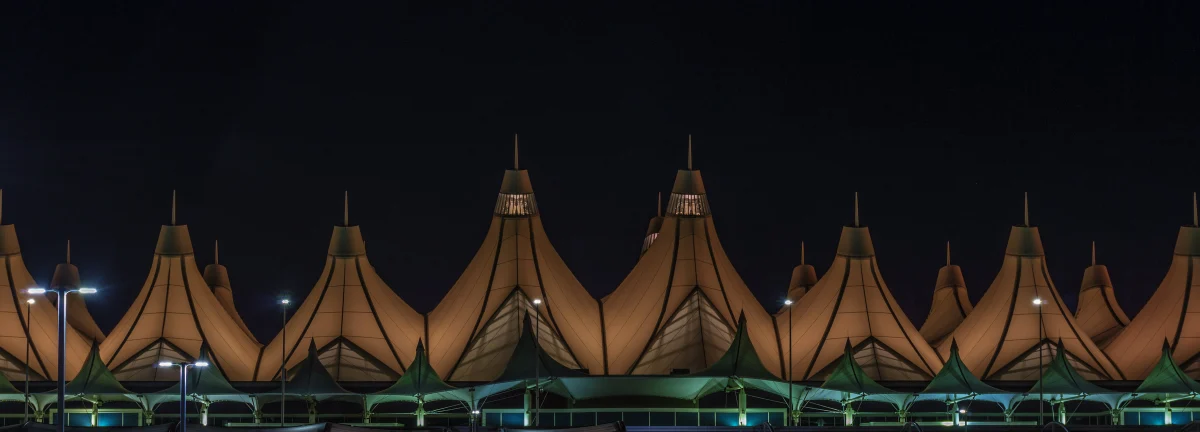
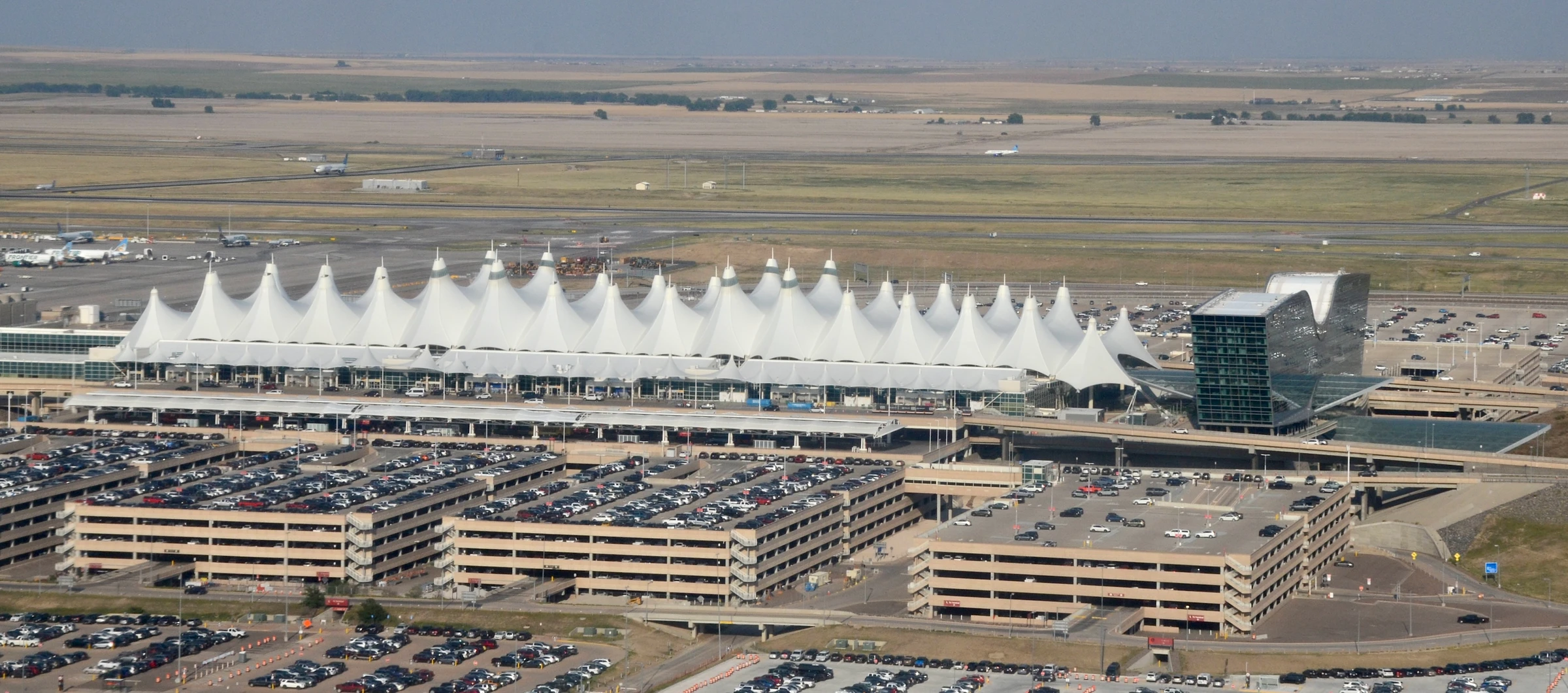
The roof line before sunrise, June 2016. Photo: Jeff Turner, CC BY 2.0 (creativecommons.org/licenses/by/2.0), via Wikimedia Commons. Cropped and resized.
Sources
- New Denver Airport: Impact of the Delayed Baggage System, GAO/RCED-95-35BR, October 1994 U.S. General Accounting Office Primary record
- Denver International Airport: Information on Selected Financial Issues, GAO/AIMD-95-230, September 1995 U.S. General Accounting Office Primary record
- Denver International Airport: Testimony, GAO/T-RCED/AIMD-95-184, May 1995 U.S. General Accounting Office Primary record
- Denver International Airport: Baggage System, GAO/RCED-95-241FS, August 1995 U.S. General Accounting Office Primary record
- Denver International Airport: Financial Statements, GAO/AIMD-96-27, February 1996 U.S. General Accounting Office Primary record
- Masonic monument at Denver International Airport, close view, 5 September 2017 Photograph by F4ith.H0p3.Ch4r1ty, Wikimedia Commons, CC BY-SA 4.0 Primary record
- Masonic monument at Denver International Airport, full view, 5 September 2017 Photograph by F4ith.H0p3.Ch4r1ty, Wikimedia Commons, CC BY-SA 4.0 Primary record
- Patricia Calhoun, Wake-up Call column, Westword, March 1994 Westword Primary record
- Jared Jacang Maher, DIA Conspiracies Take Off, Westword, August 30, 2007 Westword Study
- The KSEO 4/26/96 interview with Alex Christopher, transcript of June 1, 1996 Leading Edge Research Group, reposted Primary record
- Chris Root, A Local's Guide to DIA Conspiracy Theories, February 22, 2023 Denver Public Library Special Collections and Archives Study
- A dive into the most popular, wildest conspiracies surrounding the Denver International Airport Denver7 Study
- About DEN Denver International Airport Primary record
- Patricia Calhoun, With DIA, Federico Pena Imagined a Great Airport, Westword, February 2020 Westword Study
- Concept Model, Denver International Airport Passenger Terminal Denver Art Museum Study
- The truth is up there, 2019 MSU Denver RED Study
- Some Public Officials, Conspiracy Theories Never End, 2010 Southern Poverty Law Center Study
- The DIA murals and the Tanguma family, Rocky Mountain PBS, July 2023 Rocky Mountain PBS, in The Colorado Sun Study
- Four iconic public artworks returning, August 10, 2026 Denver International Airport Primary record
- Children of the World Dream of Peace Denver International Airport Primary record
- In Peace and Harmony with Nature Denver Public Art Primary record
- Mustang, Luis Jimenez Denver Public Art Primary record
- Notre Denver, Terry Allen Denver Public Art Primary record
- Denver International Airport conspiracy theories are taking off again, Westword, 2018 Westword Study
- Gary Sweeney and the art returning to the airport, Westword, August 2026 Westword Study
- DIA will create walkway to all concourses using underground tunnels, May 2026 BusinessDen, from The Denver Post Study
- Marni Rose McFall, Denver airport to open tunnels, 2026 Newsweek Study
- 50-year time capsule placed, October 8, 2013 Denver International Airport Primary record
- Denver International Airport addresses conspiracy theories by celebrating them in October, 2016 Denver International Airport, via Aviation Pros Primary record
- Denver airport's construction posters, August 2018 Atlas Obscura Study
- Denver airport installed talking gargoyle robot, 2019 Snopes Study
- History of the U.S. Capitol Building Architect of the Capitol Primary record
- A Merger of Equals, 2020 Lockheed Martin Study
- You'll likely be dead when these Colorado time capsules are opened New Country 99.1 General reference
- Myths of the Denver airport Visit Denver General reference
- Every Town podcast transcript Podscripts General reference
- Leonard G. Horowitz, Death in the Air, 2001, catalogue record Internet Archive Study
- Conspiracy Theory with Jesse Ventura, episode list TheTVDB General reference