
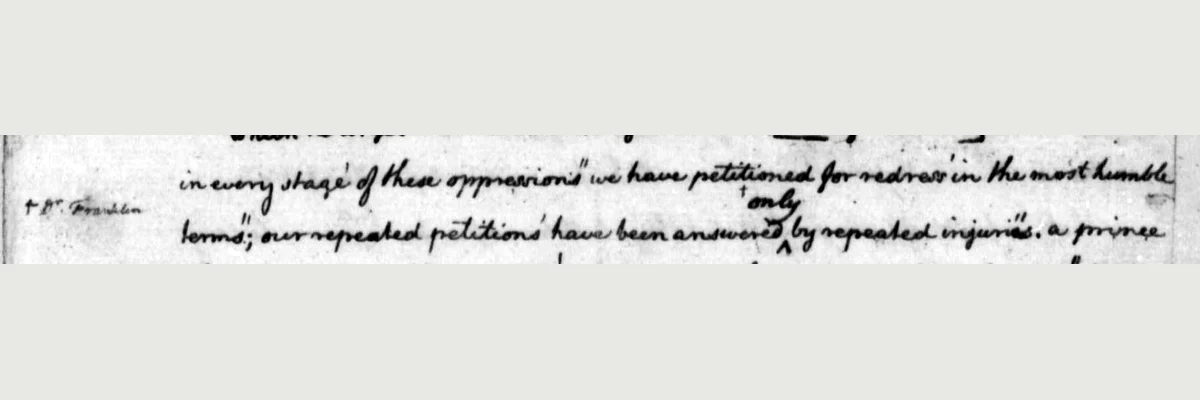
On the parchment Declaration of Independence, in its case at the National Archives in Washington, two small corrections were written into the text. In the grievance that begins "He has dissolved," the scribe wrote "Represtative," then set a caret under the gap and put the missing "en" above the line. Far down the sheet, in "answered by repeated injury," a second caret lifts the word "only" into place.
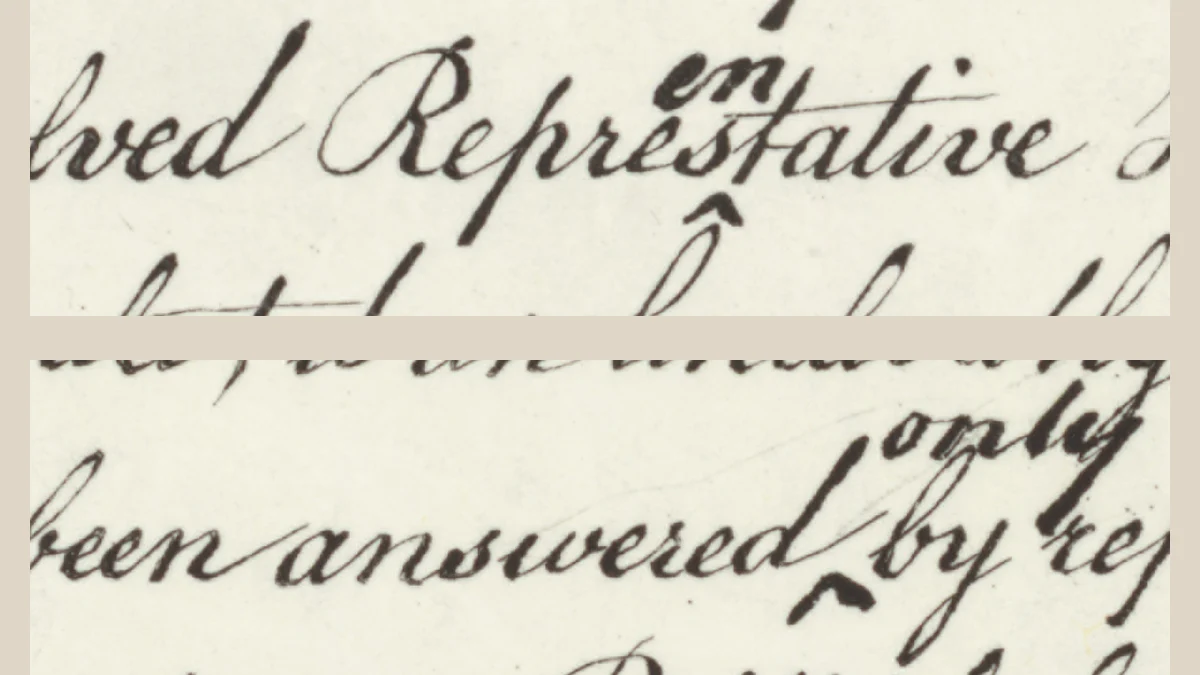
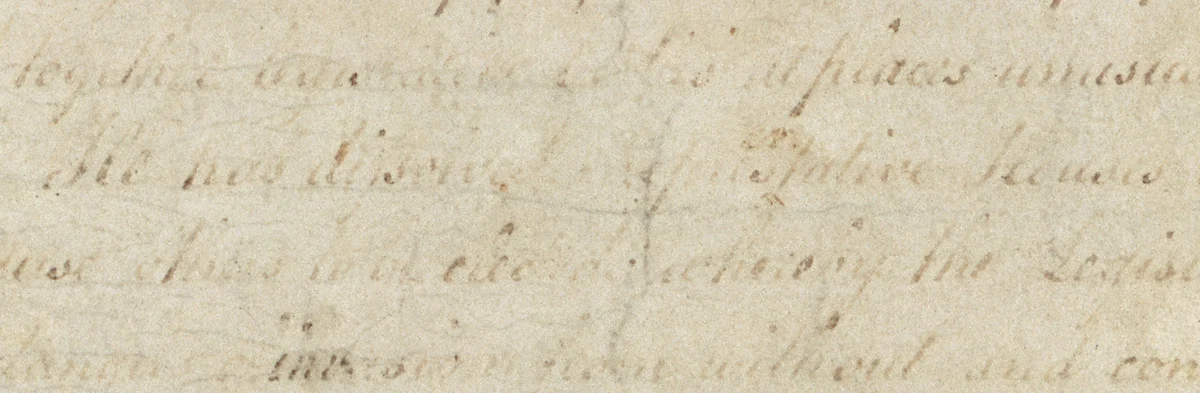
The sheet stands 29 3/4 inches high. The ink has faded to brown hairlines on tan, so far that much of the text can no longer be read from any distance. The image usually reproduced is an engraving made in 1823. On the engraving the two corrections stand out. On the sheet itself they have nearly gone. They were never hidden.
For most of 250 years they were a footnote about a careful man having a bad moment. Then a researcher named Alan W. Green took those six letters away, counted what was left, and began reading the Declaration of Independence downward.
Two carets. Six letters.
Compared at the Table
The order of events is on record. Congress agreed the text on July 4, 1776, and John Dunlap of Philadelphia printed it that evening. On July 19 Congress resolved that it be "fairly engrossed on parchment" under a new title, The Unanimous Declaration, and signed by every member.
The man with the pen was most likely Timothy Matlack, a Philadelphia brewer turned assistant to the Secretary of Congress, Charles Thomson. Most likely is as far as the record goes. Harvard's Declaration Resources Project notes that no official document names him; historians go by his handwriting and his post. He used English round hand and a quill, and Harvard's count of his errors is two.
Danielle Allen, in a 2015 study of the Declaration's punctuation, puts two official copies in front of him: Dunlap's broadside, and Thomson's copy in the Corrected Journal of Congress. Those were also the texts the finished sheet would be checked against.
Then comes the sentence that matters here. On August 2, the journal records: "The declaration of independence being engrossed and compared at the table was signed."
Compared at the table.
Nothing in that sentence says what the comparing found. A third oddity went through untouched: the parchment spells "Brittish" with two t's in one line and "British" with one in another, and nobody put a caret on that.
Six Letters Out
Green spent two decades on hidden patterns in Shakespeare, work that became the Gaia series Shakespeare Decoded, before he turned to the founding documents in July 2023. His book, The America Codes, came out on August 2, 2026, the date of the signing, as a novel about two teenagers. He calls it a novel way to tell a true story, and he has invited historians and mathematicians to check it. This account rests on his interviews and his published figures; the book's full text was not read for it.
His argument begins with the scribe. A penman of that skill, on a sheet of that weight, makes two errors and flags them with carets, inked, Green says, darker than the text around them. He had up to two weeks to start again. Green's reading: a master does not leave that, and Jefferson and Franklin would not have accepted it, unless it was meant.
He goes back to Jefferson's rough draft, and there the case gets its best fact. In the draft, "only" is itself an insertion above a caret, at the same words, with a note in the margin naming Dr. Franklin. At the first correction Green finds a gap in the draft's own word, between "Repres" and "tative."
Then he counts. Every letter, every comma, every point, with the six inserted letters left out and the long rules between sentences set aside. The total is 6,771. Green reads that as 1776 in a mirror. And 6,771 is exactly 111 times 61, so the text lays out as a perfect rectangle, 111 characters wide, 61 rows deep.
In that grid the two corrections become coordinates. Green marks the B of "by" in the second one as character 5,280, the number of feet in a mile. Around the corrections he reads connected groups of letters as anagrams, and his argument runs on through Masonic numbers, the geometry of the Great Seal and the distance to the Moon.
He reads them on to the present. Around the first correction he reads HE IS LEO FOURTEENTH, and beside it a block he reads as PRESIDENT DONALD TRUMP. Asked in a July 2026 interview on the No Way Out podcast whether Franklin knew that, he said no; Franklin, he said, was being guided.
What a Sheet Could Hold
Set aside for a moment whether it is true. Ask the better question. What would it mean for a sheet of parchment to work this way?
It would mean the founding page of the United States is two documents. One is a declaration, read aloud in the summer of 1776. The other is a machine, every comma a part, running under the first for 250 years with nobody at the controls.
It would mean the signers put their names, at the risk of their necks, to something most of them could not have read. A secret kept among a few men in one room would be the deepest thing ever done in plain sight. It would have survived the fading and the engraver, and it would have sat in front of schoolchildren the whole time. Our history of the founding would need a second author.
It would mean something larger if Green's last step holds. A code planted by clever men would be an astonishing piece of craft. A pattern that reached names not yet born would be no longer craft at all, because nobody can plant what nobody knows. On that reading, what we take for the order of events is looser than it feels, a text can hold more than its writers knew, and the people we think of as authors are closer to instruments.
Which leaves the one consequence still in front of us. If a page can carry what has not happened, what exactly are we doing when we decide things?
Two Slips and a Copy Desk
The standard account is shorter. A scribe copying a long text dropped two letters and one word, and they were put back. Harvard's project counts them as errors, and that is the plain reading of a line with a word missing.
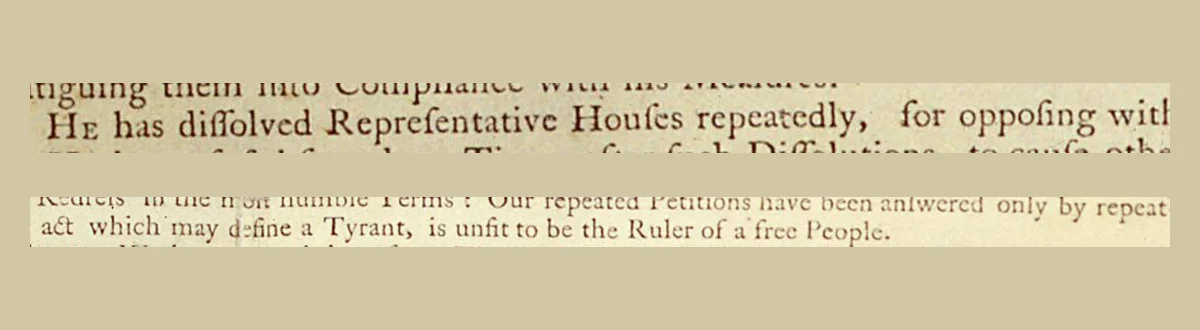
Neither word was ever in doubt. Dunlap's broadside, in type before Congress ordered the parchment, prints "Representative Houses" and "answered only by repeated Injury" in full. Copying slips sit in the draft too: at the next grievance Jefferson began to write "he has dissolved" a second time and struck it, which his editor Julian Boyd called clear evidence that he was copying. Eleven years later Jacob Shallus closed the engrossed Constitution with an errata note above the signatures.
The note "Dr. Franklin" appears beside other edits in the same draft, marking who changed what. And the gap in "Representative" falls on a line that runs along a fold, where a Library of Congress scan shows much of the line worn faint; Boyd's edition prints the word whole.

The count has its own conditions. The 6,771 leaves out six letters that are on the parchment. Put them back and the total is 6,777, which 111 does not divide. And the 5,280 needs those same six letters put back: with them out, as the grid has them, that B is character 5,274, counting from the heading.
The Same Patch, Other Names
A rebuild of the grid for this article started from the National Archives transcription, set its few marks to match the engraving and dropped the rules between sentences. It came to 6,771 characters, and all 60 row starts readable in Green's published figure match. His count of the engraving holds on those terms, and the block he reads is there.
So the test goes to the rule, as his figures show it: a connected group of letters, each used once, in any order. Run that on the same patch of the grid, nine rows by 46 columns above the first correction, and it finds the five letters of TRUMP, Green's own. It also finds BIDEN, OBAMA, PRESIDENT GEORGE BUSH and POPE FRANCIS. It is no skeleton key. In a short search that patch gave no block for PRESIDENT JOE BIDEN or PRESIDENT RONALD REAGAN, and it cannot spell PRESIDENT BARACK OBAMA or PRESIDENT KAMALA HARRIS at all. Across the whole grid most of those names come up somewhere; PRESIDENT BARACK OBAMA did not.
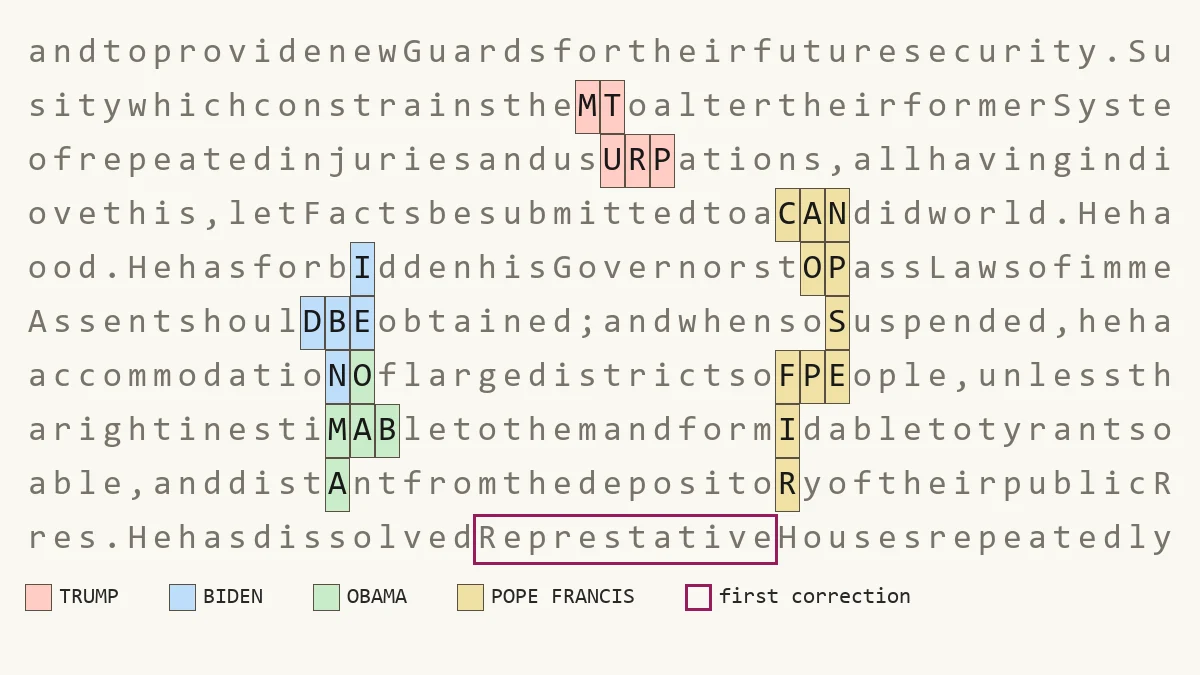
Then the same letters were shuffled at random. PRESIDENT DONALD TRUMP turned up in that exact patch in 4 of 20 shuffled grids, on a search of a few seconds each, and somewhere in the whole grid in 10 of 10. That shows the block can arise with no one designing it. It does not show that this one did.
The site has met this difficulty before: the Simpsons predictions sorted one by one, and the star map Duncan Lunan drew from radio echoes in 1973.
That test has a limit. Green's figure fits about a dozen phrases together with no letter used twice, and a single-phrase test says nothing about that.
And one thing cuts against the count from the other side. Harvard's project compared old photographs of the parchment with the engraving and found they differ: a comma after "principles," another after "Object," a period after "correspondence." Green's instruction is to go to the original. Those three marks alone would make it 6,774, and 111 does not go into that; nobody here has collated the whole sheet. The same marks would shift his rows, not break his block.
A paper from Matlack, Franklin or Thomson saying the corrections were planned was looked for in the sources opened for this article.
It was not found.
A Rule Before the Letters
Green has put his figures up and asked to be shown where he is wrong, and that offer stands. The earliest statement of the present-day readings found here is the interview of July 2026; his paid course of 2024 was not seen.
What the offer needs is a rule for reading the grid, stated in full, before the letters are looked at. Which shapes count. Which languages. How many tries. With that, a statistician could estimate how many names 6,771 characters should hold by chance. The cluster around the first correction has already been seen, so a fair trial would need the rule tried on text it has not met: the Constitution, a sermon of the same year. That could weigh the pattern. It could not settle what Matlack meant.
That part sits in Washington, under glass, on a sheet that has faded nearly to nothing. The journal says the Declaration was compared at the table. It does not say what was found there, or whether anyone in the room thought twice about two carets.
Six letters above the line, and no note on why.
Questions This Leaves You With
Is there anything a person actually does with this?
For your own life, nothing follows, and it is better to say so plainly. The parchment asks nothing of you. If you want to try it, the grid is simple to build and the National Archives transcription is free. Count it yourself, then try the rule with a name of your own choosing and see what comes back. The larger question belongs to everyone: how a country reads its founding page, and what it wants that page to have said. And anyone selling a date is selling something.
Does this sit against a religious account of the world?
It cuts more than one way. Green's reading leans on Trinity numbers and Masonic symbols. A website from 2016 read the same two carets as pointing to Jesus and the King James Bible by letter values. Some will hear guidance in a pattern like this, and some will hear a counterfeit of it, and both responses have been argued sincerely. A believer can hold that the page was guided without holding that this grid shows it. This site will not tell you which way it falls, and nothing in the parchment does either.
Do I need to rethink anything?
Think about what the Declaration has been to you. If a machine runs under it, the words you learned in school might feel smaller, a cover story for something else. Or they might feel larger, a page so charged that it is still being worked on. If there is no machine, then what you have is a careful man who dropped two letters and one word and fixed them, on a sheet that people then signed at the risk of their lives. Notice which of those you were hoping for.
What would change your mind, in either direction?
Name it now, before you are committed. Toward Green: a rule published in full that picks out this cluster and finds nothing comparable in shuffled text or in other documents of the same length, or a paper from 1776 saying the carets were planned. Against: the same rule yielding clusters just as tight in the Constitution or in a novel. The mathematician Brendan McKay answered the Bible Code that way, finding its kind of message in Moby Dick by the same method. Decide what would count before you look.
How many names should a page like this hold by chance?
No published number was found for this rule, and the rule has not been pinned down. The shuffling test above is a floor, a few seconds of searching for one phrase. It does not measure a dozen phrases locked together, chosen freely, in several languages, around a spot chosen after the fact. Some of those choices make a hit easier and some make it harder. The honest figure for that is unknown. It could be very large or very small. A stated rule and a mathematician could put a figure on it. That space is empty.
Sources
- High-Resolution Declaration Image and Stone Engraving Image U.S. National Archives Primary record
- Declaration of Independence: A Transcription U.S. National Archives Primary record
- How Was it Made? U.S. National Archives Primary record
- Dunlap Broadside [Declaration of Independence] (1776) Library of Congress Primary record
- Thomas Jefferson, June 1776, Rough Draft of the Declaration of Independence Library of Congress Primary record
- Declaring Independence: Drafting the Documents, Jefferson's Rough Draft, page 2 (1999 exhibition image) Library of Congress Primary record
- Jefferson's original Rough draught of the Declaration of Independence, Papers of Thomas Jefferson vol. 1, ed. Julian P. Boyd (1950) Founders Online, National Archives Primary record
- Unsullied by Falsehood: The Signing (2016) Declaration Resources Project, Harvard University Study
- Unsullied by Falsehood: Exact Facsimiles of the Declaration of Independence (2016) Declaration Resources Project, Harvard University Study
- Danielle Allen, Punctuating Happiness (2015) Institute for Advanced Study Study
- The Power of Penmanship: Writing the Declaration of Independence (2021) National Archives, Pieces of History Study
- Constitution 225: To errata is human (2012) National Archives, Pieces of History Study
- Alan Green: The America Codes and the 250th Anniversary of the Declaration (July 2026) No Way Out podcast Primary record
- Alan Green Decodes America (March 2025) No Way Out podcast Primary record
- The America Codes Image Gallery (2026) Alan W. Green Primary record
- See The Proof (2026) Alan W. Green Primary record
- New Historical Thriller The America Codes (July 8, 2026) EIN Presswire General reference
- Author Issues Open Challenge to Historians and Mathematicians (July 30, 2026) EIN Presswire General reference
- A Secret Declaration (2016) Chasing The Ark of God General reference
- Brendan McKay's Moby Dick test of the Bible Code method Australian National University Study